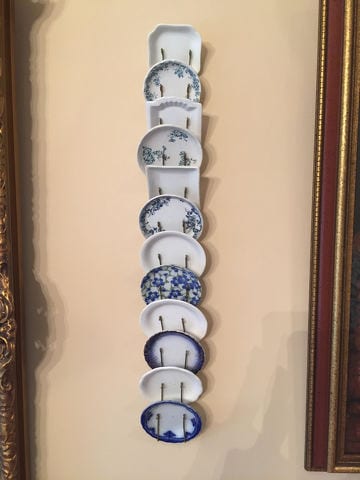
If you think your holiday table is too full, just think what a formal Victorian table setting would have looked like.
The Victorians had a utensil or a dish for almost anything that one would find on the table. There were special servers for asparagus, fish, strawberries, cold meats, lemons and ice cream. Among dishes considered important for any properly set Victorian table were bone dishes, salt cellars and butter pats.
And, while many of these dishes are no longer seen on the modern table, they have become popular for antique collectors.
Bone dishes are crescent- or moon-shaped ceramic dishes that were placed at the left-hand edge of the dinner plate. They were used to collect the bones from fish or game, seeds or peelings. The dish’s shape allowed the diner to place it at his chin for easy removal of the inedible items.
The most common design of the bone dish is a crescent with a floral design and a scalloped edge. Some more fanciful designs, such as fish shapes, are found less frequently. Bone dishes were most popular in the 1800s and early 1900s and were often given as wedding gifts. They were sold separately or included in full sets of china service.
Salt cellars, salt dips and open salts are common names for the same item, which was made to hold and dispense salt. They can be made of various materials, including glass, ceramic, silver, pewter, wood and plastic, can be found in a variety of sizes and shapes, and can be open or lidded.
Salt cellars were used before salt became refined, processed and free flowing. They have been found among Greek and Roman artifacts.
During the Middle Ages, elaborate master salt cellars were placed at the head of the table, and the master of the house would dispense salt into the smaller cellars. One’s status could be determined by the position one was placed at the table in relation to the master salt cellar. Throughout the Renaissance and Baroque period, master salts became ceremonial, and many elegant examples can be found in museums.
By the early 1800s, small individual salts were commonly found in homes. They were set at the top of each individual table place setting. Tiny spoons were used to sprinkle the salt. Many of these spoons are silver or pewter. When collecting salts, it is desirable to also collect spoons. Salts were easy for manufacturers of pressed glass to make in molds, and they were one of the earliest mass-produced items. Salts generally were sold in sets.
Anti-caking agents were added to salt by 1911. Consequently, individual salt cellars were replaced by salt shakers.
Salt cellars, both individual and master, are very collectable today. The glass-pressed glass salts are usually very reasonably priced.
However, the unique and older salts come with a high price and are harder to find in antique shops.
Butter pats or butter chips are small, 3-inch-round dishes used to hold pats of butter. Butter would be sliced into a pat from a square or be molded and placed on the dish. Sometimes, the pat of butter would be stamped with a design of the family crest or another interesting image.
These dishes were first made in the mid-1800s, but they became most popular in the Victorian era. Butter pats were set to the left of the table setting. Many of the most prominent porcelain houses, such as Limoges, Spode and Royal Doulton began to make sets of them.
Butter pats were sold as individual sets or included in full table settings. They came in a wide variety of shapes, colors and patterns.
Often, airlines, hotels and restaurants had their own specific patterns.
As time has gone by, table settings have become less complex, and the butter pat has been replaced by the bread and butter plate of today. However, it is still fun to use butter pats, which are affordable collectibles, on the table for dinner parties. They can be used to hold butter, candies or a special treat.