
Spotlight PA is an independent, nonpartisan, and nonprofit newsroom producing investigative and public-service journalism that holds power to account and drives positive change in Pennsylvania. Sign up for our free newsletters.
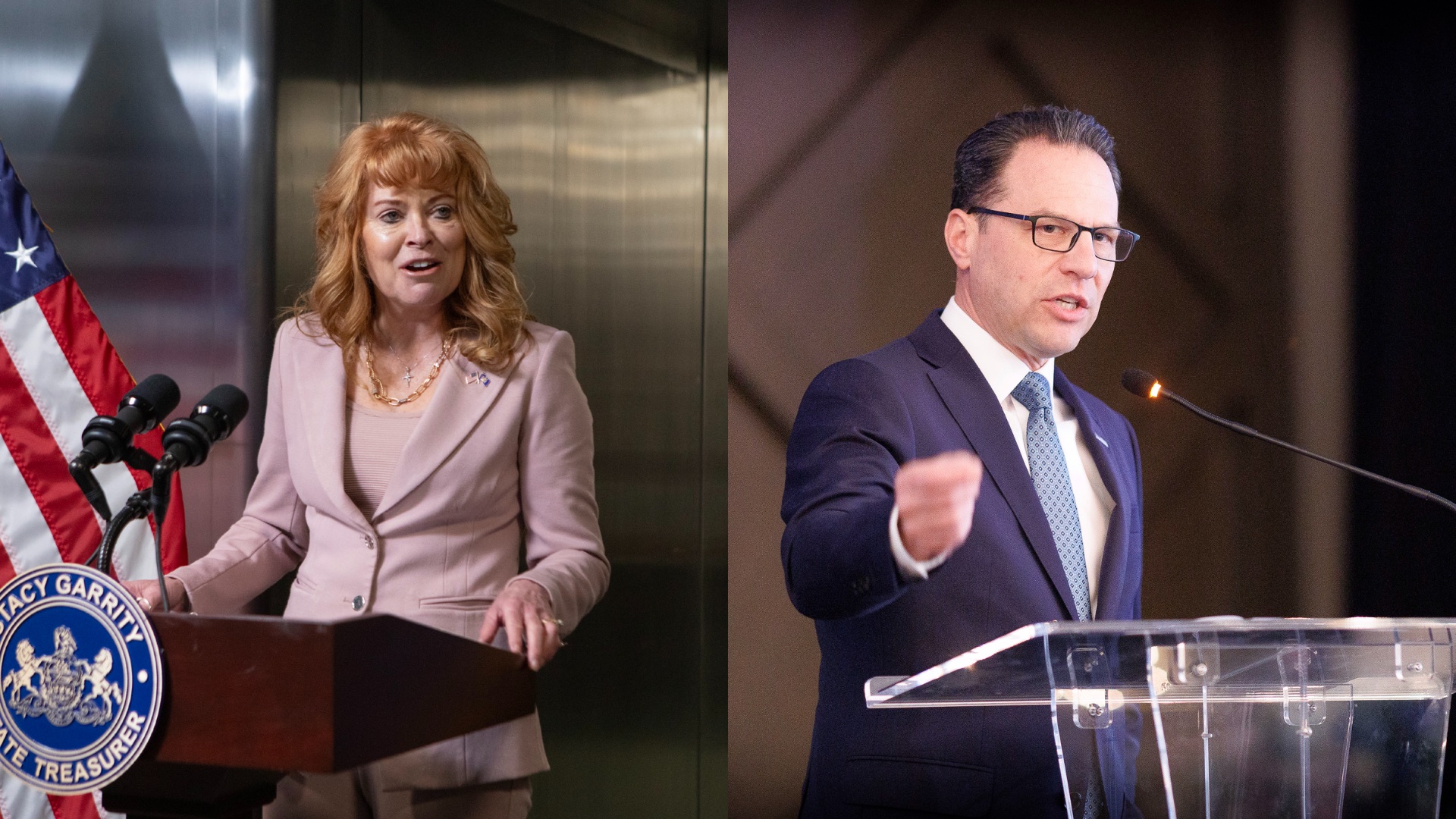
HARRISBURG — Pennsylvania’s major party candidates for governor met in Harrisburg for the first and only debate of the 2026 election on Wednesday, staking out familiar positions on affordability issues, looming healthcare cuts, and education funding.
Democratic Gov. Josh Shapiro sought to tie Republican state Treasurer Stacy Garrity to Donald Trump’s administration and defended his own record, saying Pennsylvania’s economy has seen “unheard-of growth.” He repeatedly noted he can only pass what can get through the divided legislature.
Garrity cast looming Trump-backed Medicaid cuts as common sense and painted a picture of a Pennsylvania that is “falling behind.” She tried to differentiate herself from Shapiro on data centers, skill games, and education.
The race has been uneven from the start. Shapiro, a popular incumbent, has raised about $55 million since the beginning of last year. Garrity has raised a bit over $5 million. Shapiro has dramatically outspent Garrity on advertising, and polls of the race consistently show him with a double-digit lead.
Ultimately, the one-hour debate hosted by Nexstar Media Group revealed little about the candidates that they haven’t already publicly taken a position on. The moderators did not ask any questions about energy production or the environment. They did, however, ask Shapiro about his support for Israel and how that fits into the Democratic Party and whether he’d commit to serving all four years if reelected, rather than run for president.
Here are Spotlight PA’s key takeaways from the debate.
Differences on skill games, education, and spending
Amid frequent critiques of each other’s records, Shapiro and Garrity staked out a few clear, diverging policy positions.
The question of whether and how to tax skill games has stymied Pennsylvania’s legislature for years. Now that the state Supreme Court has ruled the games are slot machines, they’ll be subject to law enforcement seizure if the legislature doesn’t act by Oct. 13.
Garrity reiterated her support for a flat fee on skill games — an approach the skills industry supports.
Shapiro said he’d support taxing the devices at the same rate as slot machines in casinos, approximately 50%, while putting the resulting revenue into the state’s coffers and “then use a core chunk of that to fund mass transit across Pennsylvania.”
On overall spending, Garrity criticized Shapiro for repeatedly signing budgets that dipped into the state’s surplus.
“His administration, he spent all your money,” she said. “He claims that he pays for balanced budgets, but clearly he didn’t, because every time, he took money from the surplus and used it to plug a budget hole.”
Shapiro countered that his budgets have been, by necessity, bipartisan, and said the state has “record revenues come in” and an $8 billion surplus. (That $8 billion is actually in the state’s rainy day fund, which is only intended for emergency use.)
“What the treasurer didn’t say is, what she would cut?” Shapiro said. “Would she cut free breakfast for kids? Would she cut the 60% increase in apprenticeship funding? What would she cut?”
Garrity didn’t make any specific proposals for cuts or new revenue, beyond saying the state could root out home health care fraud, and that her office finds some savings annually through audits.
The two also diverged on education.
Public education spending has grown under Shapiro, in part because of a court ruling that found the commonwealth’s public school funding to be unconstitutionally inequitable.
Garrity argued that “we can’t just keep throwing more money at an issue and think you’re going to get a different result” and suggested the state hold more kids back if they don’t read at grade level.
Shapiro defended his administration’s education spending, noting it has provided free breakfast, more vo-tech opportunities, and mental health counseling in schools.
“Graduation rates are up and truancy is down and it is working,” Shapiro said.
Garrity also attacked Shapiro for his evolving position on school vouchers.
“The governor has held not one, not two, but three positions on school choice,” Garrity said, noting his 2023 support for and then veto of a voucher program.
Shapiro replied that he is still open to vouchers, but said the program he vetoed didn’t have the agreement of the Democratic-controlled House and GOP-controlled Senate.
The governor also has a final say on whether Pennsylvania will enter a federal program created by Trump’s omnibus 2025 tax bill, which will give taxpayers a break if they donate to private school scholarship funds and other similar programs.
“I think prudence here makes the most sense,” Shapiro said. “We’re looking at it carefully, and in the next few weeks, we’ll make our announcements.” Garrity, meanwhile, said she’d join the program on “day one.”
Affordability
Pocketbook issues came up several times during the debate. Chief among them were gas taxes and healthcare.
On gas prices, Garrity said that she would give a $750 rebate to Pennsylvania drivers during the summer months. She noted that during his first bid for governor, Shapiro campaigned on a $250 gas rebate, but hasn’t passed one.
Garrity also said she would use Pennsylvania’s rainy day fund to pause taxes on gas and diesel for two to three months. “I think prices are going to start going down,” she said.
Shapiro said he was open to suspending the gas tax but said “it’s up to the legislature” to bring up the measure. The governor blamed Trump for the high costs of gas, pointing to his tariffs and the war in Iran.
The candidates were also asked if they would direct state dollars to make up for upcoming federal cuts to Medicaid.
Shapiro said that “every governor of every state is dealing” with the cuts, but that no state has the ability to make up the loss of federal funds.
Garrity did not address whether she would use state funds to ensure more Pennsylvanians have coverage. But she said she supports the Trump administration legislation that made those changes, noting it also cut taxes on tips and overtime.
“I think it’s common sense to require healthy adults that don’t have small kids to either work, train, or volunteer 20 hours a week to make sure that Medicaid is there for the people that really need it,” Garrity said.
Trump, Israel, and presidential aspirations
Throughout the gubernatorial race, Shapiro has argued Garrity is deferential to Trump and has sought to link her with his sweeping tariffs and upcoming Medicaid cuts. He did so again in the debate.
“When the Commonwealth of Pennsylvania put $1 in your pocket, the policies of the Trump administration — tariffs and this war in Iran, two things that my opponent supports — well, that makes it feel like they’re yanking two bucks out,” Shapiro said.
Shapiro also claimed that Garrity stands with Robert F. Kennedy Jr., Trump’s health and human services secretary, when discussing the ongoing measles outbreak.
While Garrity backed Trump on Medicaid policy, she tried to create some distance on other issues. She said she appeared with Kennedy at a rally in Harrisburg “in support of, basically, healthy eating for our kids,” but that she’s fully vaccinated and believes in vaccines.
The moderators also asked Shapiro, one of the country’s most prominent Jewish politicians, whether his support for Israel puts him out of step with the rest of the Democratic Party. He responded that “as governor, you don’t make those decisions on shipping weaponry overseas to any country,” but added that he wants people to stand against antisemitism and hopes Israeli President Benjamin Netanyahu is soon voted out.
Shapiro sidestepped a question about his presidential aspirations, and didn’t commit to serving the full four-year term if elected, though he said he’s currently only focused on running for re-election.
He noted that Garrity once pledged not to leave office mid-term, which she would have to do if elected. Garrity said she’d only pledged to serve all four years of her first term.
Other issues
An exchange about voter ID led to one of the testiest exchanges of the debate.
Garrity supports mandatory voter ID (currently, only first-time voters at a given polling location need to present ID in Pennsylvania). Shapiro told the moderators, “I’m open to putting a voter ID bill on my desk for my signature.”
But the governor added that the bill can’t be based on “conspiracy theories,” and he wants to ensure voters aren’t disenfranchised.
He then claimed that Garrity couldn’t be trusted to certify the results of an election if her preferred candidate didn’t win.
“Yeah, that’s the most ridiculous thing I’ve ever heard,” Garrity said. “I don’t even know why you’d say that, and how you can look yourself in the mirror at night.”
Both candidates were asked if they’d “commit to spending public tax dollars on new stadiums to ensure” that the commonwealth’s NFL franchises stay put. Both said they were open to a deal but struck different tones.
“I don’t think we need to be giving taxpayer dollars to billionaire owners,” Garrity opened her response, but added that if owners “came and they had a proposal and it was something that we could work out and it was a win-win, certainly, I would be open to it.”
Shapiro added that he also needed to see the plans before committing taxpayer dollars, but revealed he’d already had conversations with the owners of both the Pittsburgh Steelers and Philadelphia Eagles about new stadiums.
“The bottom line here is this: I’m going to keep these teams in Pennsylvania. I’m going to protect taxpayer dollars, and I’m going to make sure that fans have a great and affordable experience when they go to the arenas,” he said.
Garrity also repeatedly attacked Shapiro for a sexual harassment case involving a former top administration staffer, Mike Vereb.
Pressed on the incident by a moderator, Shapiro said that the investigation of the incident led to a recommendation that, should an accusation involve a high-ranking official, “the governor would be brought into that process earlier.”
BEFORE YOU GO… If you learned something from this article, pay it forward and contribute to Spotlight PA at spotlightpa.org/donate. Spotlight PA is funded by foundations and readers like you who are committed to accountability journalism that gets results.
More Elections
View all Elections
Pa. Election 2026: What You Need to Know About Your Election Day Voting Rights
Voting in Pennsylvania? Here’s everything you need to know about your rights.
Pennsylvania Voting Advocates Are Preparing for ICE to Disrupt the 2026 Election
Federal law already prohibits armed agents at polling places, but Rep. Malcolm Kenyatta has a bill to clearly ban it on the state level.
Pa. Election 2026: Everything You Need to Know About Requesting, Filling Out and Returning Your Mail Ballot
Pennsylvania has universal no-excuse mail voting. Here’s everything you need to know about the process ahead of the Nov. 3 election.


