
Dec. 20, 8:30 a.m.: I am sitting in the surprisingly cozy waiting area of a State College car dealer. I should be waking up to a bagel and coffee in Manhattan.
Yesterday, my New York host had asked me to indulge her understandable obsession with the Creamery’s coconut chip ice cream. Eager to be off, I swung too far into a head-in space at the Creamery, thus hooking the underside of my bumper on the curb.
The last time I did this my daughter lifted the front end off the curb while I backed up, which limited the damage. This time, I was alone. When I backed up I practically ripped the bumper from its moorings.
Though the damage was far worse, I am proud to report that I was able to get to “oh, well” a lot quicker the second time around. It helped that I had the Giants-Eagles game to limp home to. As any football follower knows, the game was a stunner. As a non-rabid Giants fan I was able to appreciate the way Philly came back from the dead and won on a last-second punt return (I’m sure the rabid gnashed their teeth and tore their hair).
Dec. 20, 3:15 p.m.: Poof! Thanks to a speedy chewing-gum-and-baling-wire repair and the interstate highway system, I am now coming to you from a café on Broadway. It is so much sunnier here! (The problem with central Pennsylvania winters, I am reminded, is not that they’re cold; it’s that they’re gloomy.)
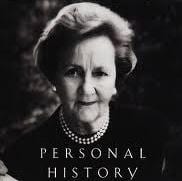
The reason I wasn’t inordinately galled by yesterday’s parking lot mishap, I’ve decided, is because I’m reading Katharine Graham’s memoir, called “Personal History.”
A quick summary: Thanks to the business acumen of her father, Eugene Meyer, Kay grew up in the sort of splendor we associate with European aristocracy: a house in town, a house in the country, and for good measure, a ranch in Wyoming; frequent overseas jaunts; private schools; nurses and governesses; friendships with everybody who was anybody in the arts and public life on both sides of the Atlantic.
It would all be thoroughly nauseating were it not for the fact that Graham acknowledges how privileged her life was – and what the drawbacks of privilege were: She was so coddled and insulated that she hardly knew how to boil an egg or iron a shirt. Worse, her parents were so busy working and hobnobbing that she and her siblings were pretty much raised by the hired help.
In 1933, her dad buys a third-rate newspaper on the verge of financial collapse. Perhaps you’ve heard of it: the Washington Post. Kay follows her father into the newspaper business, but when he begins to reduce his involvement in the day-to-day management of the paper it is her husband Phil Graham who takes the reins.
Phil comes across as a dynamo – and then we find out why: He was a manic-depressive in an age that understood little about the treatment of manic depression. While the Post prospers, Phil’s cycles of activity and paralysis become more frequent and more intense. On a summer afternoon at their house in the country in 1963, Kay hears “the ear-splitting noise of a gun going off indoors,” and finds her husband dead of a self-inflicted wound.
Everyone assumes that Kay Graham will sell the paper. Everyone is wrong. She wants to keep it in the family. But her children are too young. So into the suffocatingly sexist – and anti-Semitic — world of American business and government she steps, learning on the job.
I haven’t finished the book yet – it’s a whopper – but I’m at the most dramatic part, at least in terms of journalism history. In 1971, the Post, along with the New York Times, gets hold of the Pentagon Papers, a trove of documents tracing America’s nosedive into the quagmire of Southeast Asia. (The obvious comparison is to the WikiLeaks scandal.)
The Nixon administration tries to stop the newspapers from publishing. The newspapers’ lawyers advise their clients to do the administration’s bidding. The journalists favor going full speed ahead. At the Post, Kay Graham has to make the call. “Let’s go,” she says. “Let’s publish.”
It was a gutsy move and, I firmly believe, the right one. Up next: Watergate.
Dec. 21, 2:10 p.m.: I am now in the student union of a small college in Massachusetts, waiting for my daughter to finish her last final so we can drive back to State College. But back to Kay Graham, my bruised bumper and the reason I am offering this column on Christmas Eve.
Katharine Graham was spared one of life’s major problems: the need for money. She had oodles. But her story reminds us that privilege doesn’t protect you from life’s other problems. As glamorous as her life was, it was hard, in many ways harder than most.
This is a good thing to be reminded of at holiday time. It tamps down envy. And it keeps us from sweating the small stuff, like a damaged bumper.
More Columns
View all Columns
Subu Vedam: It’s Now One Year in ICE Custody
What is there to say about the case of Subramanyam Vedam at this point? Only this: Subu was released because, after 43 years in prison, a Centre County judge agreed […]

Penn State’s Matt Campbell Says Decisions vs. Wisconsin Have Gone Through His Head ‘A Million Times’
So, you think you’ve been second-guessing some of the decisions Matt Campbell made on Saturday night in Beaver Stadium? Join the crowd — it’s a big one. And it includes Campbell […]
Hook: The Protect College Sports Act Is a ‘Get Out of Jail Free’ Card for NCAA and Its Members
President Ronald Reagan was fond of saying that the nine most terrifying words in the English language are: “I’m from the government, and I’m here to help.” Which is a […]


