A few months ago my wife found a television series called “Heartland” that has been on the air for 13 seasons. Through the power of video on-demand and streaming services, she has spent the last few months healing from a concussion and catching up on it – she’s currently watching episodes from the 13th season so will soon be all caught up and in dire need of new material.
Set in the fictional town of Hudson in Alberta, Canada, my wife was initially drawn to the expansive mountains and vistas that appear in much of the show. Many of the scenes are shot outdoors. And she loves the connections to nature and animals, as well as a good family drama, although I generally refer to it as family dysfunction. But hey, if there wasn’t any dysfunction there wouldn’t be a reason for the show, now would there?
There is however, one pastoral scene that shows up occasionally in the series that does interest me. The series follows a fictitious modern-day family that owns and runs a cattle and horse farm on a vast piece of land in the countryside miles outside Calgary. In a throwback to earlier times, the family maintains its own burial grounds on a gently-sloped hillside on their property, set off a distance from their house.
Every now and then one of the family members will ride a horse up to this family cemetery – a waist-high wrought iron fence surrounding traditionally-shaped headstones set among prairie grass with gorgeous mountains in the background – and reminisce about family members who have passed, or have an epiphany about their current life struggle.
But it’s the concept of the small family cemetery that piques my interest. For all the metropolitan trappings we have in Happy Valley – the second largest football stadium in the nation, a 15,000+ seat arena, a 2,500 seat performance space – we are primarily a rural area, on the low end of what retailers and real estate people refer to as a tertiary market. Farm animals are a common sight around here. And not surprisingly, small family or small communal cemeteries are also common – but not so much in sight.
The Centre County Government’s GIS Department compiles a list of all the known cemeteries in the county. At last update there were more than 160. Plenty are what we traditionally think of when we hear the word cemetery and are common sights. In the immediate area around State College that would include Pine Hall, Boalsburg, Spring Creek and Centre County Memorial Park, along with mid-size ones such as Houserville United Methodist, Shiloh Lutheran and Pine Grove Mills.
Except, according to the GIS Department, between State College Borough and the townships of College, Ferguson, Harris, and Patton, there are 25 cemeteries. I only listed seven. The rest are smaller, more difficult to find, and in some cases on private property, such as the unmarked Indian burial ground on Indian Hill Road in Boalsburg, the Boal family plot in the trees on the Boal Mansion property, the Robert Moore grave in the pasture below the exit ramp curving from US-322 west to I-99 north, the Rock Spring cemetery in the trees behind the Larson Research Center on Route 45, the Goheen cemetery about a mile west of the Rock Spring cemetery, the Gray Family cemetery just off Heiskel Drive in Patton Township, and the most interesting one for me – and the one that I pass by almost every day – the Washington cemetery on Pine Hall Road just east of Science Park Road.
When we moved into our home eight years ago I went biking one day on the path along Pine Hall Road. I noticed what looked like headstones sticking out of the ground in a grove of trees behind the famous (and newly renovated) American Legion Gill Field baseball scoreboard at the intersection of West College Avenue and Science Park Road. I thought to myself, “Well, that is an extremely odd time and place to set up Halloween decorations.” Because I’d passed by countless times in my car and never seen or imagined a graveyard there. Plus, why would one be there? The large and well-used Pine Hall cemetery is just down the road.
So I rode my bike over, leaned it against a tree and looked around. These were no Halloween decorations – these were real graves. Real old graves. Maybe 20 total and from what I could make out from the headstones most were from deaths in the 1850’s and 1860’s. Yet nothing about the space said “cemetery.” It was a grove of trees, bushes and hardscrabble dirt and grass sandwiched between College Avenue and Pine Hall Road. The only historical significance most longtime Happy Valley residents probably assign to it is the aforementioned Gill Field sign that marks the location of the old American Legion baseball field that was wiped out when Science Park Road was rerouted.
As I looked from headstone to headstone I felt a number of different emotions – astonishment, sadness, awe, surprise, wonder, intrigue. There were no signs on the property offering a clue to its name or origins, and subsequent searches of maps and the internet led nowhere. I even asked a few locals if they knew anything about it and came up empty.
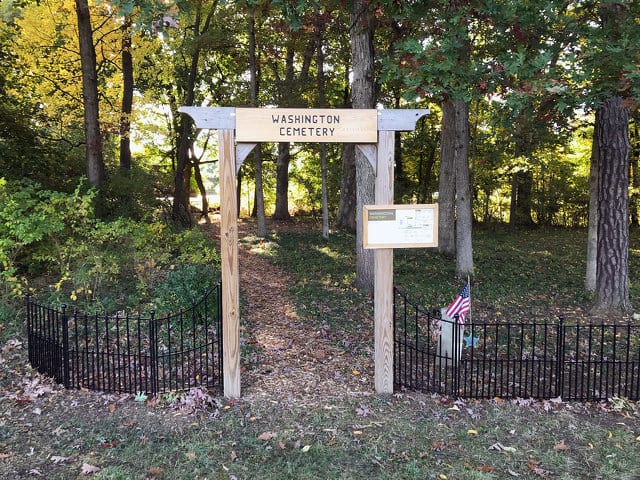
However, I was recently surprised again when I rode my bike past the property and discovered a knee-high metal fence, wooden entrance archway, historical poster, and a sign had been installed – clearly labeling it Washington Cemetery. Turns out the nearby American Legion Post #245 has taken over maintenance of the grounds, and mounted a short history of the cemetery along with a map of the graves. A wonderful gesture that honors the memory of the Houtses, Booths and others who are interred in the ground there.

Signage created by American Legion Post 245 explains the history of Washington Cemetery on Pine Hall Road and grave locations. Photo by John Hook
Which brings me back to… Halloween.
Cemeteries are a physical embodiment of Halloween. Cemeteries as we know them today started in the 1830s and it is thought one reason why was to move the dead further away from the living — keeping a separation between the two realms. My wife tells me some cultures believe this as a liminal time of year when the veil between the living and the dead is thin during these days of full harvest. She will remind me that these cultures have holidays that honor the dead — the Dia De Los Muertos celebration that marks the lives of the deceased, and All Souls Day and All Saints Day that commemorate those who have died.
In our modern culture we sometimes equate cemeteries with horror movies and scary stories. And we’ve certainly made Halloween into a sugar-laden festival of treats – which can’t get here soon enough because I’ve been picking at the Nestle Crunch minis for a week now.
Yet, cemeteries are great ways to remember loved ones and feel a connection to your personal history – to have the opportunity to go sit in a physical spot that memorializes those who are part of your past and are the reason you exist. So this Halloween season go take a stroll through a cemetery during a brisk fall day, one with your ancestors if possible, but any will do if not, and see if you can feel the thinness of that veil, listen to what those who have gone before us might be trying to tell us, and see if you too can have a personal epiphany.