
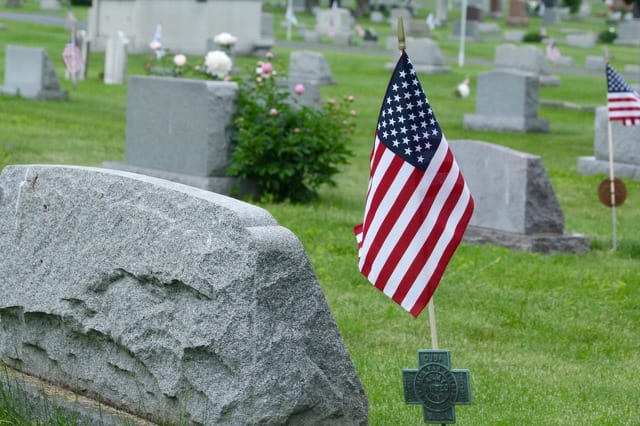
Today, this day that our country has set aside to honor those who have served and paid the ultimate sacrifice, we are called to remember.
We take the day off from work and fly the flag and place flowers on the graves of the brave who have given their lives in the protection of us and of our way of life. We do so to honor and to remember.
To remember is to call to mind an experience or event, a person, a situation, an impression or a feeling from our past.
To remember is to rely on the neural processes that we call memory. Memory is a fascinating and very complicated part of the human condition.
Memory is a funny thing.
Why can we remember some things and some people but not others? How much of what we remember is accurate and true? Do our memories change with time? If the event or the experience or the person in our memory has a strong emotion attached to it, does that change how we process our memories? Why are some memories so vivid yet others are more hazy?
I have made the joke many times. I can remember my students from 20 years ago — their faces, their names and where they went after they left Penn State — but I sometimes forget that Friday is garbage day.
Lyrics of songs from 1971? I got it down. Meanwhile, I hope I remembered to get the car inspected and send in the registration but I might have to check.
I can vividly remember how my Dad used to laugh at M*A*S*H on TV and his consistent, practical advice as I was growing up. I remember a silly dance he used to do in the kitchen to tease his teenage daughter. My mother gave me one of the white handkerchiefs he was known for, still folded in the way he used to keep them in his pocket. I remember him with a smile every time I see it in the drawer of my bureau.
A memento. A place. A picture. A distinct smell or a song. Memories can be triggered by so many different stimuli.
This past weekend, I attended a bridal shower for one of my daughter’s friends. They have been friends since kindergarten. As I was driving to the party, I found myself looking back. I remembered the girls, holding hands, getting on the bus. I remember hearing their laughter as they played Barbies upstairs. I remembered songs and programs at school. It took me back to sleepovers and middle school dances and high school boyfriends. All of those memories are bundled together – not so much as one or two distinct incidents but as general recollections of a wonderful time and a friendship that has continued as they have grown into amazing, accomplished young women.
Researcher and author Daniel Schacter outlined the “Seven Sins of Memory.” He describes transience as the deterioration and the haziness of our memories with the passage of time. He describes absent-mindedness as memory impacted by distraction (as well as our nutrition and our sleep and our overall health). He describes memory blocking as our inability to recall certain things. He describes misattribution, suggestibility, and bias as interferences with not only recall but with the accuracy of our memories. Finally, he describes persistence as the interruption of the present with unwanted and disturbing memories from the past.
I might also add selective memory. If you need examples, just turn on any news channel and depending on which side of the political debate the person falls, you will note their selective memory of the stumbles of their side and the outrage at the decisions made by the other side.
Selective memory also helps us remember the good times and to let go of the memories that no longer serve us.
And so on this day, we are called to remember. The men and women in our lives who were lost in the service to our country. The men and women who served and who came back ill or injured and whose loss in service may not have taken place on a battlefield. Enjoy your day off and have fun at the picnics and festivals that we associate with Memorial Day but try to take some time to remember too.
It has been said we die three deaths. The first is when our body stops functioning. The second is when we are put in our grave. The final death is that moment when, at some time in the future, our name is spoken for the last time. Take some time today to say those names and remember.
More Columns
View all Columns
Nittany Lions’ Defensive Coordinator D’Anton Lynn ‘Embodies What Penn State Football Is Built On’
It was 15 seasons ago when D’Anton Lynn last stood on the Beaver Stadium turf for a fall football game as a Penn State cornerback. Lynn returns in 13 days […]
Column: Can Matt Campbell Follow Curt Cignetti’s Blueprint?
One of the major talking points of this offseason has been “who will be this year’s Indiana?” — as in, which team will seemingly come out of nowhere to compete […]

Penn State Quarterback Rocco Becht on Local Fame, His Fall Class and His Dad Hanging Out With the Team
Penn State quarterback Rocco Becht is the most prominent transfer from Iowa State this past offseason. Other than head coach Matt Campbell, of course. In three seasons at Iowa State, […]


