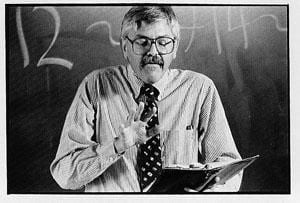
ATOP CENTRE HALL MOUNTAIN — The ties are vibrant: rich in colors, bold and engaging. They all belonged to John D.C. Buck, of State College, the late faculty member in the Penn State College of the Liberal Arts who died Aug. 18.
Joyce Buck, his spouse, brought his ties here — to the Mount Nittany Inn — to share them as gifts for John’s dear friends, dozens upon dozens upon dozens of whom gathered at the inn Sunday afternoon for a celebration of his life.
Many of them draped the ties around their necks. It was a warm and fitting tribute to a man who, as his loved ones explained, saw much more value in the things we give away than in the physical things we collect.
‘He had more fun with people than you should be allowed to do,’ said his brother Gary Buck. In remarks before the assembled, he called John a self-made renaissance man, a storyteller who could — and forever did — touch people on a deeply personal level.
John grew up without a strong fatherly presence, and so he never learned that men don’t say, ‘I love you’ to one another, Gary said.
That lack of emotional inhibition, he went on, turned out to be a very good thing.
It was John, his friends said, who shared the most dramatic, heart-felt bear hugs. He embraced his life — his family, his students, his friends — with an animated passion that undermined shortsightedness and inspired joy.
‘He wanted to embrace the entire world,’ said John Moore, a close friend and fellow faculty member in the liberal arts.
If it’s true that we spend eternity doing what we most love, John Moore said, then John Buck is making his way through heaven, ‘hugging everyone and telling them how much (he loves) them.’
Regrettably, I never had the pleasure of knowing John Buck in his 67 years. Only now, in his absence, am I learning the profound and formative impact he has left on so many lives — many of them his students’.
He joined the Penn State Department of English in 1969, having earned bachelor’s, master’s and doctoral degrees in English at the University of California, Berkeley. He remained a bona fide Californian — the Pacific always trumped the Atlantic — but committed himself to his students in Pennsylvania for well more than four decades. He retired from the College of the Liberal Arts in 2005.
In deeds and in spirit, John Buck championed the undergraduate Penn Stater, the university’s great historic mission of teaching the first-generation college student. He delighted in their return every fall and lamented their departure as each semester ended. He challenged; he chided, but always with the warmest of intentions. In serving as a longtime marshal at liberal-arts commencement proceedings, he was known to bring his ebullience — and famed hugs — to the floor.
John’s daughter and son, Catharine Buck Clarenbach and Peter Buckland, spoke with grace and eloquence Sunday about their father. It was he, Catharine said, who believed that ‘to live in this world, you must be able to do three things.’
You must be able to love what is mortal; to embrace and hold close those mortal elements of life; ‘and when the time comes to let it go, to let it go,’ she said.
She said her father wanted everyone to know the importance ‘of being alive — and to make you alive, and to make his students alive.
‘It was his hope for every student he had,’ Catharine said. He wanted to make them more alive.
In his own life, he found in words a way of living. He found that they ‘parse the universe of feelings,’ as Peter Buckland explained. In his father’s life of language, teaching and learning, Peter said, ‘woven words were for him the sounds closest to divinity.’
As I listened Sunday, I saw that John Buck brought a rich divinity all his own. He was instrumental in developing an honors program in English here at Penn State and another at St. Xavier University in Chicago. In later years, he coordinated the English advising center at Penn State.
‘He received the Christian R. and Mary F. Lindbeck Award for Distinguished Undergraduate Teaching in 1984, and the Undergraduate Student Government Academic Assembly’s Excellence in Advising Award in 2002,’ his obituary reads. ‘Because he understood his success depended upon staff from the department and the college, he shared the monetary award with them.’
John Buck shared. He shared his love of life, of words, of food. He loved sushi, calligraphy, office hours held at Svoboda’s Books. He loved poetry and how to read it aloud. He loved the nuances of stories, the vast beauty of nature and the flashes of lightning that he and Joyce would watch from the Mount Nittany Inn.
By example, he taught that in living, there is loving.
For times like ours — for any time at all — it is hard to imagine a better life lesson.