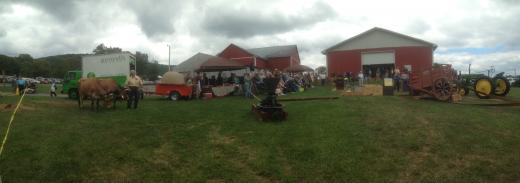
When you head down West College Avenue and continue west for a piece, you’ll quickly find yourself in Rock Springs — and at place in a time many people have forgotten.
Visitors to Penn State’s Ag Progress Days can journey back to the way it used to be, thanks to some experienced farmers participating in the history they helped create.
Darwin Braund still returns to volunteer every year, even after serving as the volunteer curator of the Pasto Agricultural Museum located on the expo grounds from 1998 until 2008. Braund said he became the second volunteer curator of the museum after Jermone Pasto, the museum’s namesake, wanted to retire from the job.
“I knew he wanted to retire so I talked to Pasto and asked if I could get on the list to take over for him,” Braund said.”He said “List? We don’t have any list. Are you interested’? So I said maybe.”
Braund has lived in several states, had lots of different jobs and, by his own account, has retired three times. Braund grew up a “dairy farm boy” in Sayre, Pa., and graduated from Penn State with a Bachelor’s Degree in Dairy Science in 1956. After graduation, he served as an extension dairy specialist for Penn State for four years, before moving to Wisconsin.
“I took a leave to the University of Wisconsin to get my masters [in dairy management],” Braund said. “I was given a $1,500 stipend under the assumption I would come back after my degree to work. Well, I didn’t, and I had to pay all that money back.”
After having his job in the feed industry eliminated in 1964, Braund earned a doctorate in Dairy Nutrition from Michigan State University in 1967. He joined the faculty of the University of Kentucky, then became the Director of Research and Development at Agway Inc., a feed company in Syracuse, N.Y. before retiring after 22 years of service. Restless even after all his travels, he became an academic once again, becoming a full professor at North Carolina State University, before retiring a second time.
Braund’s third and final retirement came when he retired as volunteer curator of the museum. As a member of the Board of Directors of the Penn State College of Agriculture Alumni Association he not only voted to build the museum, he also holds the record for most items donated, a total of 146. Braund still shows oxen at the expo every year, which he is quick to say oxen are not ordinary cows; but rather a bovine bull calf that is at least four years old and trained to work.
For Braund though, the Ag Progress days mean something far more to him than just his own personal agricultural career. His daughter, Pamela, was killed in a car accident on her way to visit the expo as she traveled from the family home in New York. A scholarship was set up in her name at her High School in Manlius, N.Y. The $1,500 scholarship is available to any student who has enrolled in an accredited university program and plans to pursue a career in either education or journalism — two of Pamela’s favorite areas of study.
Today, Braund is optimistic about the expo and what it does for the community.
“I’ve never heard an ugly word about [the museum]” Braund said. “People come from all over to see people and when they get here, they can’t leave.”
Rita Graef, current curator of the museum, said the museum offers many activities in the fall, including butter churning and spinning and weaving.
“We want to bring alive antique and historic artifacts by engaging those still actually involved in that kind of work,” Graef said.”Our focus is on agriculture and rural life up until the 1730’s. We take historic artifacts and connect them with the present day.”
Graef said she became curator after Braund left, and her interest in the museum sprouted from her interest in food and the machinery that makes it. Braund’s father, who was a chef, sparked her interest in all things culinary.
Braund says the museum works with local companies such as Gemelli Bakers, 129 S. Pugh St., to make artisinal bread and biscuits.
During Ag Progress Days, they use antique farming machinery such as a thresher, to separate the grains from the stalks and husks of wheat, so that the bakers can make the bread.
“I’ve always had a passion for food,” Braund said. “I’ve always appreciated the table end of where food comes from.”
Others who have been at the museum for years also remember some hard times, such as when they museum wanted to put on an extension to the existing building. Steve Spencer, a 25-year volunteer, has created many of the museums exhibits. The former Penn State Professor of Dairy Science, says that before Ferguson Township let them build the addition to the museum, they had to fight with them a little at a time.
“They requested there to be lighting all over,” Spencer said of the vast area of farmland that encompasses the property. “They also wanted our plot plans to extend right to [PA-45] even though there were homes there.”
Spencer, who received his Bachelor’s Degree in Dairy Science from Penn State in 1958 and his Master’s Degree in Farm Management in 1960, said they were eventually allowed to build and that he is amazed at the popularity of the expo itself and how it has grown.
Others in attendance have also contributed greatly to the museum and Penn State. John Ziegler is the only card carrying professor emeritus of meat science at Penn State. He took over nearly every meat course offered at Penn State from his professor, P. Thomas Ziegler, (no relation) when the older Ziegler retired in 1957.
John Ziegler graduated from Penn State with a Bachelor’s Degree in Animal Husbandry (a degree no longer offered) in 1950. He then received his Master’s Degree in Animal Industry in 1952 and his doctorate in 1965. Ziegler said that when he took over the meat courses at Penn State, not only were they popular among undergraduates, but almost all restaurant and hotel management majors also took the course.
Ziegler said many things have changed since his start in the industry, such as how every farm cured and prepared all the meat they slaughtered on the farm.
“in 1972 the federal government came in and took over all the meat processing in Pennsylvania,” Ziegler said holding up and old metal-bristle brush he used to clean meat cutting tables with. “They said the wooden tables got too many grooves in them and held too much bacteria, so they made us use plastic ones. Well, the plastic ones had grooves too, and worse than the wood.”