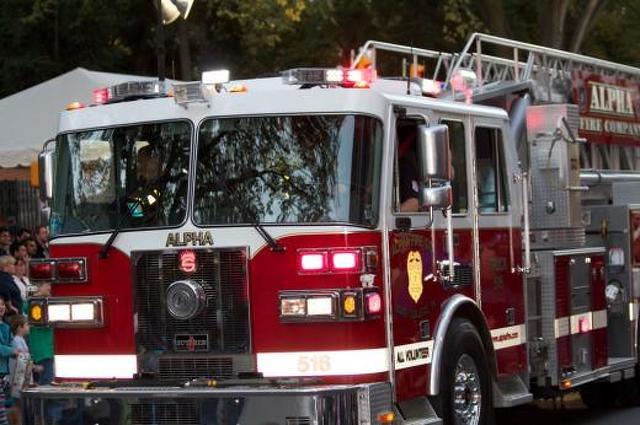
Volunteer fire companies around the country are facing challenges to recruitment and retention as older firefighters retire and younger ones see their time stretched thin.
Alpha Fire Company is hoping to sustain and possibly increase its volunteer force over the next few years with a substantial increase in the stipends available for eligible firefighters.
‘The fire department is not in crisis… but the reality is we have some weeds in the garden and if we don’t tend to those weeds in the coming years they’re going to emerge and be troublesome,’ Centre Region Fire Director Steve Bair told College Township Council last week.
The current full stipend is $570, which essentially functions as reimbursement for volunteers’ own out-of-pocket efforts. The proposed Centre Region Council of Governments budget for 2018 would increase that to $1,128. The Alpha proposal would increase that again in 2019 and 2020 to reach an annual stipend per eligible firefighter of $5,000.
The department hopes to incentivize potential and current firefighters who would devote hours to the fire company but can’t because they work a part-time job to supplement their income.
‘We’re losing volunteer hours to part-time employment,’ Bair said. ‘We have people who work part-time who would join the volunteer fire department if they could afford to do so, but frankly it’s not cheap to live here so these people need to put those available hours into a part-time job.’
For 2018, the per capita cost for participating municipalities will be $16.55, well below the average of $40.80 for Pennsylvania volunteer fire companies. The per capita average for career, or paid, fire departments is $194.14. If the full stipend increase is implemented, per capita costs would still remain on par with or below peer averages.
Bair said that historically in the United States and most places in the world, conditions eventually make an all-volunteer fire department impossible and departments go through a common progression. From all-volunteer they become mostly volunteer. That describes Alpha’s current position with some full- and part-time staff in support positions. Departments typically then transition to paid hours to offset volunteer losses followed by becoming a career department.
Alpha will maintain a volunteer department for as long as is practical and the increased stipend isn’t meant to shift that focus, Bair said.
‘Some people ask me how long can we have a volunteer fire department and the answer to that is we can have a volunteer fire department as long as we have sufficient numbers of willing and capable people stepping up to do the job,’ he explained. ‘We’re very fortunate right now and we have a fair number of people that want to do this job, enjoy doing this job and serving the community in this capacity.’
But the department does have some looming challenges. The number of incidents Alpha responds to increases every year, with 1,307 in 2016, up from 1,193 in 2015. Meanwhile, the department’s non-student volunteers continue to age on average with some retiring and some on restricted duty, typically meaning they are limited to driving. The company’s natural attrition has increased, lingering around 1.5 members per year before 2012 but increasing to 2.4 per year since then.
Alpha also has seen a gradual increase in the number of firefighters whose volunteer hours decrease because they have taken on part time jobs. About 6 percent of Alpha’s non-student volunteers now work a second job, having previously hovered around 3 percent. At least 35 percent of Penn State student volunteers work a part-time job in addition to school. Bair said the department’s research also has shown interest among part-time employees in the region who would become volunteer firefighters if they weren’t working a second job.
With volunteer hours stretched, that means fewer firefighters responding to more incidents. The median number of volunteer responses has decreased in each of the past three years.
It’s also meant Alpha is able to attend fewer community events — 48 in 2016 compared to 65 in 2013.
‘We’d like to do those. It’s a great way to engage the community, but we have less time to do those,’ Bair said. ‘This is bad for a volunteer fire department because this is what generates goodwill. It’s where you develop support for a fire department.’
The proposed stipend of $5,000 is based on the average part time hourly wage of $9.40 for cashiers and $11.21 for clerks in the Centre Region working 10 to 12 hours a week.
‘To be an incentive to give the fire department hours you might give somewhere else, you have to be competitive with those somewhere-else hours,’ Bair said. ‘The idea is to make the stipend competitive with a part-time job and that will hopefully get back some hours of people in the fire department who are working part-time jobs… and we can access new volunteers.’
While the proposed budget is being considered by COG, Bair has discussed the idea at State College Borough and College Township council meetings, receiving a positive reception at both. He will present the proposal and background at upcoming Patton Township and Ferguson Township boards of supervisors meetings.
Alpha has about 100 stipend-eligible members per year, meaning the end cost would add $500,000 to the COG budget. Eligibility is determined by a point system based on participation in incident response, training, meetings and other company services.
The 2017 operating budget for Alpha is about $1.07 million, compared to an average of $6 million for a modest-sized career department.
A stepped implementation has been proposed for the stipend to double each of the next three years, reaching $5,000 per eligible member in 2020, in order to ease the transition for municipalities.
‘If we act now we can ease into it over a couple of budget cycles,’ Bair said.