
My granddaughter Penelope, 5 months old today, has embarked on one of life’s great adventures: the intake of gummable and eventually chewable food.
So far, her adoring parents have tickled her taste buds with pureed sweet potatoes, bananas and avocados. On the video clips, which I watch with the zeal of a conspiracy theorist poring over the Zapruder film, she has looked none too sure about any of these delicacies. I figure she’s holding out for hot fudge sundaes.
Or rice cereal. I asked my daughter if that staple of her own babyhood was going to be on Penelope’s menu any time soon.
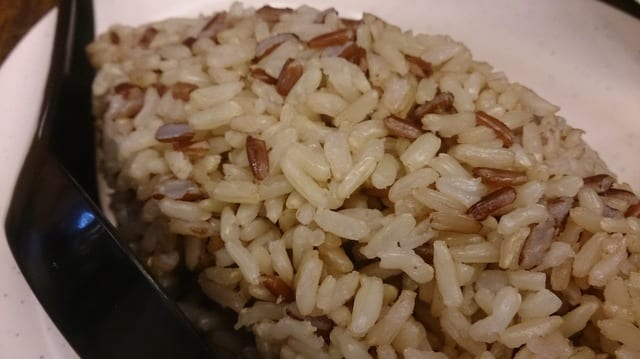
Ix-nay on the ice-ray, she told me (though not in pig Latin). Rice has arsenic in it. In fact, brown rice is more arsenicky than white rice.
Brown rice, toxic? The iconic healthy grain?
Over the years we’ve gotten used to wild swings of the healthy eating pendulum. Take your basic breakfast. One minute we were told to lose the toast (carbs: bad), keep the eggs (protein: good); the next it was lose the eggs (cholesterol: bad), keep the toast (grains: good).
Same thing with red meat: We went from lose the bun, eat the burger to lose the burger, eat the bun – and back again.
It got to the point where we assumed that sooner or later everything we thought was good for us would turn out to be bad for us, and vice versa.
Except brown rice. Apparently, it’s not news that there’s arsenic in brown rice, but it was news to me. And ill-timed news, at that.
For the last few years, with varying degrees of dedication, my household has tried to make January, a miserable month anyway, a time of ritual purification. One of the books we consult for meal planning is “Detox Yourself,” whose author, Jane Scrivner, urges us to eat “a large portion of rice” every day.
“It acts as a sponge that travels through the gut collecting all the silt and waste, then flushes it out,” the author says. The best rice for the job: short-grain brown.
Scrivner’s book, first published in 1997, was not breaking new ground. Brown rice has been the darling of health food promoters since at least the 1970s, when many of us Boomers, aghast at our Cocoa Puffs-Wonder Bread-Miracle Whip-Minute Rice-Shake ‘n Bake-Jell-O childhoods, began following recipes out of vegetarian cookbooks. The consistent message of these books: brown rice: good, white rice (and all the other salty, sugary, preservative-laden, nutritionally challenged crap we grew up on): bad.
Even now, various nutrition websites tout brown rice as a nutritious, gluten-free grain that can prevent diabetes, heart disease, cancer and gallstones while reducing cholesterol and helping you lose weight.
But if you google “brown rice and arsenic,” you learn that rice absorbs more arsenic from the soil and water than other grains and that brown rice contains 80 percent more arsenic than white rice. And arsenic: bad, definitely bad.
This was like finding out that all your childhood heroes were misogynists, racists, anti-Semites, drunks, bullies, cheapskates, tax evaders and litterbugs.
Or as Cary Grant says in “Arsenic and Old Lace,” “Do you want to be poisoned, do you want to be murdered, do you want to be killed?”
Fortunately, it is possible to keep most of the healthful benefits of brown rice while losing most of the arsenic. All you have to do is scrub each individual grain with steel wool.
Kidding.
What you really have to do is rinse and soak the rice every 8-12 hours for 48 hours (hey, what else have you got to do with your time?), then cook it the way you cook pasta. That is, use a lot more water than rice, boil ‘til fluffy, then pour off the water and serve it to your worst enemy.
Alternatively, cook rice in your coffee maker instead of your rice cooker. (But then you’ll have to make your coffee in your popcorn popper, your popcorn in your toaster, your toast in your blender…)
Alternatively, you can cut back on rice and eat the less arsenic-absorbent grains, such as barley, bulgur, amaranth, millet, polenta or farro.
I was at a dinner party recently where the conversation, probably because it was January, turned to the latest mortifications of the flesh that an overindulgent society dreams up so that we may live long enough to become burdens to our children.
It depressed me. I found myself looking forward to what I think of as the bonus round: the time in life when you’re free to eat whatever you like because no amount of self-denial will save you from what my dad used to refer to as “the inevitable.”
When that time comes I’m going to give up healthy grains altogether and eat hot fudge sundaes to my heart’s content. I hope Penelope will join me.
More Columns
View all Columns
Paterno: Keep the Faith and Stand Your Ground, Penn State Fans
One of the great leadership lessons from Lincoln was the lesson of the letter. When he was angry, he would write a letter to the person who’d angered him. He’d […]

For Starters, the Nittany Lions’ Identity? 42% Penn State, 40% Iowa State
Matt Campbell uttered the same three words again and again and again on Tuesday in his press conference in Beaver Stadium — where he and his Nittany Lions return on […]

100 Years for State High’s Band: Time Flies When You’re Having Fun
Since its inauguration in October of 1937 as the State College High School football field, Memorial Field has produced some remarkable memories. It has showcased the shining talents of six […]


