
This is the second installment of our look at North Atherton Street and its development into a major commercial district.
When the 1906 campaign to name the town after George Atherton failed – officials at the local bank complained that it would cost $250 for new stationery – those who wanted to memorialize Penn State’s ‘second founder’ had to settle for a street, and a relatively unimpressive one at that.
In 1929, North Atherton extended from College Avenue to the borough line at Hillcrest Avenue – ‘a wiggly dirt road,’ as historian Jo Chesworth described it in a June 2002 article in Town & Gown magazine. ‘Along the way you passed a handful of houses, a couple of barns, the site for a rail freight depot (opened in July 1930) … and Penn State’s new (in 1926) 18-hole golf course.’
Then the highway came in and changed everything.
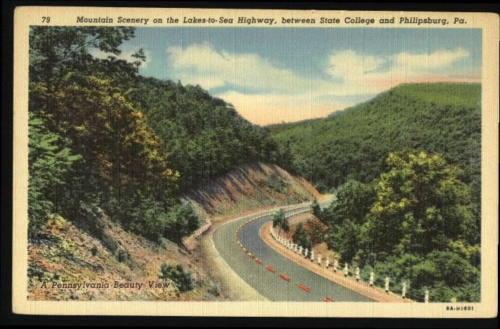
It wasn’t Interstate 99, of course – Bud Shuster’s four-lane legacy wouldn’t be built for another seven decades, give or take. This was the Lakes-to-Sea Highway, also known as the Ship-to-Shore Highway, which originated in Cleveland and ran from Erie southeast through Harrisburg and Philadelphia to Atlantic City.
J. Laird Holmes – ‘State College’s first teacher, first tax collector and first burgess (mayor) to be re-elected,’ Chesworth wrote in T&G – was serving in the Pennsylvania General Assembly in 1929. It was Holmes who pushed to have what would eventually become U.S. 322 cut through the borough.
‘Realigning meant making a relatively straight shot across the farms north of town; putting in a gradual curve at College Avenue, whose intersection with Atherton was offset on the southwest corner by Grace Lutheran Church (torn down for Arby’s); and paving the wide 18-foot roadway (16-foot was the norm) in concrete from Carson’s Corner to College Avenue,’ Chesworth wrote in the T&G article ‘North Atherton Street: A Depression-era highway brought a new avenue of progress to State College.’
The next year, 1930, ground was broken for the Nittany Lion Inn – Penn State officials envisioned the new highway bringing customers to the once inaccessible campus and borough –College Heights School was built the same year at 721 N. Atherton.
In 1931, State College annexed land on both sides of North Atherton Street from College and Ferguson townships. Commercial development – particularly automobile dealers – soon followed in the borough and across the new municipal boundary.
Clemson Motors, which sold Chryslers, was the first.
‘State College’s Oldest Auto Dealer Congratulates The Borough On Its 50th Anniversary,’ Clemson’s ad in the Aug. 28, 1946, special edition of the Centre Daily Times proclaimed.
‘Our Taxi Service is a 24-hour-a-day public service job – the kind that has a lot of headaches, and little glory. But we’re going right ahead with it, for we feel that we’re building for a bigger and better State College,’ Clemson’s copywriter informed Times readers. ‘And that’s been the Clemson policy ever since we established our automobile business, 22 years ago – in 1924 to be exact.’
That business was apparently a bit bumpy immediately after World War II.
‘New cars aren’t coming through with the speed that we had hoped they would, so it behooves each and every one of us to take the best possible care of the car that he now has in order to get the maximum possible mileage out of it,’ Clemson’s add cautioned.
But as peacetime production picked up, Clemson Motor Co. and Taxi Service (North Atherton Street, phone 4991; South Allen Street, phone 3421) was soon joined by other dealers on North Atherton’s ‘new auto row.’ They included Hartford Buick, Antes Motors (Ford), O’Donnell Motors (Hudson), Dix Cadillac and Jack Beasley Ford, Chesworth reported.
Antes Motor Sales called itself ‘the Baby of State College Auto Dealers’ in its ad in the special anniversary edition of the Times.
‘We realize that babies should be seen and not heard, but we’ve got so much to shout about – the new 1946 Ford, for instance – that we just can’t keep quiet,’ the ad for Antes – Route 322, one-eighth mile north of State College, phone 2505 – stated.
‘We think State College is a mighty fine place; if we didn’t we wouldn’t have located here – would we? We’re serious when we say that, and we’re serious when we say that our plans call for Antes Motor Sales to play a far more important part in State College’s next 50 years than we did in the first. After all, you know, There’s a Ford in Your Future.’
In 1924, ‘with automobiles … on the increase,’ Dewey Krumrine – then 25, and a grandson of the original settlers of College Heights – launched with his father, John N. Krumrine, what would become State Gas & Oil, as Chesworth chronicled the company’s development in ‘Story of the Century: The Borough of State College, Pennsylvania, 1896-1996.’ They started small, with a one-pump gasoline station on Old Boalsburg Road, moved their operation to 1217 North Atherton St., ‘where fuel could be more easily received from the Bellefonte Central Railroad at its old Krumrine stop,’ and eventually opened 17 gas stations in the Centre Region.
Howard Johnson’s later opened where the Mario & Luigi restaurant would one day serve Italian food.
And Carl ‘Smoky’ Temple ran the Temple Drive-In Theatre on a site later occupied by Wal-Mart and North Atherton Place.
K-Mart was actually State College’s first so-called ‘big box’ store – today a major retail chain occupies almost every square foot of the North Atherton corridor on which a bank or a restaurant does not sit – at 100 Valley Vista.
In 1956, J. Alvin Hawbaker started to build the Park Forest Village development in Patton Township, across North Atherton from a dump, where a pre-green-and-sustainable Penn State burned its trash and local residents went to shoot rats.
While the streetscape has changed dramatically, two businesses that began in 1964 remain: Dairy Queen at 2009 N. Atherton and Tire Town at 2045.
Next: I-99 changes everything – again.
Earlier coverage
More Local News
View all Local News
State College Teen Turns Passion for Card Games Into New Downtown State College Business
Just over a year after graduating from State College Area High School, a 19-year-old entrepreneur is preparing to open a new trading card, tabletop and retro gaming store in downtown […]
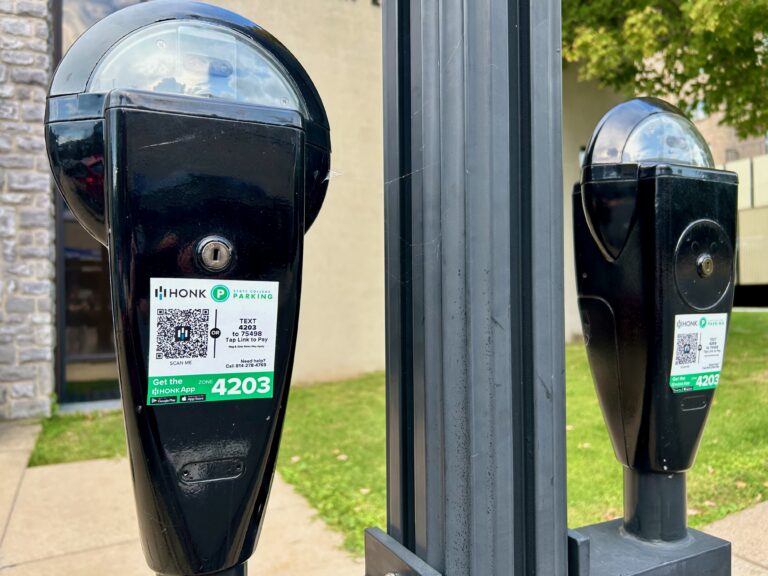
State College Transitioning to New Official Digital Parking Payment Platform
State College will officially transition to HONK Mobile as the borough’s official digital parking payment system on Tuesday, Sept. 1. Parking sessions can be purchased via the HONK website, the […]
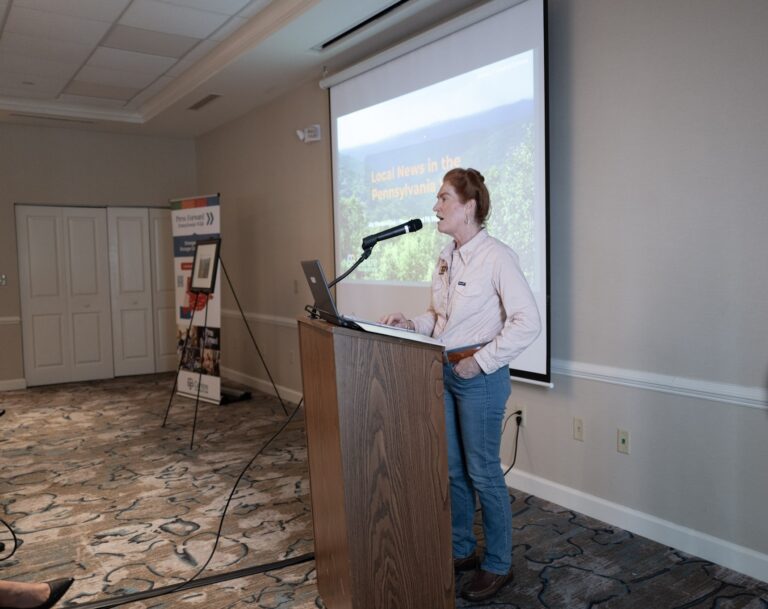
Press Forward Survey Highlights Value of Local Journalism
Press Forward PA Wilds unveiled the results of a yearlong research project that gathered feedback from more than 2,000 residents across nine counties.


