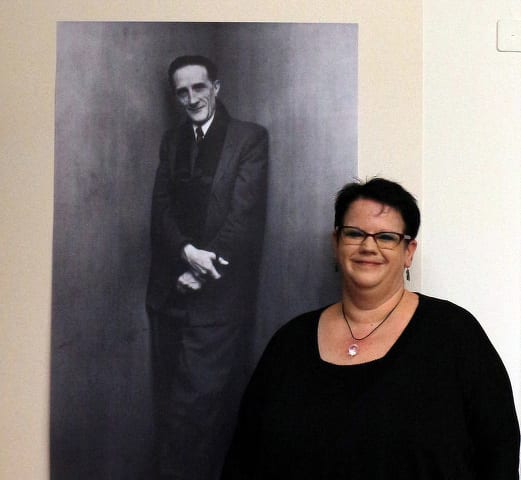
Bellefonte native Jill O’Connor has spent five years scrutinizing the work of one of the art world’s most enigmatic figures. As her master’s thesis, O’Connor has developed a theory that, according to her, no Marcel Duchamp scholar has yet asserted.
O’Connor will share her ideas with the community at 8 p.m. Wednesday at the Bellefonte Art Museum for Centre County, where she is an intern.
Early in the 20th century, French conceptual artist Duchamp rattled the western relationship to art.
‘He wanted to make art that had an intellectual aspect,’ O’Connor said, ‘and not just art that appealed to the eye.’
Rather than creating the still life, landscape or figurative work of his contemporaries, Duchamp presented ‘readymade’ (a phrase he coined) objects in unusual contexts. He maintained that the artist alone decided what qualified as art.
‘It just so happens he was breaking new ground,’ said O’Connor. ‘He was not just some guy who stuck a urinal in an art show and called it art,’ referencing one of Duchamp’s most startling pieces, ‘Fountain.’
O’Connor’s thesis hinges on two masterpieces in particular, and how the seemingly unrelated works actually do, in her view, affect each other. Moreover, O’Connor makes her assertion through Duchamp’s cryptic concept of the “infra-thin.”
She said, ‘Duchamp writes, ‘the possible, implying the becoming — the passage from one to the other takes place in the infra-thin.”
She applies this idea to two pieces, “The Bride Stripped Bare by Her Bachelors, Even” (also called “The Large Glass”) and “Given: 1. The Waterfall, 2. The Illuminating Gas.”
O’Connor’s presentation will feature visuals of each piece, with the details of each enlarged and isolated to facilitate her discussion.
“The Large Glass,” constructed of bits of metal, wire and dust encased in two separate glass sections, depicts a form Duchamp called ‘The Bride’ in the top section and what he called “malic” forms in the lower portion depicting the bachelors.
“Given” also has two distinct sections. The first, a set of wooden doors imported from Spain, have peepholes. When the viewer looks through, they see a nude female form lying on its back.
‘No one was looking at these works through the lens of the infra-thin,’ O’Connor said.
Friends of the State Museum of Schwerin in Germany supported her research.
‘I was surprised that no one else had come up with the theory,’ she said. ‘The more I researched, the more comfortable I became.’
Her research involved not only the pieces and their history, but Duchamp’s 46 notes on the infra-thin, discovered after his death.
O’Connor’s presentation may just illuminate some of the mystery surrounding Duchamp for conceptual art enthusiasts. And, for those unfamiliar with his work, her accessible vocabulary and detailed explanations can provide a solid introduction.
‘What he was doing was breaking new ground,’ she said, ‘and in the process (he) became one of the most important and influential artists of the 20th century.’
Her presentation deals with adult subject matter not suitable for those under 18.