
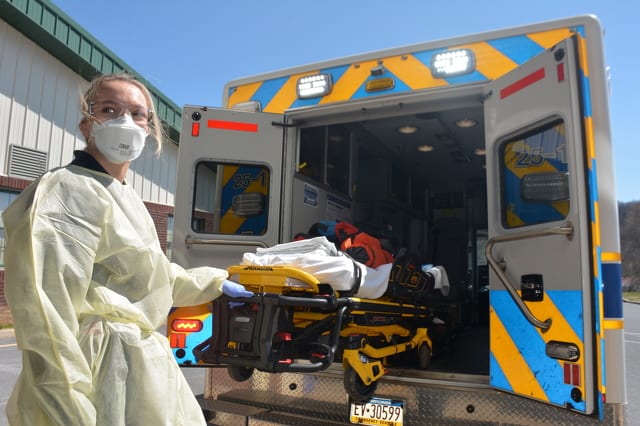
As always, Centre County LifeLink EMS is ready to respond at a moment’s notice to help people during an emergency, even as the coronavirus makes close contact with others more dangerous.
The nonprofit is preparing to continue to be there to respond for those in need in case the situation becomes worse. But the extra costs and fewer funds due to the coronavirus is a concern.
Right now things are slow for the service, because without Penn State students and staff on campus, a large percentage of its call base is not in the area. For the week of March 15-21, ambulance calls were down 35 percent, said executive director Scott Rawson, who noted that calls were down from an average of 17.35 per day to around 11 per day that week.
“That is a huge impact because our main source of funding is the fee for service,” he said. “So that is something that we are really concerned about right now, because we are funded through fees for our service and from our membership program. The thing is, we have to be in a state of readiness so if this becomes a full-blown pandemic (locally) and we start getting a lot more ambulance calls, we have to be ready to respond.”
Another concern for the service is the possibility of the ambulance staff becoming sick. This is all too real for people on the front lines. Besides the moral and emotional impact of seeing a fellow worker get sick, the service would also struggle financially due to an ill worker.
“Then we would have to pay overtime to cover for them in order to maintain that state of readiness,” said Rawson.
On top of that, there is additional costs related to COVID-19, including the purchase of cleaning solutions and personal protective equipment.
“Where we have spent the most is on the gloves. We did order a pretty large quantity of gloves for our personnel because we respond with a minimum crew of two people on every call. Our staff is taking universal precautions on every call,” said Rawson. “The other thing is, when they are available, the sanitizing agents for our ambulances and ambulance stations. And the masks. We have been provided some masks by the Centre Region Emergency Management Agency that they had in stockpile. Should it become a full-blown pandemic, the supplies are going to go quiet quickly.
“It is a significant concern for us, and we have had a special meeting with our board of directors to discuss how we can cut costs and limit expenses,” said Rawson.
Another concern is neighboring ambulance services that are smaller than Centre LifeLink. These services are facing staffing shortages and are short on supplies, and any illness to the staff could be detrimental.
“If they even lose one crew to sickness, that creates an additional hardship for them, and our coverage area then expands,” said Rawson.
Centre LifeLink is working with the county emergency management agency to look for financial assistance that might be available from state or federal government.
Rawson said patients with symptoms who are able to contact their family physician and treat their symptoms at home should do so.
“Certainly if they are experiencing shortness of breath or some of the more severe symptoms, then by all means, go to the hospital, but the COVID-19 can be treated with the patient remaining at home,” said Rawson. “If they call with those symptoms, then we are taxing the abilities of the hospital as well as our ambulance service and the supplies. Then, we may not have those available for those who really, really may need it.”
When responding to a person with COVID-19 symptoms, the EMS will have gloves and masks on as they normally would.
“The difference is, if someone calls with an influenza-like illness, we are going to get a mask on the patient and our crew will wear the N-95 masks that will provide greater protection to our crew,” said Rawson. “When we are dispatched for a call with someone who has the signs and symptoms of the coronavirus, we are getting the callback number on our text alert and then we can call and talk to the patient, so if possible we can get a mask on the patient before we arrive at the scene or possibly have the patient come out into the open air, rather than in a confined space to protect our ambulance crews a little better.
“Our staff is concerned, but not scared. They are trained to deal with these situations and they do utilize the universal precautions. Our medical director and our infection control safety officer have provided an abundance of information to deal with these situations as well,” said Rawson. “So I think they are very well-prepared, but we just don’t know to what extent it will occur.”
The service is currently finishing up its membership drive. Memberships go a long way to benefiting the station, as well providing a benefit to members.
“If community members purchase a membership, that will do two things,” said Rawson. “Not only will it support our organization financially, but it will also ensure the patient, that if they call 911 and need an ambulance transport, they won’t pay any out-of-pocket expenses for that. So it is kind of a win-win.”
Information on memberships is available at centrelifelink.com.
More Local News
View all Local News
Penn State Rises in U.S. News & World Report ‘Best Colleges’ Ranking
Penn State climbed into the top 25 for public schools in the U.S. News & World Report “Best Colleges” for 2027 released on Tuesday, but remained much lower on the […]
Centre County Man Who Admitted to Killing His Wife Pleads Guilty to Third-Degree Murder
A Centre County man pleaded guilty to third-degree murder on Wednesday for the strangulation death of his wife in October 2025. Alan K. Reed, 75, will be sentenced to 15 […]
Centre County Prison Board Hears Renewed Call for Outdoor Recreation
A Centre County resident renewed calls for outdoor recreation at the Centre County Correctional Facility at the September Prison Board meeting, prompting a sometimes tense discussion between the resident, commissioners and prison officials.


