
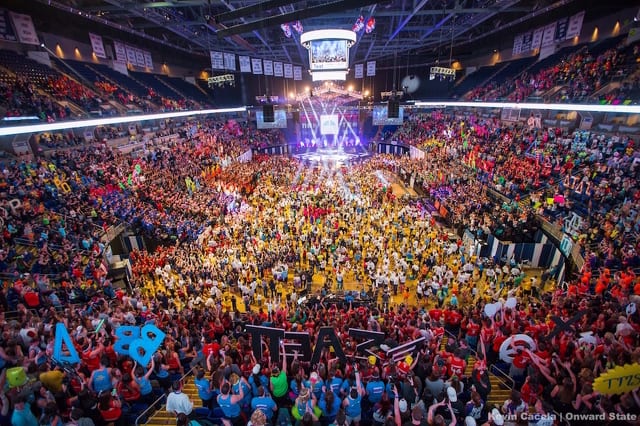
In the many years that I have helped college students prepare for their internships and eventual careers, I have had the opportunity to evaluate their resumes. At Penn State, almost every student I see lists THON as an “experience” on their resume. Drilling down a little deeper, it is interesting to note how students define experience.
From athletes who participate in the hour-long pep rally performance each year at THON to students who dance for 46 hours to the dedicated volunteers who put in hours behind the scenes serving on a committee, it seems like everyone lists THON as among their college experience. Obviously, the investment and the return from each of those roles differs significantly and raises the question “What exactly do we mean by experience?”
Experience can defined as either the “direct observation or participation” in an event or events or “the practical knowledge or skills derived from participation in an event or activity,” according to Merriam-Webster.
In other words, the concept of experience can be both a noun and a verb. We can experience a concert, baseball game or a huge community event like THON or we can gain experience in time management, the management and direction of others, communication skills, etc. through involvement in THON.
How and if some of those experiences should be listed on a resume is a topic for debate.
Consider the layers of experience that with take place at this coming weekend’s Penn State football game. There will be law enforcement, the business owners and other people who have to manage the visitors to Happy Valley. There will be staff who carry out and manage stadium operations. There will be the radio and TV announcers and the crews of professionals who carry the “experience” beyond the stadium itself. There will be the fans in the stands, the students, the tailgaters and the many visitors to not only Beaver Stadium but to all of Centre County and immediately beyond. Dance team. Cheerleaders. Blue Band. The family members of the players. There will be the referees and the coaching staff. Finally, there will be the players who are actually playing the game.
Human nature is a funny thing. Each will likely claim some ownership or “experience” with what we hope will be a win for the Nittany Lions. Each will say they experienced that football game.
Not all experience is the same.
I heard a speaker several years ago who reflected on the layers of experience within the experience. Motivational speaker Jon Vroman, founder of the Front Row Foundation, uses the “front row’ analogy to talk about life experiences. His message is that those who chose to live life from the front row versus from the cheap seats in the back get a more rich and rewarding experience. I’ve used that analogy with many students about their college experiences. Where have you chosen to sit in your decisions about class work and extracurriculars and getting involved?
How exactly is experience measured?
Case in point. I was in Las Vegas earlier this month with 13 Penn State students and another faculty member on a trip for a course when that madman began shooting into a concert crowd from the 32nd floor of a hotel. We were about a mile away from the worst mass shooting in recent history — a horrific and tragic incident that left 58 people dead and more than 500 people injured, of whom 45 or so remain hospitalized as I write this column.
It is important to note that none of us were in the vicinity of the shooting. At the time we heard “active shooter” all of the members of our group were under the same roof, in a safe location, several blocks from the incident. After hearing the all clear, we were eventually able to resume our class activities and to continue on with what ended up being an amazing educational experience for the class.
Despite some anxious moments, our group later met and decided that to make this larger experience — one that tragically impacted so many people — our “experience” seemed not only an embellishment but disrespectful to those who were so significantly impacted. Although I suspect that all of us will think about it whenever we talk about the course or the trip to the west coast (or perhaps when we think about Las Vegas), we were never at risk. Not all experience or experiences are the same.
In helping students develop their resumes, we look at outcomes. How did your experience in that event change the event? Did it change you? What skills and competencies did you get from that experience? Did participation in that experience change your path or the path of others? If not, should it be listed on your resume? Is that an experience for which you should claim ownership?
When does exposure to something shift over the line and become a measurable, marketable experience? When is our observation or participation in an event or activity just something that is part of this larger human experience we call life?
More Columns
View all Columns
Everything I Experienced Covering a Game at the New Ryan Field
This past Friday, I had the honor of covering Penn State in the first game played in Northwestern’s new Ryan Field, and it’s an experience I won’t soon forget. The […]
Here’s How Penn State QB Rocco Becht Thinks He Can Do Better
EVANSTON, Ill. — Rocco Becht is a smart guy. He’s a wise old head in college football terms. This is his fifth season playing and mostly starting Power 4 football. […]
Worse Than Bad. Chip Kelly, Jerry Neuheisel and Northwestern Pile On Penn State. Again
EVANSTON, Ill. — Important dates in Big Ten Conference offensive coordinator hiring history, good to know especially now, in the aftermath of Penn State’s total collapse over the past six […]


