
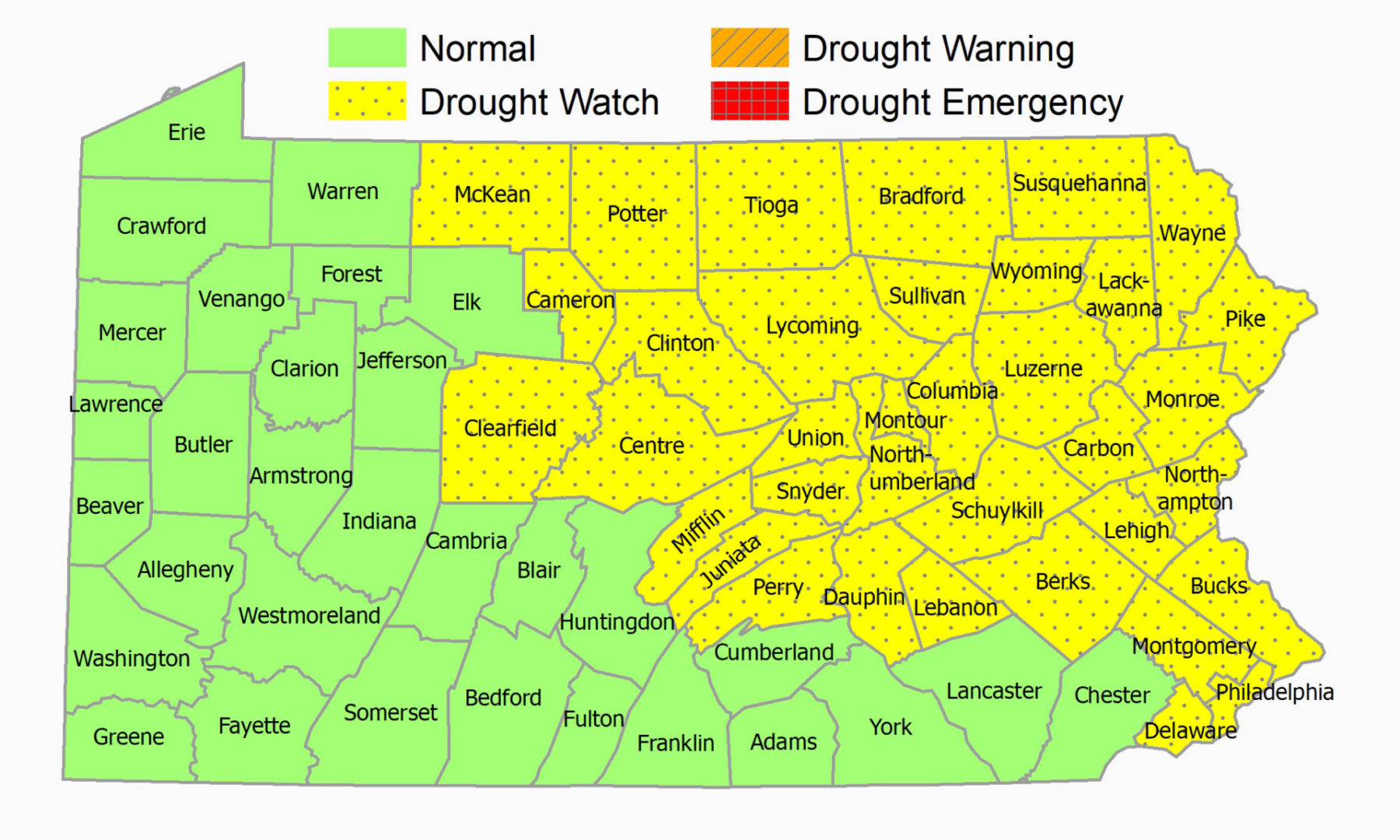
Though the region has experienced some rain over the past week, it hasn’t been nearly enough to lift Centre County out of a drought watch.
Centre is one of 36 counties to remain under a drought watch, which was first declared on Aug. 31, according to the state Department of Environmental Protection. Residents are encouraged to voluntarily reduce their water use by 5 to 10%, or about three to six gallons per day,
“Conditions have improved with the recent rain, but we need to see continued meaningful precipitation over several months and have public water suppliers in affected counties returning to normal operations before the drought watch can be lifted,” DEP Acting Secretary Ramez Ziadeh said in a statement on Tuesday. “We ask Pennsylvanians in these counties to continue to use water wisely and follow simple water conservation tips to ease the demand for water.”
Some counties experienced very dry conditions throughout the summer, while others have had increasingly dry conditions over the past several weeks.
Along with Centre, counties on drought watch include Berks, Bucks, Bradford, Cameron, Carbon, Clearfield, Clinton, Columbia, Dauphin, Delaware, Juniata, Lackawanna, Lebanon, Lehigh, Luzerne, Lycoming, McKean, Mifflin, Monroe, Montgomery, Montour, Northampton, Northumberland, Perry, Philadelphia, Pike, Potter, Schuylkill, Snyder, Sullivan, Susquehanna, Tioga, Union, Wayne, and Wyoming.
DEP has notified water suppliers in each of the counties to monitor supplies and update drought contingency plans as necessary.
Four indicators are used to determine drought conditions — precipitation, surface water (stream and river) flow, groundwater level and soil moisture — and declarations are not based on one factor alone, according to DEP.
“The DEP Drought Coordinator monitors the indicators in close partnership with the U.S. Geological Survey (USGS), which maintains gauges in streams and wells in many locations across Pennsylvania,” according to a DEP news release. “There are normal ranges for all four indicators. DEP makes drought status recommendations after assessing departures from these ranges for all indicators for periods of 3-12 months… DEP shares these data and its recommendations with the state and federal agencies and other organizations that make up the Commonwealth Drought Task Force. Drought watch and warning declarations are determined by DEP, with the concurrence of the task force.”
A daily map showing the status of all four indicators for each county is available at the USGS Pennsylvania drought condition monitoring website.
No counties are at the drought warning or emergency stages. With a drought warning, residents are asked to reduce water consumption by 10 to 15%, At the emergency level, which also requires final approval by the governor, nonessential water use restrictions can be put into effect.
DEP offered a list of ways residents can conserve water:
- Don’t let run the faucet while brushing your teeth or shaving and shorten the time you let the water run to warm up before showering.
- Run the dishwasher and washing machine less often, and only with full loads.
- Water gardens in the cooler evening or morning hours, and direct the water to the ground at the base of the plant, so you don’t waste water through evaporation.
- Water lawns only if necessary. Apply no more than 1 inch of water per week. Avoid watering on windy and hot days.
- When mowing your lawn, set the blades to 2-3 inches high. Longer grass shades the soil, improving moisture retention. It also grows thicker and develops a deeper root system, so it can better survive drought.
- Check for and repair household leaks.
- Sweep sidewalks, decks, or driveways instead of hosing them off.
- Replace older appliances with high-efficiency, front-loading models that use less water and energy.
- Install low-flow plumbing fixtures and aerators on faucets.
- Set up a rain barrel to be ready to repurpose rain when it does fall. See this Penn State Extension guide for details.
More Local News
View all Local News
Penn State Rises in U.S. News & World Report ‘Best Colleges’ Ranking
Penn State climbed into the top 25 for public schools in the U.S. News & World Report “Best Colleges” for 2027 released on Tuesday, but remained much lower on the […]
Centre County Man Who Admitted to Killing His Wife Pleads Guilty to Third-Degree Murder
A Centre County man pleaded guilty to third-degree murder on Wednesday for the strangulation death of his wife in October 2025. Alan K. Reed, 75, will be sentenced to 15 […]
Centre County Prison Board Hears Renewed Call for Outdoor Recreation
A Centre County resident renewed calls for outdoor recreation at the Centre County Correctional Facility at the September Prison Board meeting, prompting a sometimes tense discussion between the resident, commissioners and prison officials.


