
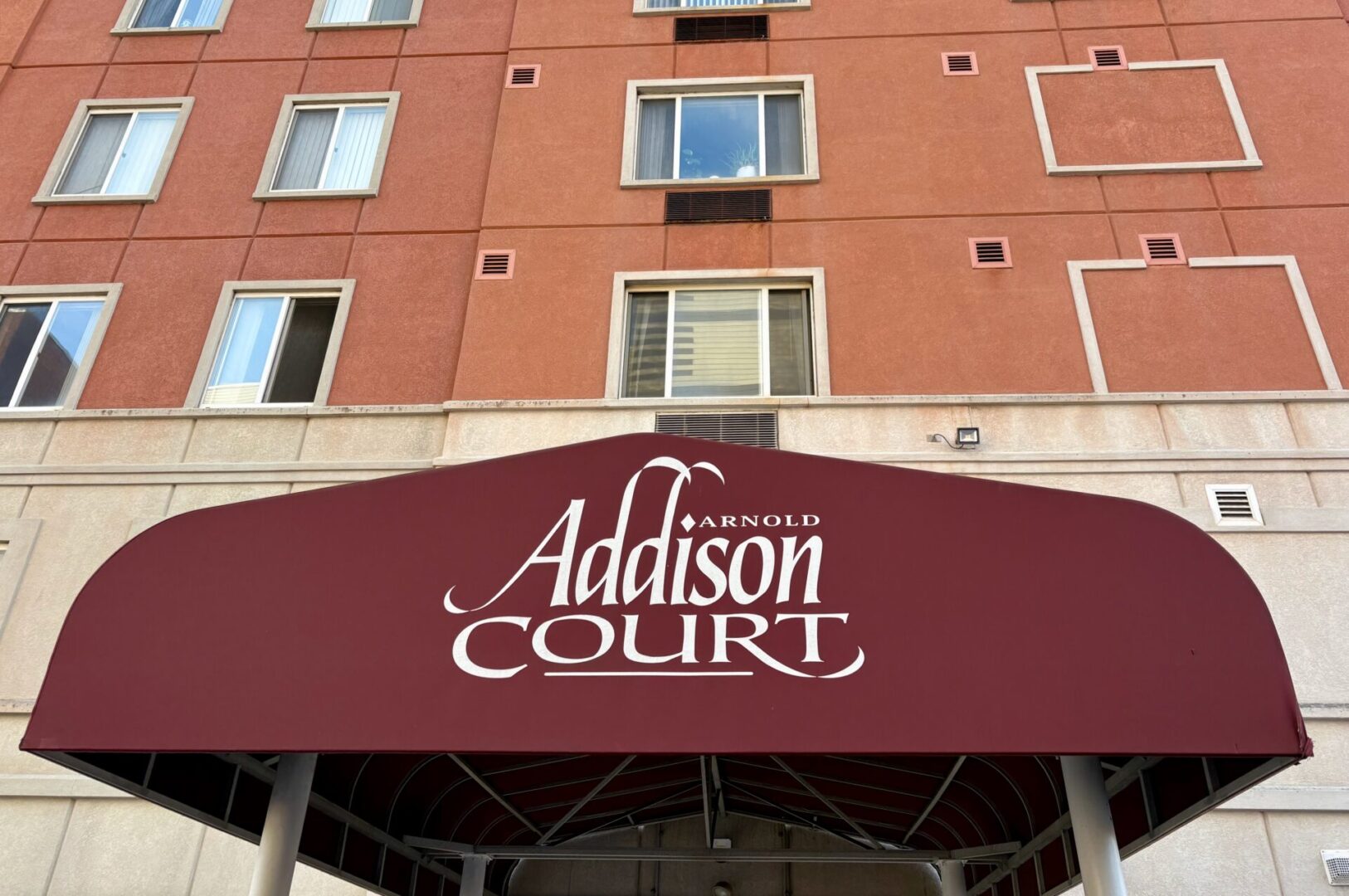
The developer who is acquiring the Arnold Addison Court property in State College says he now will attempt to preserve the current building as low-income housing for seniors and people with disabilities as “plan A,” instead of constructing a new student apartment complex on the site.
PrimeCore CEO Ara Kervandjian told State College Planning Commission on Thursday night he will pursue Low-Income Housing Tax Credits that would subsidize rehabilitation of the existing building at 120 E. Beaver Ave. and require that it remain income-limited and rent-restricted for another 40 years. The previous affordability requirements of the tax credits used to construct the building in 1994 expired at the end of 2024, and the current owner has a deal in place to sell the property to PrimeCore.
“This is now our plan A, as opposed to the original submission,” he said. “We’re willing to pursue this path for Low-Income Housing Tax Credits to attempt to preserve the building, and we’ll do it in good faith. But that significantly changes the project timeline. It adds approximately two additional years of carrying costs for us and our pre-development efforts, and requires substantial investments in consultants, design, legal application costs before any certainty of an award for tax credits.
“However, the economics of preservation are entirely dependent on successfully securing… LIHTC funding.”
If he is not successful in getting the LIHTC, Kervendjian said he will return to his original plan of razing the building and constructing a new seven-story development that mirrors the neighboring Pugh Centre, with ground-floor commercial, six floors containing 40 apartments, including four inclusionary housing units, a rooftop terrace and underground parking.
He is still seeking a zoning text amendment that would permit a uniform building height of 65 feet, rather than requiring a step-down to 45 feet on the southeast half, so that “a viable Plan B exists for us if our preservation efforts and funding does not materialize,” he said. Constructing a building with split heights can be accomplished, but is inefficient and costly, Kervendjian said.
“It creates a necessary backup plan so Addison Court does not end up in limbo if preservation funding cannot be secured,” Kervandjian said. “The most economically viable backup plan to LIHTC preservation would be construction of a building similar to the building to the east, which is Pugh Centre.”
PrimeCore has the Addison Court property under contract and is scheduled to close the deal next week. Kervendjian said if the LIHTC application is unsuccessful and the zoning change is not adopted, he is uncertain if PrimeCore would still go ahead with the original plan submission. But, he added, the company would redevelop or reuse the property in some fashion and it would not be for low-income housing if the tax credits are not awarded.
Kervendjian, who has been the most prolific developer of low-income housing in Centre County in recent years, has applied for LIHTC funding for seven projects since 2012 and has been successful each time in his first application — a feat borough planning director Ed LeClear called “rare.”
“We’re confident about our abilities,” Kervendjian said. “We’ve got a good relationship with the [Pennsylvania Housing Finance Agency] and we know how to submit proposals.”
The LIHTC process can take up to two years from pre-application preparation to notification, Kervandjian said. During that time, Addison Court leases will be renewed, and for those who wish to seek other housing, Continental Real Estate Management, which had already been enlisted to assist tenants with finding suitable new homes, will be available to help them relocate.
That will give current residents of Addison Court — where 50 of the 89 units are occupied — more time to remain in their apartments, regardless of the outcome.
Tenants received a letter in December initially informing them that all current leases would have an end date of Nov. 30, 2026. Staff from the borough and the Pennsylvania Housing Finance Agency, which administers the federal LIHTC program in the commonwealth, reviewed legal documents related to the property and determined a deed covenant prohibits the eviction of tenants who resided there as of Dec. 31, 2024 without cause before Dec. 31, 2027 because of a required three-year wind-down period after the affordability requirements expired.
If the LIHTC is awarded, construction to renovate the building might temporarily displace residents. Kervandjian said his company will work with the tenants to ensure they have somewhere to live during the construction.
“That means we will need to plan carefully now, not wait until the last minute,” he said. “We do not intend to leave anyone without security or peace of mind about where they will live.”
That did not sit well with two Addison Court residents who spoke during public comment. Both questioned the need for extensive rehabilitation of the building.
“Maybe some apartments need to be cleaned up, but Addison Court was built solid,” said Kathryn Santoro, a tenant who has frequently spoken at public meetings about the challenges of finding alternative affordable housing in State College. “It’s a solid building. So I don’t know what renovations you are saying that’s going to cost a lot of money.”
Kervandjian said Addison Court has not had any major maintenance since it was built and now has “significant deterioration and deferred capital needs.” He added that “rehabilitating the building to modern living standards which the residents deserve” will require “substantial investments” in infrastructure, such as a new roof and mechanical systems, the common area and the individual apartment units for renovations to bathrooms and kitchens.
The HVAC system will also need to be updated to meet the energy efficiency requirements of the LIHTC program.
Zoning Amendment
Addison Court was on the agenda Thursday night after Borough Council referred Kervandjian’s request for a zoning text amendment to the planning commission for a recommendation.
A 2007 zoning amendment limits building heights to 45 feet on Beaver Avenue within 200 feet east and west of the 200 block of South Allen Street, splitting the Addison Court property into two maximum height limits. The intent was to prevent tall buildings that would create a “canyon” effect at the corners of South Allen Street and Beaver Avenue, former longtime borough planning and zoning officer Herman Slaybaugh told council and planning commission.
PrimeCore is proposing the zoning provision be reduced to within 100 feet of South Allen Street, which Kervandjian and Slaybaugh said would protect the intent of the amendment. The height limit on the corners would remain unchanged and the other properties between 100 and 200 feet from the 200 block of South Allen are part of Schlow Library and the municipal parking lot, both of which almost certainly will not be redeveloped.
“We should always strive to make those regulations the minimum needed to achieve the public purpose,” Slaybaugh said.
While stressing that preservation of Addison Court is the preferred path, Kervandjian said allowing a uniform height would make a more efficient project if he does return to the student apartment complex plan.
“It’s more efficient to build one same level building as opposed to stepping down,” he said. “You have basically two separate roofs. You have three walls that you cover: the outside of the left, outside on the right, and in the middle. So there are economic savings, so it makes it more economically feasible.”
The planning commission only received an overview and will discuss a recommendation during its meeting at 7 p.m. on June 18.
Curtis Shulman was the only commission member to offer an opinion, saying he appreciated Kervandjian’s shift to pursuing preservation as the primary option and that the zoning change made sense if the LIHTC application is not successful.
“Being that it’s private property, I think it’s pretty fantastic you’re willing to go through with option A,” Shulman said. “And if it doesn’t work, I would think that option B, we’d want to make it as efficient as possible because you’re going to go through this process that’s two years regardless. The economic overhead of that has to be challenging, to say the least.”
Several community members who spoke during public comment were less sanguine.
One said that the borough should not enable the potential displacement of older and disabled residents.
“It is necessary to recommend against this proposal if we are to continue being a State College for everyone,” borough resident Silas Smith said.
Two others said they do not trust that developers have the best interests of the community in mind.
“I do not trust the plan. I don’t think that there is a reasonable way to assure that a good faith effort will be made to get a LIHTC tax credit,” borough resident Amanda Lundberg said. “… I think that having Addison Court and having a space for our elderly right in downtown, there really isn’t a replacement for that. That is for the good of the entire community.”
Kervandjian, whose father-in-law, Henry Sahakian, was the original developer of Addison Court, said he is a local community member himself and pointed to his company’s record of developing properties with 186 units for low-income residents over the past decade.
“Our intentions are genuine,” Kervandjian said. “I know it might be surprising why we’re here to pivot and put Plan A being to save this building and renovate it and restore it to what it was, and for the benefit of the residents. That’s exactly what we’re planning to do, putting a hundred percent effort behind it and our reputation.”
More Local News
View all Local News
Harlem Globetrotters Bringing New Rivalry Tour, Free Pregame Party to Bryce Jordan Center
The Harlem Globetrotters are bringing a new lineup of rivals and interactive basketball challenges to Penn State in March as part of the team’s 2027 world tour. The exhibition basketball […]

State High Band Celebrates 100th Anniversary
More than 230 State College Area High School marching band alumni returned to the field on Friday night to join 240 current band members for a celebration 100 years in […]
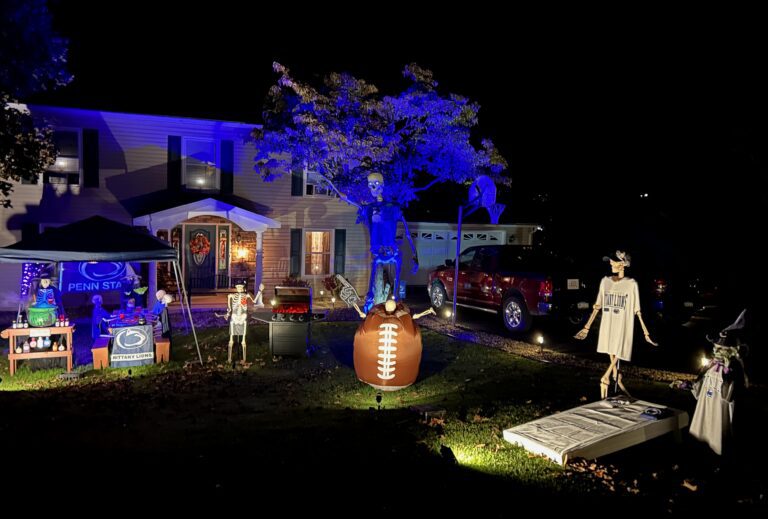
‘Big Leboneski’ and Friends Are Back in Bellefonte With Tailgate-Themed Display to Raise Money for St. Jude Children’s Hospital
A 12-foot-tall skeleton named Big Leboneski and his friends are back for another year on a Centre County family’s lawn to raise money for St. Jude Children’s Research Hospital. Now […]


