
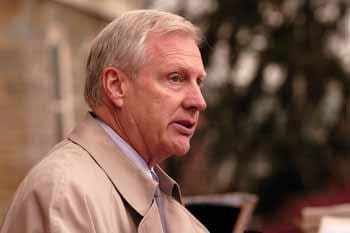
Gov. Tom Corbett’s 2012-13 budget proposal would shave $64 million from state general support for Penn State, leaving state monies to account for just five percent or six percent of the overall university budget, President Rodney Erickson testified Wednesday.
The hit would sock Penn State’s general-education mission especially hard, he said, appearing for a state House Appropriations Committee hearing in Harrisburg.
Of its $4 billion annual budget, the university spends about $1.65 billion on general-education functions, primarily classroom instruction. About 77 percent or 78 percent of the general-education total comes from tuition revenue; the rest, primarily from the state, Erickson said.
That state money goes mostly to offsetting tuition rates for in-state students, who pay about $15,000 a year at University Park.
Out-of-state peers pay about $27,000 annually, a price that closely reflects the actual cost of their education, university officials have said.
But ‘we can’t continue to offer that kind of tuition break for Pennsylvania residents as the (state) appropriation continues to fall,’ Erickson told House members Wednesday.
He said Corbett’s proposed cut ‘will fall disproportionately on students from lower-income families, many of whom are working, committed’ to part-time jobs already. ‘They will be hurt most by this.’
Penn State already leads the Big Ten in student-loan default rates.
Erickson called it ‘critically important’ that in-state tuition rates be kept as low as possible. The median family income among in-state students is 10 percent lower than the statewide median income, and 40 percent of them are eligible for federal Pell Grants, Erickson said.
Plus, he went on, 62 percent of in-state undergraduates work at least 12 hours a week to help make ends meet.
‘These are people who are absolutely critical to the future of the commonwealth,’ Erickson said.
If in-state students had to bear the entire burden of the 30-percent state-funding cut that Corbett has proposed, Erickson said, they would see a nearly 10-percent tuition increase in the fall.
He told legislators that the university will not impose an increase that burdensome, though. It’s continuing to explore new cost-control measures to ease its expense sheet, Erickson said.
‘We will continue to cut costs wherever we can because we do not want to (put) the impact of any further cuts any more heavily upon our students and their families than we have to,’ he said.
But at some point, Erickson said, as the state continues to trim resources, ‘we simply can’t do business as usual year-in and year-out. We need to know where this is heading.’
Lawmakers passed a 19-percent state-funding cut for Penn State and the other state-related universities last year. The average tuition increase at Penn State was about five percent.
Erickson’s appearance Wednesday marked his first appropriations testimony as university president, a role he assumed in November. He appeared for about two hours, taking questions alongside top executives of other state-related universities: the University of Pittsburgh, Temple University and Lincoln University.
Appropriations-committee members appeared generally supportive of the universities. At least one — Steve Samuelson, a Lehigh-area Democrat — said he wants the institutions to see no funding cuts in the coming year.
The hearing marked one step in the state budget-negotiation process, due to wrap up by June. Unlike in past years, the state-related-university executives are not expected to appear for a Senate Appropriations Committee hearing for this budget cycle.
Among Erickson’s other remarks Wednesday:
- Penn State looks forward to ongoing talks in the General Assembly about its status under state Right-to-Know provisions, he said. Proposals now circulating in Harrisburg would pull the state-related universities more fully under those provisions, requiring the institutions to release more details about employee compensation, business and research contracts, and other financial documents.
‘I’ve been committed to much more openness’ as president, said Erickson. He has indicated he would have no objections to opening all employees’ compensation information for public review.
He suggested the university may have some privacy concerns about research contracts with industrial entities — and about private philanthropic agreements that ‘really don’t involve public funding.’
But the university would want to disclose as much as it can — ‘where it doesn’t violate law or individuals’ privacy rights,’ Erickson said.
- Erickson, making the case for strong state support, noted that many Penn State faculty and staff members have seen salary freezes in two of the last three years. That makes employees ‘much more susceptible to moving to other places.’
He favors a strengthening of the traditional partnership between the state and Penn State, he said, calling it good for students and good for Pennsylvania’s economy.
‘ … (T)he support we receive from the commonwealth really goes to our core mission’ in instruction, Erickson said.
Earlier coverage
More Latest Penn State News
View all Latest Penn State News
Greek Life at Penn State: Plus Ça Change
It was back to business as usual among the Woo people last weekend, which meant very loud outdoor parties, very many shirtless young males and very many young females wearing […]

New Judge to Oversee Penn State Fraternity Cocaine Ring Case
A new judge has take over the case against the men accused of operating a cocaine trafficking ring out of two off-campus Penn State fraternity houses, a day before the […]
‘Night at the Museums’ to Showcase Penn State Exhibits and Archives
By Chris Kick, Penn State Ag Sciences News The second week of Penn State’s fall semester offers a chance to visit university museums during the “Night at the Museums,” planned […]


