

A local groundwater geologist is using the very substance he studies to heat and cool his building, with the help of newly installed solar panels.
Todd Giddings, of Giddings & Associates in Ferguson Township, has been using geothermal technology to heat and cool his home for the last 40 years and his office for the last 30. In December, Giddings added solar panels on the southern-facing roof of the office building along Enterprise Drive.
His June electric bill for the 10,000-square-foot office building was $120, after West Penn Power applied credits for electricity he sold back to the grid.
Though alternative sources of energy grow ever more popular and governments pledge to reduce emissions — like Ferguson Township itself — Giddings has much experience in the field.
In March, he presented at the International Ground Source Heat Pump Association meeting in Denver, where he said his photovoltaic solar and geothermal hybrid system was well-received.
He said most people are familiar with the popular forms of alternative energy: solar and wind. Both require the right conditions. Solar panels need to face relatively south and not be in the shade, and they require a decent bit of space. Giddings said windmills aren’t a good investment on the floor of Happy Valley.
“There’s a third form of alternative energy that is not well-known, and that is geothermal energy, the heat that’s in the earth,” he said.
Giddings’ geothermal system is what’s known as an open-loop system that draws water from the aquifer, but all systems work basically the same way. The groundwater, which stays at a nice mean temperature of about 52 degrees year-round, is used to warm the office building in the winter and cool it in the summer. In the winter, the colder water is returned to the earth to be warmed again, and in the summer the hotter water is returned to the ground to cool.
That takes energy, however, which is where photovoltaic panels come in.
The panels on the building are wired together and generate direct current, with 600 to 950 volts coming off each of the four strings. Those wires flow into a small box called a combiner, which is located on the side of the building. The combiner performs its namesake function, and the next part of the process is an inverter, where Giddings said “the real magic” happens. There, the direct current is converted into alternating current. That then goes to a transformer, which steps the voltage down to about 208.
Downstream from this is the West Penn Power meter, where workers will take readings on how much power the building draws from the grid and how much the solar panels sell back to the grid.
He said his system — using the natural temperature of the earth and reducing his carbon footprint — sits well with him philosophically, but there are obvious economic benefits, too.
What scares off most people, he said, are the large upfront costs, which he offset through federal tax credits that paid for about 30 percent of the system. Since it’s a commercial building, the investment provided for accelerated depreciation, which offsets taxable income.
So, for the first five years of the system, the reduction in the electric bill only ranks as the third best reason for the installation of the panels, he said.
The building, located at 3049 Enterprise Drive, was made to conserve resources. Designed by Fred Fernsler, now of Fernsler/Hutchinson Architects LLC, the building has a solar overhang to shade windows in the high afternoon sun, 6-inch deep walls for added insulation and double-paned glass windows with built-in slim shades and a coating to reflect infrared light.
Giddings said Fernsler’s mechanical engineer designed the building around his wish to use geothermal technology.
When Ferguson Township passed a resolution promising to reduce emissions to zero by 2050, Giddings applauded the plan and asked they consider his building as a model for future plans.
More Community & Entertainment
View all Community & Entertainment
January Is a Call to Action to Respond to Stalking
This column by Centre Safe Executive Director Jennifer Pencek originally appeared in The Centre County Gazette. When we talk about acts of interpersonal violence, oftentimes people will focus on sexual […]

Busy Weekend of Fall Festivals and More on Tap Around Centre County
The weekend of Sept. 29-Oct. 1 is packed with activities around Centre County, including fall festivals, Oktoberfests, fairs, concerts and more. Check out some of the weekend highlights below. For […]
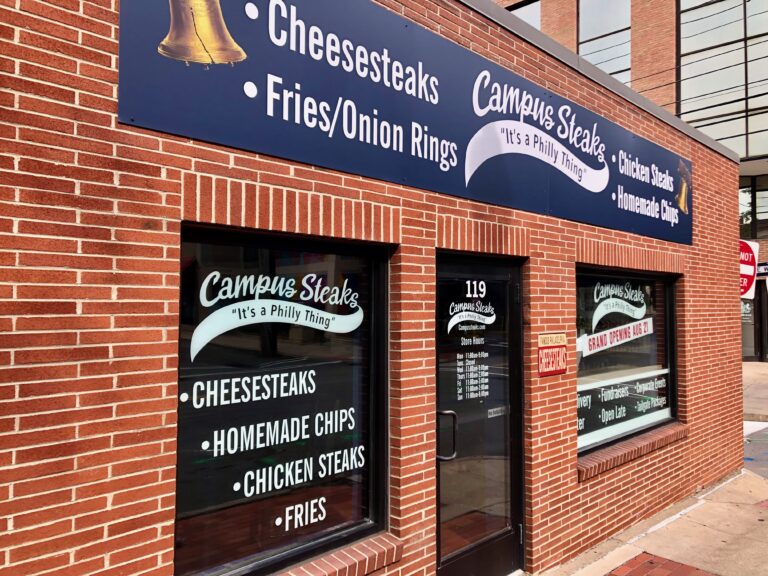
Downtown State College Cheesesteak Shop Sets Opening Date
A new cheesesteak shop that promises a taste of Philly in downtown State College has set an opening date. Campus Steaks plans to hold a grand opening on Aug. 28 […]


