
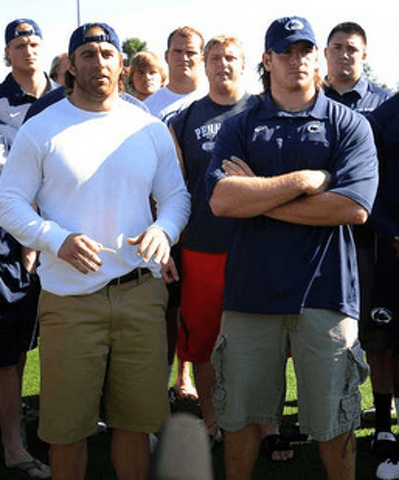
This is what negative recruiting at Penn State looked like on July 25, 2012 — four years ago to the day when that phrase took hold at Big Ten Media Day this past Monday:
“It was an absolute free-for-all,” Michael Zordich recalled via telephone from Youngstown, Ohio, earlier this week.
“Everyone’s phone was constantly ringing. There were several universities that had coaching staffs on our campus. And they were not only on our campus, but they were knocking on the campus apartment doors of our players – our own door included.
“It wasn’t like it was just one phone call, ‘Hey, we’re here. Do you want to come play for us?’ They were fishing. I didn’t care who it was, it was just a matter that someone was there, knocking on our door and asking us to leave Penn State.
“I didn’t care which school it was. I wasn’t going anywhere. Illinois was pretty dominant. I do remember them knocking on the door. They all were very persistent.”
On July 24, 2012, the NCAA levied historically onerous sanctions on Penn State, including a $60 million fine, the loss of scholarships, a bowl ban, the loss of its victories from 1998-2011 and a free pass out of State College for any current or incoming Penn State football player.
That last one opened up a recruiting feeding frenzy – referenced by Zordich, a key member of that 2012 squad — that has never been seen before or since in all of college sports. It made Penn State players and recruits open game through the start of summer preseason drills the next August, a 13-month window for college football recruiting to truly go breaking bad. In word and in deed.
Specifically, the NCAA stipulated that, “Any entering or returning football student-athlete will be allowed to immediately transfer and will be eligible to immediately compete at the transfer institution, provided he is otherwise eligible. Any football student-athlete who wants to remain at the University may retain his athletic grant-in-aid, as long as he meets and maintains applicable academic requirements, regardless of whether he competes on the football team.”
It was a crazy time.
POSITIVELY UNPRECEDENTED
Coaches from other universities came to Penn State by the dozens. They sent texts to Penn State’s players by the hundreds. And made thousands of phone calls, not only to the players on the team, but their families, girlfriends, roommates and former Nittany Lion and high school coaches. And it was all legal, albeit often not very ethical.
“Penn Staters understood the scale of the situation and everything that happened,” said Zordich. “People outside of the university might not understand the total amount of chaos that it caused inside the football team and for the guys. We were kids going to school and playing football. Then, all of a sudden, every camera in the world was pointed at us and there were people trying to get us to leave. There were these sanctions. It’s hard for people to understand because they weren’t there. It was a very wild time.
“There was obviously a lot going on. There was a ton of scrutiny from the media and the public overall. I don’t want to say rightfully so, but it was a very testing time. No one really knew what was going on – what or how it happened, what was involved. Nobody really had an idea. We were kind of used as the face for all of that scrutiny.”
What happened next would be labeled Lion lore and legend, were it not so verifiably true. Zordich, a fifth-year fullback and a team leader, and fellow legacy standout Michael Mauti led the efforts to keep Penn State football together. Zordich is quick to point out, again and again, that it just wasn’t Mike & Mike who did the work. “It was all the seniors,” he said this week. “They were incredible. They deserve the credit.”
But it was Zordich and Mauti who ran point.
“We talked with the coaches,” Zordich recalled. “At first we thought we’d sit back and see how all of this would play out. But it got to a point where we kind of got fed up with it because there was nobody sticking up for us. The administration was absent. None of us were speaking, although everybody was talking about us. Nobody had heard what we had to say.
“We weren’t even there when it happened – it was 10 years prior to us getting to Penn State. We kind of felt we were being used to take the heat. We had to stand up not only for ourselves, but mainly the university. The entire school was taking a hit for something a few — or however many it was — were responsible for. We didn’t plan on going anywhere. We were very proud of who we were. We weren’t the bad guys.”
Behind the scenes, Zordich and Mauti teamed with head coach Bill O’Brien and strength coach Craig Fitzgerald to start recruiting their own teammates — to stay. They also decided to take a positive message of unity and hope to the rest of the country and specifically Nittany Nation, with a short but passionate two-man speech to a national television audience the morning of July 25.
“Mike and I found out we were going to be speaking and we sat down to write something,” said Zordich. “Then we talked about it and there was really nothing that we needed to write down. We felt that if we wrote anything or read from a script, it would give the illusion that we were being fake. What we said was what we meant, so it was really easy to go out there and say what we said, because we meant it. That truly came from a very real place.
“We weren’t speaking for just us. We were speaking for anybody whoever had anything to do with Penn State and had been through that campus. And the program itself and the name. There were a lot of things being said about Penn State and the university and the program. It was all coming from outside sources, from people who knew nothing about Penn State itself.
“We absolutely understood why it was all happening, but it was important that we as players addressed it – it was important to the future of the program. We might have been young, but we were thoughtful, mature human beings. There was a lot at stake. We felt obligated and wanted to get the word out there: ‘Hey, pump the brakes. Everybody relax. Everything’s OK. We’re here. We’re all right. We just have to get through this. Let’s not tear ourselves apart. Let’s come together.’”
THE VIDEO
So, backed by about two dozen teammates, Zordich and Mauti marched out from the Lasch Building onto the Penn State practice field to a flank of TV cameras and recorders and reporters. Then they delivered a shared speech for the Penn State ages. It lasted all of 2 minutes and 12 seconds. The two spoke a combined 460 words – 306 by Zordich, 154 by Mauti. And that doesn’t include their polite exit line of “Thanks for coming out.”
Watch it here:
Zordich began with: “We want the nation to know that we’re proud of who we are. We’re the true Penn Staters. We’re going to stick together through this. We’re going to see this thing through. And we’re going to do everything we can for the university. We know it’s not going to be easy, but we know what we’re made of…We have an obligation to Penn State and we have the ability to fight – not just for a team, not just a program but an entire university and every man who wore the blue and white on the gridiron before us. We are going to embrace this opportunity and we are going to make something every special happen in 2012…
Mauti added: “We take this as an opportunity to create our own legacy. This program was not built by one man and this program sure as hell is not going to get torn down by one man. This program was built by every alumni, every single player who came before us; it was built on their backs.”
Then Zordich continued: “When we go out there every Saturday we suit up for our teammates, first of all. Second of all it’s for the fans, the students and all the families of Nittany Nation who support us through all of this. We’re going to do everything in our power to make them proud. And we’re going to do everything in our power to get this place back on track. I’m personally calling out every person in Nittany Nation, all the students, faculty, fans and family members, alumni, everybody – please, please come support us because we need you just as much as you need us. Together, we’re going to get through this thing to the end…”
And Mauti concluded: “No sanctions, no politicians are ever going to take away what we have here. None of that is ever going to tear us apart. Right now, all we can do is put our heads down and just go to work. That’s all we can do. We’re going to fight for Penn State, we’re going to fight for each other, because this is what Penn State is about – fighting through adversity. We’re going to show up every Saturday and we’re going to raise hell.”
And, mostly, they did.
With very few complaints, then or throughout the season. Not on July 25 and not in the ensuing days and weeks. Not even when the team’s top receiver left. Or when its top rusher left. Or when its only veteran kicker left.
“That would be an excuse,” said Zordich, looking back. “There’s no time for those. To bring in that negative energy is more of a waste of time – time that could be concentrated on doing the right thing and getting the job done.”
OB AND THE LIONS
Now, with his playing career finished and as he looks ahead to formulating an off-the-field career (in case you’re hiring) that is sure to embody the leadership, drive, maturity and inner strength he displayed four years ago, Zordich doesn’t recall his July 25 rallying cry as anything special.
He points to Mauti, to his teammates, to O’Brien, to the Penn State fans as the ones who didn’t back down. It’s a self-effacing Penn State pride that comes naturally to him; it’s in his genes. His dad Mike was a strong and stoic All-American safety for PSU, a leader who went on to a long pro career and is now an assistant coach at Michigan. His mom Cindy was a Penn State cheerleader, full of enthusiasm, and now a photographer and marketing pro, who passed along strong communication skills to son Michael and daughter Aidan (also a PSU alum).
The younger Zordich had 11 months with O’Brien, but the lessons learned were good for a lifetime.
“Coach O’Brien means a whole lot to me,” said Zordich. “He was thrown into a very ugly situation, but he was the right guy at the right place at the right time. He did a tremendous amount. Not only for the school, but for our lives. He taught us a lot, not just about football, but how to handle things. Like how to take a loss and how to pick yourself back up. The game really translates into your own life much more than people think. You can learn a lot of lessons from it. Coach O’Brien did a very, very good job of helping us understand that.
“But the thing that meant more than anything else was being a part of that team and sharing the locker room with those players. That bond we had was very real. I’m glad to carry that with me for the rest of my life.”
EASY AND HARD
When Zordich looks back on this week from four years ago, as it played out for all of America to see, he doesn’t view it as some heavy burden he carried.
It was easy, as was his decision to stay at Penn State and the work he and others did to literally save Penn State football throughout 2012 and beyond.
“The thing I would say people don’t understand the most is not that we did it, but how easy it was for us to do it,” Zordich said. “Don’t get me wrong. What we did was hard. It was a very tough time and there was a lot of work that went into the entire process. Talking with guys, building that bond and staying while looking out for the university. That’s a lot of very hard things to do. It took a lot of time and there was a lot of lost sleep during that time.
“But as hard all of that was, it was easy for us. It wasn’t a burden. It’s who we are. That’s the type of men we are.”
More Columns
View all Columns
The 2 Kinds of Penn State Football Adversity: In-Game and Post-Game
Penn State coach Matt Campbell talks a lot about handling Adversity. A lot. It’s going to come, he says. It’s how you handle it. Adversity came to Beaver Stadium on […]
Penn State Lost to Wisconsin: How Bad Was it?
How bad was it? Ahead 17-0 just 18 minutes into the game and lost bad. Ahead 20-10 until Wisconsin scored with just 211 seconds left in the game and lost […]
Penn State Football: Tonight, the Haters Were Right
On Dec. 11, 2023, Twitter user @drewjanda put out a since-deleted post that now lives in sports meme infamy. It read as follows: “The haters said I couldn’t do it. […]


