This story was produced by the State College regional bureau of Spotlight PA, an independent, nonpartisan newsroom dedicated to investigative and public-service journalism for Pennsylvania. Sign up for Talk of the Town, a newsletter of local stories that dig deep, events, and more from north-central PA, at spotlightpa.org/newsletters/talkofthetown.
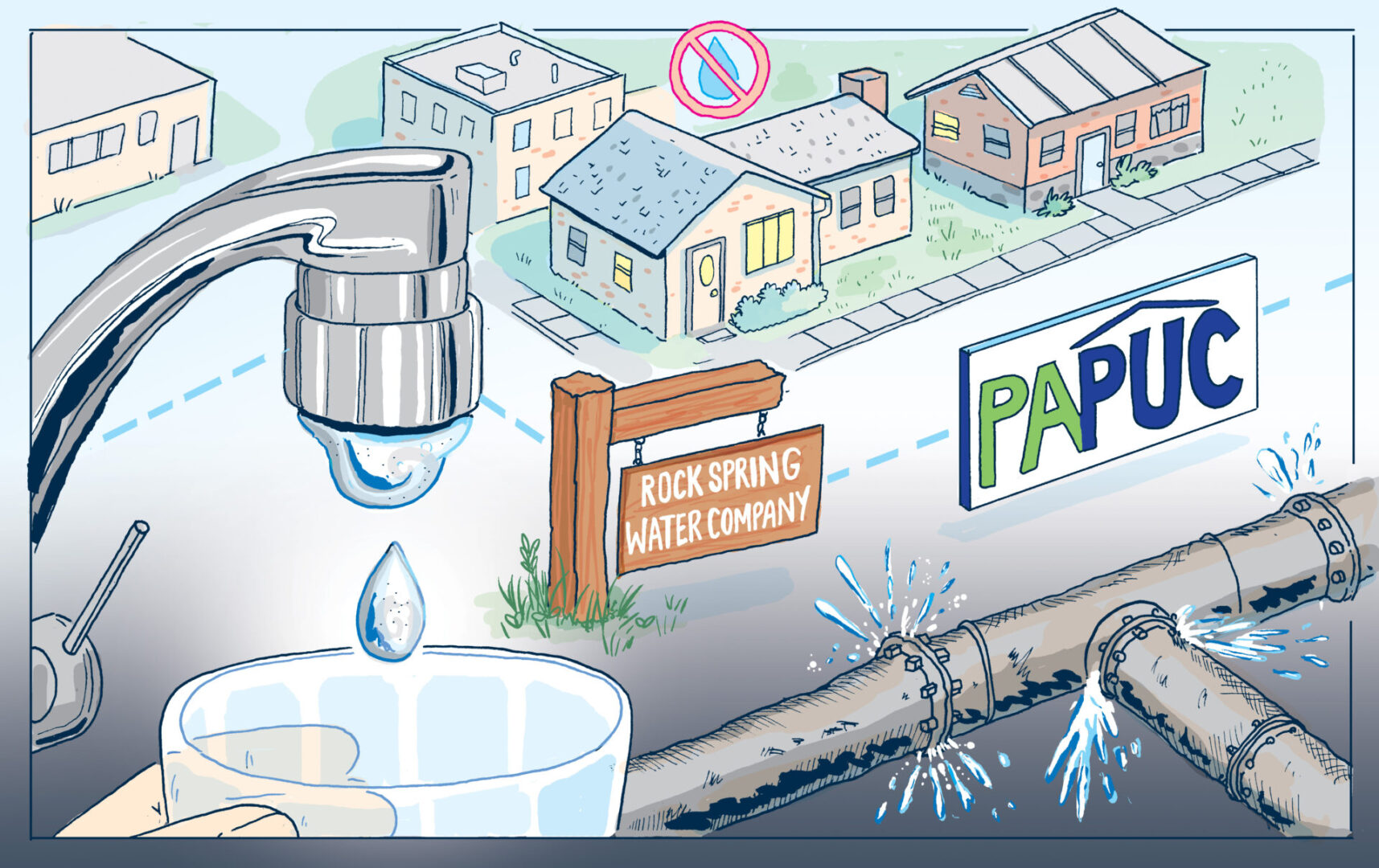
FERGUSON TOWNSHIP — Nearly two years after a Spotlight PA investigation found that customers served by Rock Spring Water Company were failed by the private utility, state regulators, and elected officials, a judge has recommended a forced sale.
Rock Spring “cannot reasonably be expected to furnish and maintain adequate, efficient, safe, and reasonable service and facilities in the future,” Administrative Law Judge John Coogan wrote in a 190-page recommendation issued Wednesday.
Coogan is advocating for Pennsylvania American Water — one of the state’s largest investor-owned utilities — to formally buy Rock Spring Water Company. Pennsylvania American was tapped by regulators last year to take over Rock Spring’s operations on an emergency basis to stabilize services for the company’s roughly 500 properties.
His proposed decision is the latest step in a seldom-used and lengthy regulatory process, known as a Section 529 investigation. The Pennsylvania Public Utility Commission’s Bureau of Investigation and Enforcement launched the review in September 2024 to determine whether a forced acquisition of Rock Spring Water Company was warranted.
The recommendation is not entirely unexpected and still needs approval from the commission.
However, it’s a blow for the State College Borough Water Authority — which operates just eight miles from the center of Rock Spring’s system and has tried numerous times to buy the private utility — and for customers who likely will face higher bills.
Several told Spotlight PA in 2024 they were conflicted over whether it was worth paying more for reliable water.
The company’s rates haven’t increased since 2013, and estimates to update the system range from $13.5 million to $16 million. Public input and testimony shared throughout the process show a divide among customers, who wonder what new ownership could mean for their bills.
In his recommendation, Coogan acknowledged those fears but cited testimony that an acquisition wouldn’t unreasonably impact rates. For Pennsylvania American, the PUC approves rates. So the cost of updating Rock Spring’s systems would likely be spread out across the company’s entire 2.4 million customer base.
The recommendation also reaffirms the PUC’s stance that it can only order a sale to a provider under its jurisdiction, which largely includes investor-owned companies, not municipal entities like the State College water authority.
State law leaves “no ambiguity” on that issue, Coogan wrote.
Representatives for Pennsylvania American and the State College authority told Spotlight PA they’d provide comments on the matter after having time to review the judge’s recommendation.
Rock Spring and its lawyer did not respond to a request for comment at the time of publication.
Rock Spring has racked up dozens of regulatory violations — including for failing to protect the system’s water source, shutting off service without proper notice, and letting a leak go unfixed for six months — and tens of thousands of dollars in unpaid civil penalties as part of a yearslong legal battle with the Department of Environmental Protection over excessive water loss.
For over a decade, Rock Spring’s management resisted state directives to fix the system and find a new owner, while years of neglect led to crumbling infrastructure, low water pressure, regular outages, and sometimes lengthy boil water advisories. The Public Utility Commission even erroneously told a customer in 2018 that it didn’t regulate Rock Spring, according to Spotlight PA’s investigation published in June 2024.
Issues with the company were referred to the PUC’s investigative division in May 2024 and a formal review launched in September that year.
In March 2025, Pennsylvania American became the interim operator of Rock Spring, after the Pennsylvania Office of Consumer Advocate requested an emergency takeover of the company to prevent “irreparable” injury.
“Without water service, the public health and safety of Rock Spring customers will be compromised,” Melanie Joy El Atieh, deputy consumer advocate, wrote in the filing.
Meanwhile, state officials urged Rock Spring’s owner J. Roy Campbell to negotiate a sale to State College while under temporary management. Those talks were unsuccessful, with the company’s lawyer rejecting a $65,000 purchase offer last summer.
Lawyers for Rock Spring, its emergency receiver, and state regulators proposed a range of ideas for the system’s future last year: Give Rock Spring more time to raise rates and reorganize; allow Pennsylvania American to file for bankruptcy to enable a municipal sale; or let the State College authority buy the system.
Coogan shot down those proposals, citing Rock Spring’s repeated failure to comply with state directives and regulations. He said the bankruptcy idea wasn’t “thoroughly vetted,” as it was only first suggested in final legal briefs, and could cause delays. And although the State College authority appears to be the most logical choice, a public sale could only happen voluntarily.
“Unfortunately, however ideal a candidate SCBWA may be to operate RSWC, it does not change the fact that negotiations between SCBWA and RSWC are not advancing,” he wrote.
Coogan declined to set a “range of reasonableness” for the purchase price of Rock Spring, saying Pennsylvania American and the company must negotiate. If the PUC adopts his proposed order, the parties would have three months to reach an agreement. By the end of that period, Pennsylvania American could ask for more time or for regulators to approve the sale.
If Pennsylvania American and Rock Spring can’t reach an agreement, the investor-owned utility could seek control through eminent domain. Pennsylvania American would also submit a plan for improvements to the PUC, and all parties in the case would have time to submit comments before approval.
Additionally, Coogan’s recommended order says “all reasonable and necessary” costs related to Pennsylvania American’s receivership shall be paid for by sale proceeds. If an acquisition doesn’t cover expenses, the investor-owned utility may make a claim in a future base rate case.
Participants in the case have until March 10 to file any disagreements with the recommendation.
This story may be updated.
SUPPORT THIS JOURNALISM and help us reinvigorate local news in north-central Pennsylvania at spotlightpa.org/donate. Spotlight PA is funded by foundations and readers like you who are committed to accountability and public-service journalism that gets results.