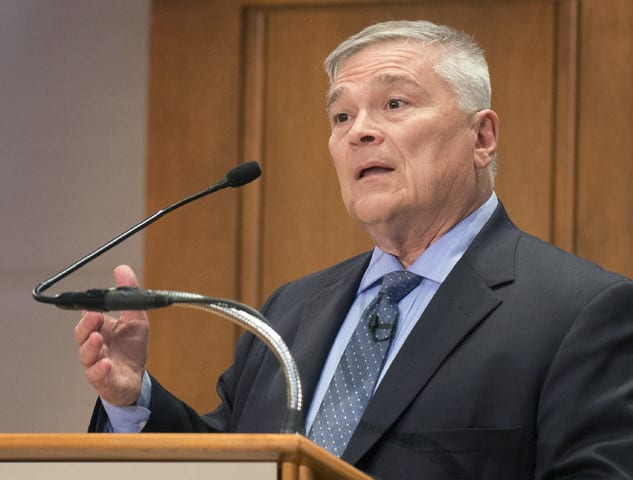
A judge ruled on Monday that Penn State President Eric Barron can be subpoenaed for deposition in the estate of Joe Paterno’s lawsuit against the NCAA.
Potter County Judge John Leete, who is specially presiding in the case, denied a motion by Barron and the university to quash his third-party deposition. In their motion to quash filed on March 30, attorneys for Penn State and Barron argued ‘President Barron has no unique, first-hand knowledge that is likely to be relevant to any of the plaintiffs’ remaining claims, and plaintiffs have no bona fide reason for subjecting President Barron to a deposition.
The Penn State attorneys also argued that preparing for and attending a deposition ‘would cause unreasonable annoyance, embarrassment, oppression, burden and expense, especially in view of President Barron’s substantial professional commitments between now and April 29, 2016 (the discovery cut-off in this case).’
The subpoena issued to Barron ordered him to testify in a deposition Wednesday morning at the Penn Stater Conference Center Hotel, though it is unclear if that proceeded as scheduled.
The Paterno estate along with former Penn State football assistant coaches Jay Paterno and Bill Kenney are suing the NCAA, its president Mark Emmert and Oregon State President Ed Ray, the NCAA’s executive committee chair in 2012 when the NCAA issued sanctions against Penn State in the wake of Louis Freeh’s investigation and report on the Jerry Sandusky child sex abuse case.
The lawsuit, filed in 2013, claims commercial disparagement and defamation, citing the use of the Freeh report in the NCAA’s consent decree for sanctions with Penn State, most of which was later repealed or ended early. The plaintiffs say the report and sanctions resulted in damage to commercial interests and values and harmed the former assistant coaches’ ability to find similar work.
Last month Leete granted the Paterno estate’s motion to compel third party discovery from NCAA infractions committee members, though he denied depositions. At the same time he ordered the Paternos to turn over background documents from their commissioned critique of the Freeh report.