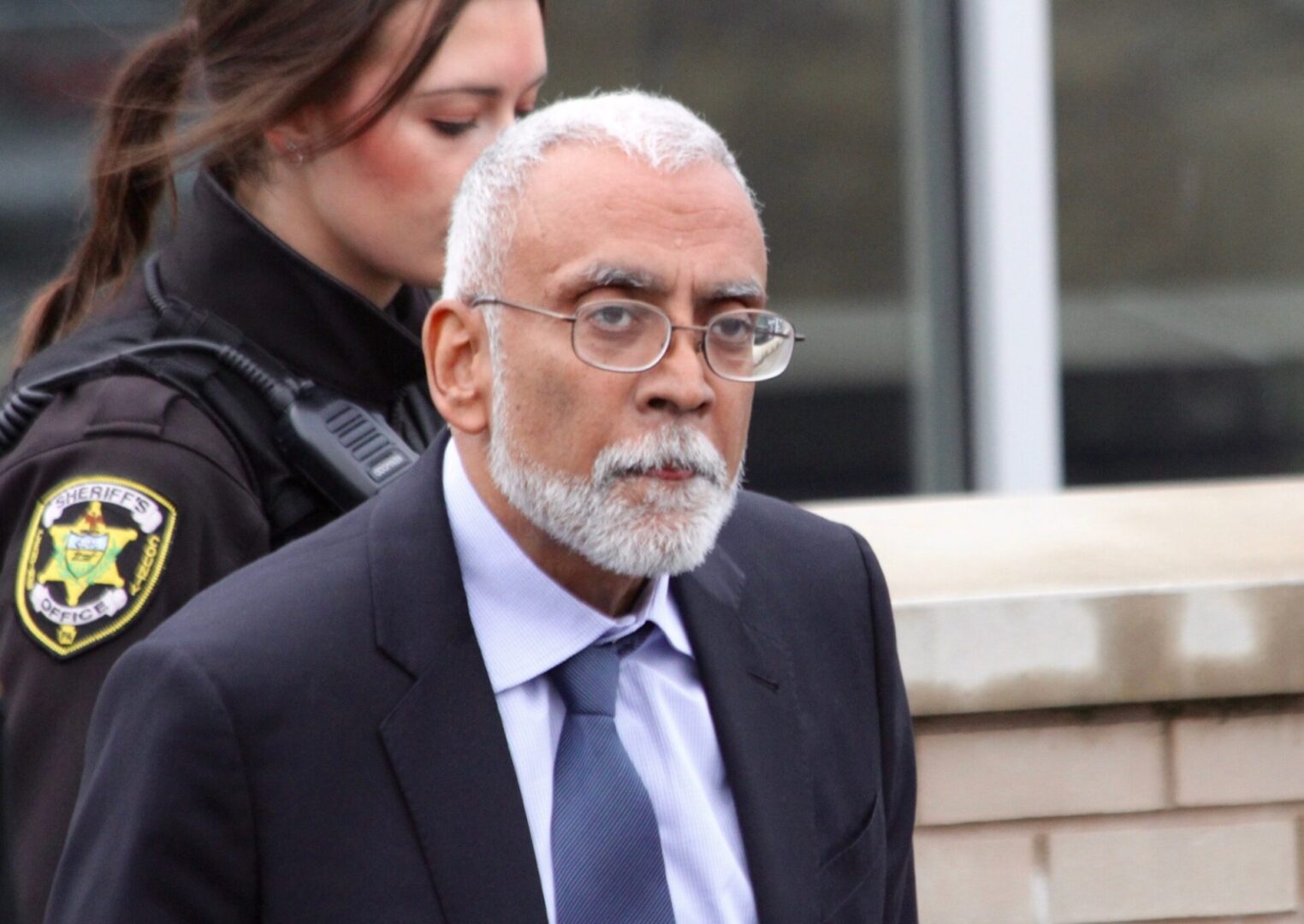
A federal judge could decide next week whether to waive the deportation order for a State College man who spent more than 40 years in prison before his murder conviction was overturned, only to be detained by immigration authorities.
Federal Immigration Judge Adam Panopoulos has scheduled Subramanyam “Subu” Vedam‘s hearing for April 1. The hearing in Elizabeth, New Jersey, Immigration Court will be conducted remotely and Vedam, who is detained at the Moshannon Valley ICE Processing Center in Clearfield County, will testify in court for the first time since his murder trials in the 1980s, according to a spokesperson for his family.
The government and Vedam’s attorneys will be able to call and cross-examine witnesses during the hearing, which is expected to last several hours.
Vedam’s immigration attorneys said that judges often rule from the bench at the conclusion of such proceedings. If Panopoulos rules in his favor, the 64-year-old Vedam would have his status as a permanent legal resident restored and could be released from Moshannon as early as April 2.
After being convicted in 1983 for the murder of Thomas Kinser near State College, Vedam resolved a separate, earlier case by entering a no contest plea to four counts of selling LSD when he was 19 years old. The drug conviction resulted in a 1999 deportation order and is the basis for Immigration and Customs Enforcement’s efforts to remove him from the country since his release from Huntingdon state prison in October, after a Centre County judge vacated the murder conviction.
ICE is seeking to deport Vedam to India, where he was born during a brief period when his parents returned to their native country. He has lived in the United States since he was nine months old and has no immediate family India or resources to assimilate there, the family spokesperson previously said.
He is a green card holder who was on the cusp of earning his citizenship when he was arrested, his family has said.
After he was taken into federal custody on Oct. 3, Vedam was transported from the Moshannon Valley facility to Texas then Louisiana in preparation for his removal. He was then returned to Clearfield County after a federal district court granted an emergency stay.
The U.S. Justice Department’s Board of Immigration Appeals in February put a moratorium on ICE’s efforts to deport Vedam while his case proceeded through immigration court.
“Given the facts and circumstances in this particular case, we conclude that the record before us presents an exceptional situation,” Temporary Appellate Immigration Judge Paul A. McCloskey wrote in the opinion explaining the decision.
Later in February, New Jersey-based Immigration Judge Tamar Wilson denied Vedam’s request to be released on bond, ruling that she did not have jurisdiction to do so because of his conviction on drug charges, felonies that she said make him subject to mandatory detention.
Ava Benach, Vedam’s immigration attorney, argued that had Vedam been incarcerated solely on the drug charges, and not the murder conviction for which he was exonerated in 2025, he would have been released by 1992 and would not have been subject to mandatory detention under rules that were in place at the time.
Benach also said Vedam would be no danger if released on bond, pointing to Vedam’s exemplary record during his 43 years of incarceration. He earned three degrees, becoming the first inmate in Huntingdon state prison’s 150-year history to achieve a master’s while incarcerated, created and led a prison literacy training program, led fundraising efforts for Big Brothers Big Sisters and tutored other inmates to help them earn diplomas.
A Justice Department attorney contended that because he has been in prison for four decades, he has had no opportunity to show he would not be a danger. Wilson agreed that even if she did have jurisdiction to release Vedam on bond, he cannot establish that he does not pose a danger to the community.
Now Panopoulos will decide whether to exercise his discretion to waive Vedam’s deportation order entirely.
Vedam has been behind bars since he was arrested in 1982 for Kinser’s murder.
Kinser had last been seen by family on Dec. 14, 1980, when he borrowed a van to drive his friend and fellow 19-year-old State College area resident Vedam to Lewistown to buy LSD. Vedam said Kinser dropped him off in State College when they returned and he did not know what happened to him after that.
After hikers discovered Kinser’s body on Sept. 19, 1981 in a sinkhole at Bear Meadows in Harris Township, prosecutors said Vedam used a .25 caliber handgun to shoot his friend in the head. Vedam’s conviction was based in part on his purchase of a .25 caliber gun, which he said he did not acquire until after Kinser’s death, and a shell casing of the same caliber found under Kinser’s remains. A murder weapon was never found, and casings of different calibers were also discovered in the area.
After he was convicted in 1983, Vedam was granted a retrial in 1988 and was convicted again.
In recent years, however, Vedam’s post-conviction attorneys uncovered evidence not presented at either trial, including documents they say showed that bullet hole in Kinser’s skull was too small to have been made by a .25.
In August, a Centre County judge ruled that the evidence could have swayed the jury to find Vedam not guilty at trial and overturned the conviction. Two months later, Centre County District Attorney Bernie Cantorna announced that he would drop the charges against Vedam because, with key evidence and witnesses no longer available, it would be nearly impossible to prosecute the decades-old case.
Vedam’s quest for exoneration and subsequent fight against the deportation order have received national attention, including a recent episode of the Sundance TV and AMC+ documentary television series “True Crime Story: It Couldn’t Happen Here,” hosted by Hilarie Burton-Morgan.
A special screening of the episode, followed by a panel discussion, will be held from 5 to 8 p.m. Thursday in the Katz Building auditorium at Penn State’s University Park campus. Light refreshments will be offered at 5 p.m. and the screening will begin at 6 p.m.
The panel discussion will follow. It will include Penn State Dickinson Law Professor Gopal Balachandran, who was the lead attorney in the effort to overturn Vedam’s murder conviction and whose Criminal Appellate & Post-Conviction Services Clinic played a role in the victory. It will also feature Josh Cunningham a 2025 Dickinson Law graduate, former clinic student and current public defender who worked on the case, and Thomas Place, a post-conviction law expert and Penn State Dickinson Law professor emeritus.