
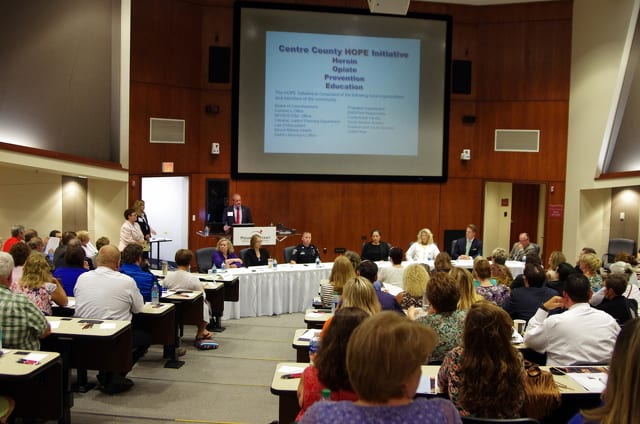
As the heroin and opioid epidemic continues to sweep across America, the Centre County HOPE (Heroin/Opiate Prevention and Education) Initiative took its first steps in battle with a problem that has cost 43 Centre County residents their lives in the past 30 months.
A town hall meeting was held Tuesday in the Galen and Nancy Dreibelbis auditorium at Mount Nittany Medical Center. Moderated by Stephanie Bradley, Ph.D., managing director of evidence-based prevention and intervention support center at Penn State, the panel consisted of a who’s who of state and local specialists, each with a different perspective to offer. The meeting was the first in a series of three and covered topics design to educate about the heroin and opioid problem in the county.
The evening opened with remarks from Centre County Commissioner Steve Dershem, who was a driving force in collaborating efforts between what has now become 13 local organizations, to form HOPE; Centre County Court of Common Pleas Judge Pamela Ruest, who discussed the ongoing work to bring a drug court to Centre County, with a goal of reducing recidivism in the criminal justice system; and a short video message from state Sen. Jake Corman, who was unable to attend the meeting as his son was playing in the state final of the Little League tournament in Bradford.
Stephanie Bradley, Ph.D., managing director, evidence-based prevention and intervention support center, Penn State University, moderated the panel discussion and, following brief introductions of the panelists, got into the heart of the discussion asking each what their agency or organization is seeing in regards to heroin and the effects of opioid addiction.
Officer Adam Salyards is the community relations/crime prevention specialists at the State College Police Department. Two weeks ago, he saved a county resident’s life by administering the opioid effect reversing drug Narcan, now carried by three local police departments in Centre County. He said the police department is, many times, the first to come into contact with people who have overdosed on heroin or prescription medication, and its a trend he said is on the rise.
“We’re seeing more and more overdoses and, as a result, more deaths,” said Salyards. “And, in addition to that, we’re seeing an increase in related crimes, such as thefts and serial burglaries. Addicts need money to fund their habit, and they’re committing crimes to get what they need. It’s getting worse.”
Salyards also said his department has seen an increase in distribution of heroin and other opioid-based drugs.
The drugs are getting stronger too. According to Jason Snyder, communications director for Pennsylvania Department of Drug and Alcohol Programs, his office has seen an increase in the drug fentanyl showing up as a “cutting” agent, used to mix with heroin to make the product go further, thus making the dealers more money. He said fentanyl is an opiate 100 times stronger than the powerful painkiller morphine.
“People really don’t know what they are getting when they buy a bag of heroin,” he said. “One dose can kill.”
Cathy Arbogast, assistant administrator for Centre County Drug and Alcohol Services said the number of outreach calls that come into her office has drastically increased over the past several years. She said many of the calls are relating to people with no insurance to pay for help, or the access to resources to get the help they need.
Several of the panelists noted that many people don’t want to come forth to seek help with their addiction because of the stigma society has put on drug addicts. All agreed this is a stigma that needs to be lifted, and these people should get the help they need, without fear of ridicule or shame.
“Stop thinking it looks a certain way, because it doesn’t,” said Katie Hugo, certified recovery specialist with Crossroads Counseling. “It’s just not 18-year-old and 19-year-old teenagers dying because of these drugs. Now, we’re seeing a lot of people in their 30s and 40s becoming addicted too.”
Dr. Kassandra Botti, director of Emergency Medical Services at Mount Nittany Medical Center explained that in the past year, she too has noticed an increase in heroin overdose patients in the emergency room aged 30 to 40.
“People have chronic pain issues, and when their physicians begin to wean them off their medications, they can’t handle it. They are already addicted,” she said. “When they can’t get their prescribed medications as easily anymore, they tend to seek other methods, and they can get the same high from heroin. And, at a cheaper price.”
Like the stigma of who does heroin, the panel also discussed several other myths about addictions, which led Bradley to coax discussions about ways to lift these misconceptions.
“I think peer-to-peer testimonial is the most powerful way for us to overcome these stigmas,” said Snyder. “There are a lot of people I talk to about addiction that have no idea what they are talking about, and we can’t fault them fully. They got their information from a bad source, and they are just passing on what they think they know.”
“People that have addiction problems are not bad people,” commented Benninghoff. “They are good people with a bad problem.”
Arbogast said disrupting the stigmas placed on addicts is an issue leaders will need to deal with for a long time to come; however, she said people in positions of assistance need to continue to show people there is hope, and through long-term recovery programs, beating the addiction is possible.
Hugo also noted treating opioid-addicted people with other diagnosis can be positive in the long-term recovery of patients, thus further reducing the society-placed stigmas.
“We need to diagnosis all the issues of the person, including their addictions, mental and physical health and other personal issues they are having before we decide on what kind of treatment they need,” Hugo said. “We need to focus on treating the whole person and not just the addict.”
The panel concluded their discussion with tips and recommendations county residents can do concerning this growing epidemic. Panelists discussed The Act 139 Good Samaritan Law, which legally protects residents who help an overdose victim receive medical treatment; the location of seven county drop boxes for proper disposal of unused or unwanted medications; the availability of Narcan without a prescription at local pharmacies for families and people susceptible to heroin or opioid overdose; and continued involvement in awareness and education about the heroin and opioid epidemic in Centre County.
The next HOPE sponsored town hall meeting is scheduled for mid-September and the topic will be treatment and recovery.
“We’re also seeing that more and more people are reporting heroin or opiates as their drug of choice,” said Arbogast.
More Community & Entertainment
View all Community & Entertainment
January Is a Call to Action to Respond to Stalking
This column by Centre Safe Executive Director Jennifer Pencek originally appeared in The Centre County Gazette. When we talk about acts of interpersonal violence, oftentimes people will focus on sexual […]

Busy Weekend of Fall Festivals and More on Tap Around Centre County
The weekend of Sept. 29-Oct. 1 is packed with activities around Centre County, including fall festivals, Oktoberfests, fairs, concerts and more. Check out some of the weekend highlights below. For […]
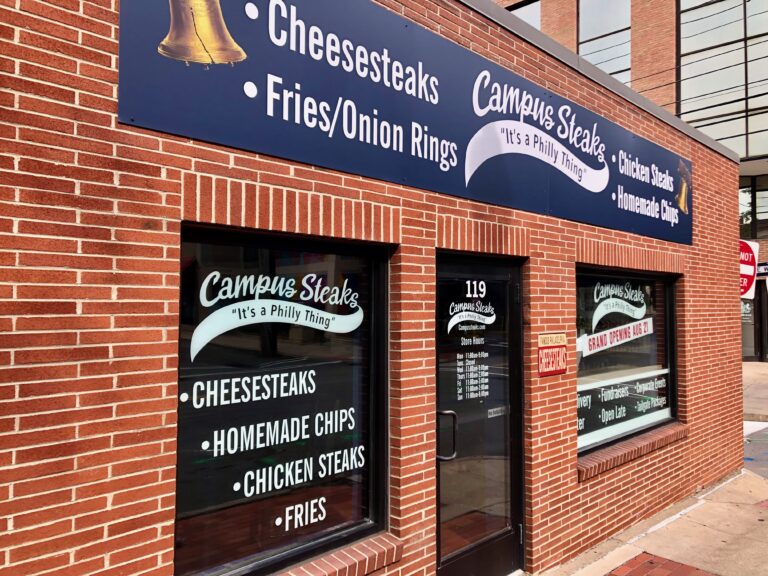
Downtown State College Cheesesteak Shop Sets Opening Date
A new cheesesteak shop that promises a taste of Philly in downtown State College has set an opening date. Campus Steaks plans to hold a grand opening on Aug. 28 […]


