
A crisis can strike a school in different ways, but whether they command national headlines or not, traumatic events leave administrators and staff with a duty to help their students and communities respond and recover.
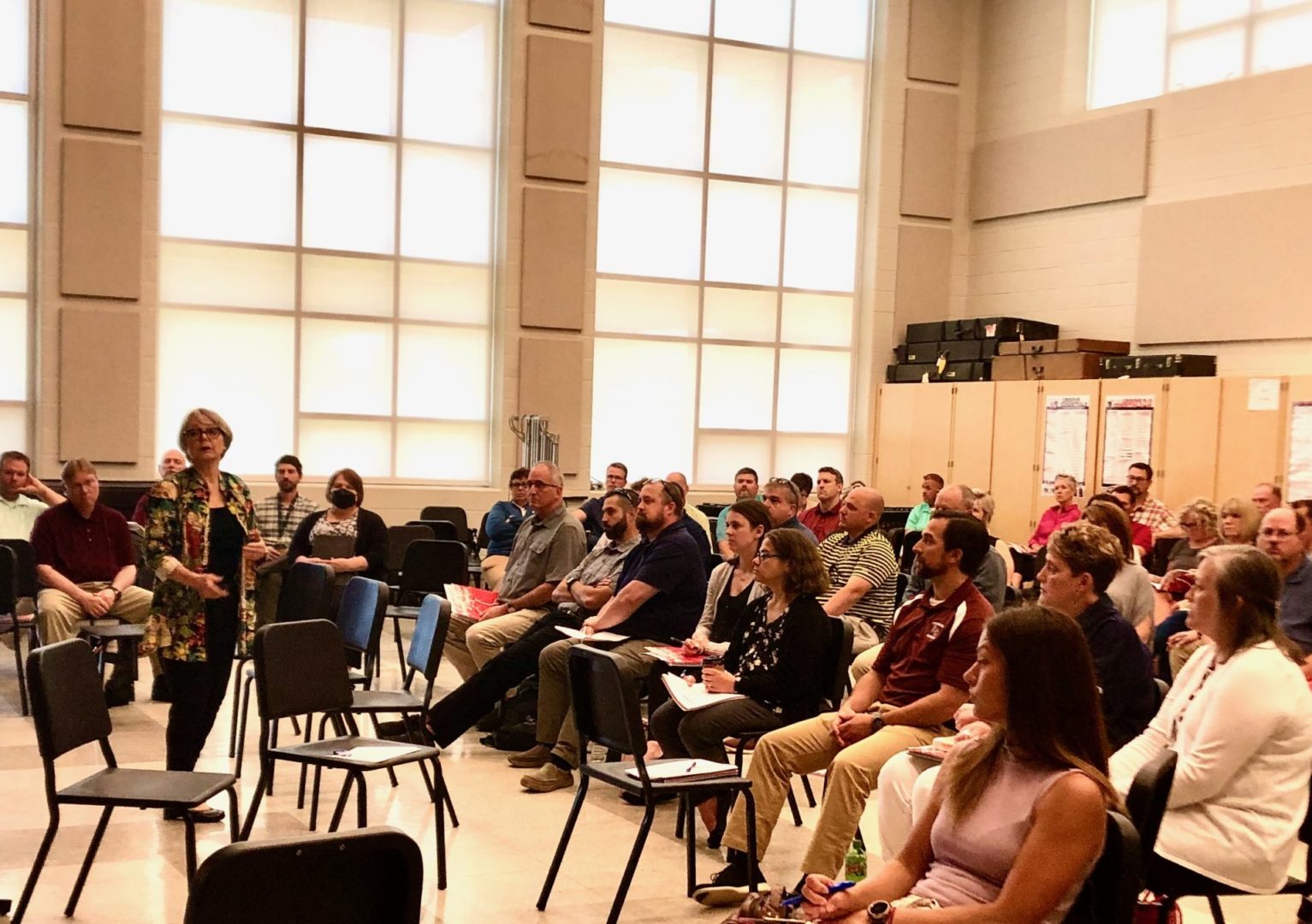
More than 100 counselors, social workers, administrators and staff members from school districts in Centre and surrounding counties gathered this week at State College Area High School to learn from a national expert about responding to those crises and managing the aftermaths.
Cheri Lovre, founder of the Oregon-based Crisis Management Institute, has worked for more than 40 years on school crisis response, trauma intervention and violence prevention. She has provided response for most high-profile school tragedies, such as shootings at Columbine, Red Lion and Nickel Mines, schools affected by 9/11 and Hurricane Katrina, and many more incidents. She will be working with staff in Uvalde, Texas this summer as the community there deals with the aftermath of the shooting at Robb Elementary School that claimed the lives of 19 students and two teachers in May.
But, Lovre said, a crisis does not need to be national news to demand a coordinated and thoughtful response.
“It can be anything from a child that dies of a terminal illness, a child that dies in a car accident, all the way up to something like what’s happening in the news, school shootings and those kinds of things,” Lovre said. “We cover mostly the more common events — death in a traffic accident, any time students would be grieving about something.
“We do some parts only for counselors, some parts only for administrators and many parts together, because collaboration is what makes it work. We cover the checklist of things to do, some of the points of grief, of suicide, of trauma, of how to set up a space where kids can come together and be able to share memories of a person that they know and love that has died. Those are the topics that we cover and we look at how we do it collaboratively in a school setting.”
The workshop was organized by Central Intermediate Unit 10 after district superintendents began discussing a desire for such training last fall. Personnel from Moshannon Valley, Curwensville, Keystone Central, Bellefonte, Philipsburg, State College, Clearfield and West Branch districts, as well as the Clearfield County Career and Technology Center and the Central Intermediate Unit, participated in the three-day training from Tuesday through Thursday.
Jacquelyn Martin, superintendent of Keystone Central, was a driving force behind the training. She had taken it 20 years ago as a new administrator in a different school district.
“Fortunately, I’ve had the training. Unfortunately, I’ve had to use the skills that I’ve learned in this training to deal with crises in various school districts,” Martin said. “It came to me over the past year that while the superintendent has the training and skills, it really would be more important for everyone on our team to be able to understand the same type of training and background.”
Lovre said it’s the first time in her career that she can recall school administrators being the driving force behind providing the training.
“That’s incredibly hopeful because the people at the top that make the decisions have prioritized doing a wonderful job,” she said. “Most of the time it’s the counselors that are the driving forces that bring me in and we hardly get an administrator to attend a training. I would send my kid to any one of these schools in a heartbeat. I’ve been very heartened by working with this group, more so than any training I can think of. I’m very impressed.”

Having multiple school districts in the region host the training was important, Martin said, because it provides a collective experience that can lead to collective support to lessen the impact and aftermath of a potential tragedy.
“What I found really helpful about the first day of our training was that people had a chance to really get to know each other and realize that no school has to be on an island by themselves or deal with this alone, that there is a lot of support out there,” Martin said.
“We also took some time to dive into various scenarios and how would we react when things happen, because each tragedy has its own unique circumstances, so there really isn’t a step-by-step manual on how to deal with each specific event. Having folks have some time to think through actions or plan for potential solutions was super helpful and it was great to have a collaboration between teachers, counselors, administrators, superintendents and school resource officers to collectively think about that, because it will take all of us to respond to any event.”
Those responses are each unique and vary based on the nature of the event, Lovre said.
“If a student has died because of a suicide or homicide, it’s a very different response than a student who has died of a terminal illness where, for instance, we knew about it ahead of time and we could do some of what we call anticipatory grief, preparing the kids and the staff,” she said. “It’s just as important for us to work with the staff as it is with the students because really kids will do as well as the adults around them. My goal is to help adults have the best handle possible on how to do this.”
She added that school shootings garner national attention, but that it’s important to provide balance because schools are, by and large, safe places for students to be.
“When we think about are kids safe in school, they really are,” Lovre said. “When we look at what are the chances that your child will die because of school violence, it’s actually extremely low, in comparison to we lose one in 1,600 kids to either gun violence or unintentional deaths to guns in their home or the home next door.”
That’s one of the key takeaways Lovre hopes attendees of the workshop will have.
While schools need to find appropriate ways to be prepared, a heavy emphasis on the threat of school shootings can have a damaging psychological effect, she said.
“We’ve gotten so involved in the safety part of doing school drills that I think we need to walk a very cautious line about what it does to kids psychologically to over and over and over again barrage them with the fact that there may be a shooting at school, when in fact they are hundreds of time more apt to die because of a gun incident that happens outside of school,” Lovre said. “What I’m seeing is children who bring guns to school because they’re afraid, and we’ve told them to be. So I am concerned about how we have brought in what I would call a heavy police presence and approach at the expense sometimes of the psychological well-being of children and I think that there are other ways that we could do this work that would be healthier for them.”
Caring for the social and emotional well-being of students is another key takeaway.
“Prevention is so important and if there’s anything we need to be doing it’s putting more focus on social-emotional learning, every single day, every single year, for every single kid,” Lovre said. “Every day every child needs to be recognized and experience someone listening to them, that they matter. So social-emotional learning would be one thing I would say is critically important.”
For Martin and other regional school administrators — who have seen their collaboration strengthened as they consulted on dealing with the COVID-19 pandemic — that combination of prevention and response is critical.
“Many administrators have a lot of experience in preventive action,” Martin said. “We’re very skilled and trained in those types of practices however many people don’t have the opportunity to figure out what are we going to do in response to a crisis after it happens. Prevention is key, but response is also super important in the process.”
More Local News
View all Local News
State High Student to Represent Pennsylvania at U.S. Senate Youth Program
A State College Area High School junior will travel to Washington, D.C. in March as one of two Pennsylvania delegates to the United States Senate Youth Program (USSYP). Claire Chi […]

Local Startup Lands State High, Penn State Grad on Forbes ’30 Under 30′ List
A State College native and Penn State graduate is receiving national attention after finding himself included among the country's most promising entrepreneurs.

State College Teen Explores Highs and Lows of Turbulent Times with Newly Published Poetry Collection
For one Centre Region teen, the COIVD-19 pandemic provided a chance to unleash pent-up creativity through a published poetry collection.


