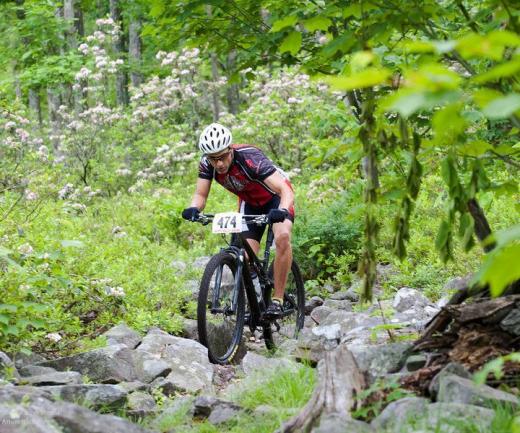
In 2011, Nittany Mountain Biking Association (NMBA), in partnership with the Pennsylvania Department of Conservation and Natural Resources (DNCR), began a 10-year initiative to upgrade the Rothrock Trail Forest trail system through improvements to 23 miles of trail and the addition of 30 miles of trail.
Since then, six miles of new trails and 3.5 miles of trail re-routes have been completed by NMBA members.
History of Rothrock and its Trails
Rothrock State Forest is named for Pennsylvania’s ‘Father of Forestry,’ Dr. Joseph Trimble Rothrock, a native of Mifflin County and the state’s first forestry commissioner. The forest is comprised of approximately 97,000 acres across Huntingdon, Centre and Mifflin counties.
Situated in the Ridge-and-Valley Region of the Appalachian Mountains, Rothrock is represented by rugged, rock-strewn ridges, full of Chestnut oaks and mountain laurel. Deep valleys and bottom lands include cool, clean streams, hemlocks and rhododendrons. The forest is well-known for its vistas, intriguing natural areas like Bear Meadows and Alan Seeger and its extensive network of recreational trails for hiking, mountain biking, camping, hunting and fishing, horseback riding and sightseeing.
“It provides a place for users to come, unwind and explore the natural splendor of Pennsylvania’s forests,” said Jacob Mazzei, recreational forester for the Rothrock State Forest.
Mazzei said the management of Rothrock, like all state forests, is guided by the tenets of the State Forest Resource Management Plan (SFRMP). State forests are expected to provide a variety of uses for the public, from the continuous supply of forest products to safeguarding water quality and quantity.
He said in regards to recreation, Rothrock’s mission is to provide area residents with dispersed, low density recreational opportunities.
“The trail system of the Rothrock is comprised of a mix of historical traces – old woods roads, mostly- as well as trails developed on old CCC era firebreaks and footpaths. Many district and user-generated trails have been added through the years,” Mazzei said.
Though many trails were designed and constructed for sustainability, Mazzei said other trails have begun to deteriorate, mainly due to the increase in visitors to Rothrock in the last few decades. These include trails designated as ‘shared-use’, indicating they are open for hiking, biking and equestrian use.
NMBA and its Role in Rothrock
In existence since 2001, NMBA became a more organized non-profit group two years ago. NMBA President Terri Rudy said the initiative to improve the trails located in Rothrock began immediately after the restructuring and organizing of the mountain biking club.
“Out of the groups and organizations that use the trails in Rothrock, our group is the main group to work on the trails. We really needed to address the erosion and sedimentation problems for a lot of our trails,” Rudy said.
Registered with the DCNR Conservation Volunteer Program, NMBA helps to maintain the trails in Rothrock throughout the year. Other organizations which take part in maintaining the trail system include Mid State Trail Association, Standing Stone Trail Association and Friends of Coopers Gap.
“Volunteers perform the bulk of our trail maintenance on the Rothrock,” Mazzei said. “NMBA has been a valued partner in achieving these goals, contributing literally thousands of volunteer hours each year not only on specific projects they develop that are approved through our office, but also just importantly to general clean-up and maintenance.”
Mazzei said he is astounded at the yearly work completed by NMBA members.
“The people who utilize our shared-use trail, especially in the Tussey Mountain to Shingletown area, have no idea how much work NMBA members engage in to keep those trails open for use by all.”
The Initiative
NMBA has developed an aggressive plan to build 30 new miles of trail and upgrade 23 miles of existing trail, all while maintaining the current trail system.
Rudy said the group’s first goal is re-route the trails in bad condition, replacing unsustainable trails with new sustainable ones. After completing this, the group will move on to other re-routes and more new trail creation.
Dave Pontzer, Rudy’s husband, board member of NMBA and trail liaison said the organization developed the trail plan as a guide and a goal to reach.
“By achieving this trail plan, we will be creating more trials to ride on,” he said.
Rudy said the goal of the initiative is simple, improve the trail system.
“There’s so many more people that access and use the tails in Rothrock. It’s really just to make them more sustainable, so that we have them for longer,” she said.
In order to complete the trail work, NMBA has applied for grants and held fundraisers to purchase the necessary tools. The group currently has hand tools like brush cutter and chain saws, which are stored in a shed in the parking lot of Tussey Mountain.
Part of the initiative proposed by NMBA also had the group recently apply for a grant to purchase a mini-excavator.
“With the mini-excavator, we can get a lot more done in a shorter amount of time. We won’t need as many volunteers doing the hard handwork that takes a long time to do,” Rudy said.
Goals
Pontzer said the trail system is a destination spot for mountain bikers, as parking lots near trails are often full every night of the week.
Rudy agreed.
“Right now, even Rothrock as it is right now is a destination mountain biking location. There are people who come from all over, even internationally, to ride the trails and to use the trails. It’s (the initiative) going to make it even that more appealing for people who are coming,” she said.
Rudy said the forest is somewhat segregated into a Tussey section, Coopers Gap section and Whipple Dam. Much of the work being done currently is to connect these different sections together.
Because of this, one goal is for hikers, bikers and horseback riders to be able to navigate through the trail system without having to drop out onto a road to make connections to the various trails throughout Rothrock.
Mazzei said these improvements will ultimately help to connect the community, the various organizations that use the Rothrock trail system with nature.
“Anything done to connect local communities with their surrounding natural resources is a positive for a variety of reasons, from health and fitness to increasing people’s sense of place about where they live or come to play to providing opportunities to learn about local ecosystems and the role forests play in their quality of life.”
For more information about Rothrock State Forest, visit www.dcnr.state.pa.us/forestry/stateforests/rothrock/index.htm by clicking here.
To learn more about NMBA, visit www.nittanymba.org or the group’s Facebook page.