
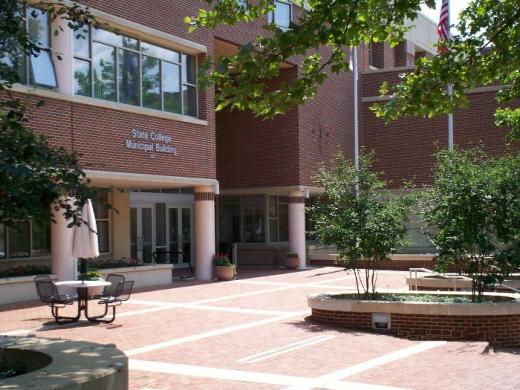
I have been asked, as a folklorist who has devoted the past 15 years to studying the life ways of the Woo people, what I think of State College’s proposed noise ordinance.
I think it would be catastrophic.
The Woo people, after all, take their name from the noise they make. Deprive them of the right to raise a ruckus and we imperil their survival as a distinct people.
Like so many seemingly irrational behaviors that turn out, upon closer observation in the field, to serve a crucial culture-maintaining function, noise-making plays a vital role in the social life of the Woo.
The Woo are in a late-adolescent life stage when interpersonal communication is extremely difficult and painfully awkward. The males, in particular, have only recently emerged from the grunting phase of their development when they arrive in Wooland. Playing loud music, especially while imbibing eloquence-impairing fermented beverages, neatly solves this problem by making all conversation, apart from the occasional ‘woo’ cry, impossible.
The difficulty of interpersonal communication among the Woo has been exacerbated in recent times by the introduction of non-oral communication devices. Indeed, Woo couples frequently can be observed tapping furiously on these devices instead of talking to each other or even gazing soulfully into each other’s eyes while sharing a meal at a public dining establishment.
Between the loud music that fills their nights and the incessant ‘texting’ that dominates their days, oral communication skills might well be atrophying among the Woo. If so, proponents argue, noise restrictions could lead to a revival of such skills.
But the elders who instruct the Woo in the great halls of learning fear the situation is beyond remedy: They report indications that the ability to speak and listen has already gone by the wayside. If they are correct, the loud gatherings might be the only thing keeping the Woo people from total social disintegration.
The other reason not to enact a noise ordinance is that it could suppress Woo generosity. So transported are the Woo by the dulcet screams and gentle pounding of their favorite singers and instrumentalists that they wish to share their music with all who are fortunate enough to live within earshot. As is often the case in societies where gift exchanges are an important component of social life, refusing what is offered is simply out of the question.
Those who prefer moral suasion to legislative remedies ask whether the Woo might be prevailed upon to voluntarily restrict their music-sharing to the hours before midnight in deference to their non-Woo neighbors, most of whom are diurnal rather than nocturnal.
The problem there is that while the Woo gladly share their music with fellow tribesmen, they evince a selective blindness, often found in insular societies, toward outsiders. Consider, for example how Javanese villagers responded to the arrival of anthropologist Clifford Geertz to study their culture:
‘We were intruders, professional ones,’ Geertz wrote, ‘and the villagers dealt with us as Balinese seem always to deal with people not part of their lives who yet press themselves upon them: as though we were not there. For them…we were nonpersons, specters, invisible men.
‘…People seemed to look right through us with a gaze focused several yards behind us on some more actual stone or tree. Almost nobody greeted us…they acted as if we simply did not exist.’
A walk through the Highlands suggests that things are much the same with the Woo people. When informed of non-Woo complaints about their nocturnal activities, they often declare that non-Woo persons should not be living in Wooland, thereby ignoring the incontrovertible fact that many of the dwellings in their midst have been continuously occupied by non-Woo families for almost a century.
These, then, are delicate matters. My recommendation: Rather than rush into a vote on a noise ordinance, the Borough Council should engage a team of ethnographic fieldworkers to conduct a cultural impact study. Such studies are modeled on the more familiar environmental impact report. The thinking is that just as any significant change in land use could profoundly affect the physical and spiritual resources of air, water, flora, fauna, land forms and scenic values, it could also profoundly affect the humans who live in the region.
The Woo people have developed a way of life that centers on communal habitation wherein social solidarity is maintained through the ritual inducement of trance-like states via prolonged exposure to loud music and prolonged consumption of fermented beverages. Disruption of these rituals could disrupt the culture.
The result: the further diminution of human diversity, for which we all would be the poorer.
Before local government legislates this unique people out of existence, there needs to be dispassionate scientific investigation of the impact of noise restrictions on this fragile population.
Specifically, we need answers to such questions as: How much woo would a Woo person pitch if a Woo person couldn’t pitch woo?
More Columns
View all Columns
Penn State Lost to Wisconsin: How Bad Was it?
How bad was it? Ahead 17-0 just 18 minutes into the game and lost bad. Ahead 20-10 until Wisconsin scored with just 211 seconds left in the game and lost […]
Penn State Football: Tonight, the Haters Were Right
On Dec. 11, 2023, Twitter user @drewjanda put out a since-deleted post that now lives in sports meme infamy. It read as follows: “The haters said I couldn’t do it. […]
Penn State Football After Dark: Homecoming Contest Begins a String of ‘Night Shift’ Games
Under coach Matt Campbell, Penn State football practice is held early in the morning, with coaches and players arriving at Lasch Building before the sun comes up. For the next […]


