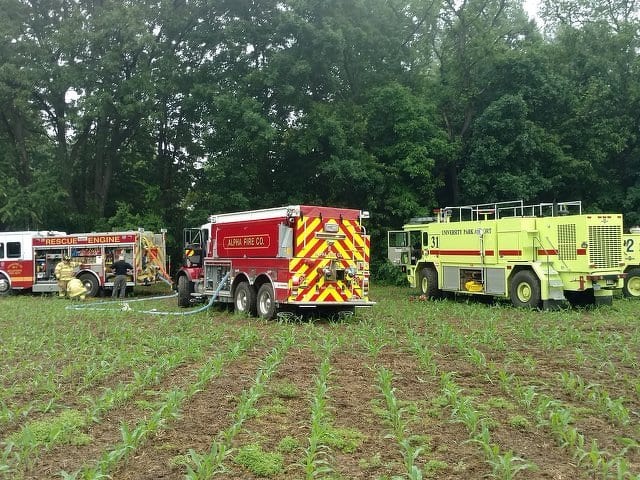
The twin-engine Piper Navajo was making its final approach to runway 24 at University Park Airport at 8:25 a.m. on June 16 when pilot Gary Orner contacted the airport tower.
‘With you on approach,’ Orner said and the tower gave clearance to land the plane.
That was the last communication between the tower and the plane.
At 8:43 a.m. ground crews near the end of runway 24 contacted the tower to report smoke in the woodline about one mile northeast of the airport. That turned out to be where the plane had crashed in a heavily wooded area owned by Penn State in Benner Township. Theplane was destroyed on collision, killing Orner, of White Oak, Pa., and his passenger, Dr. Robert Arffa of Pittsburgh, an eye surgeon who frequently traveled from the Pittsburgh area to State College to perform LASIK surgery for Nittany Eye Associates.
The plane’s final moments are described in the preliminary report issued Friday by the National Transportation Safety Board. The report constitutes an initial assemblage of facts and describes a flight, originating from Washington County Airport at 8 a.m., that didn’t seem to encounter any problems before it was found crashed in the woods.
Brian Rayner, senior air safety investigator for the NTSB in Ashburn, Va., is leading the investigation and arrived at University Park Airport on the afternoon of June 16, several hours after the crash. The investigation and final report could take a year or more to complete, he said.
Rayner said last week that the investigation — with assistance from the Federal Aviation Administration, aircraft engine and frame manufacturers and others — would examine the pilot’s background, the condition of the plane and the environment at the time of the crash.
The wreckage path of the plane was about 450 feet long and investigators accounted for all major components.
‘The initial impact points were in treetops about 70 feet above the ground, and tree trunks and branches displayed impact fractures and sharp, angular cuts along the length of the wreckage path,’ the report stated. ‘Both wings were fragmented along the path. Both engines and each main landing gear were separated and scattered prior to the main wreckage.’
The fuselage came to rest upright, and the post-crash fire destroyed the instrument panel, cockpit, and cabin area. The engines were damaged by the impact and fire and displayed extensive thermal damage.
The preliminary report said Orner was certified to fly single-engine and multi-engine aircrafts and had 12,400 hours of flight experience, 350 of which had come in the past six months. His most recent FAA first-class medical certificate was issued March 7, according to the report.
The plane, owned by Aero National Inc. of Washington, Pa., was manufactured in 1980 and had its most recent annual inspection on Feb. 19, with about 16,000 aircraft hours recorded.
Around the time of the crash, the recorded weather had an overcast ceiling at 300 feet, calm wind, and visibility of one mile in mist, with a temperature of about 62 degrees.
Following his preliminary report, Rayner will compile a factual report, which if approved, would be released publicly along with what is called a public docket. The five-member safety board will review the reports and evidence and determine a probable cause along with analysis and explanation of how the crash happened.