
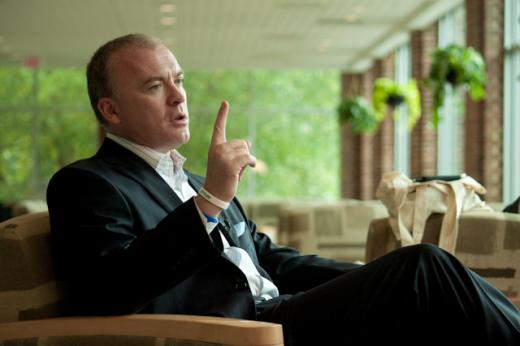
It’s been just about seven weeks since Patrick Chambers was named the 12th head coach in Penn State basketball history. A Pennsylvania native, Chambers spent the previous two seasons as coach at Boston University, where his teams went 42-28 and advanced to the NCAA Tournament last season.
Chambers, 40, cut his teeth on collegiate basketball working under Jay Wright at Villanova. Now, he has his own program in the Keystone State. He sat down with Mike Poorman on Tuesday in the HUB on campus to talk about the past of Patrick Chambers and the future of Penn State basketball.
The interview runs in two parts, beginning today and concluding on Friday.
It’s been 45 days (since you were hired). How has it been?
It’s been great. I’m having a lot of fun. We have a full staff. I’ve been all over the country and I enjoy traveling. I think we are getting some things done. We are slowly changing the environment.
Our team is here and they are working extremely hard on and off the floor. And with recruiting, we’ve been out checking out prospects. I really can’t talk about them.
It’s going well so far. I’m excited about where we are headed. But one thing I need to be is patient. As a new head coach, you want to make your statement, you want to change things now. But that’s not reality. We have to be patient, we have to pick the right guys for us.
And we have to be patient with the current team. I really can’t work with them right now. We have to wait until Aug. 22-23 when we start doing four-on-four. Then I get my hands around them a little bit and see what we have.
As a fast-paced guy that I am, I just have to exhale a little bit and take deep breaths.
Have seen the (current) guys? Have you seen them on tape?
I’ve seen them on tape. So far I’ve watched maybe 10 tapes to get a feel for what we have coming back. Now Talor (Battle) and Jeff (Brooks) and DJ (David Jackson) and Andrew (Jones) are a big part of it, so I want to start going back a little further to see the other guys.
It takes a lot more investigation to find those guys as they run the floor. I have our video coordinator, Adam Fisher, working on a highlight reel of Jermaine (Marshall) and Jon Graham and Billy Oliver. Sasa (Borovnjak) was hurt. And Adam’s working on all the incoming freshmen.
I’ve seen a lot of YouTube stuff on most of the guys, but it’s always good to get a real look at what they do in a real game, not YouTube stuff.
Do you think you are going to get the good graces of a rebuilding year or expectations are going to be strong out of the chute?
That’s a good question. I think everybody is interested in seeing how we are going to play. I think they’re interested to see who wants to play hard, who wants to compete. They want to see that. They want to see an energized team, an energized program. And then we’ll see what happens.
I wouldn’t say they’re going to give me a pass this year. I don’t think it should be that anyway. We have some talent.
Can you put some numbers on it? Is .500 a good number to shoot at?
Our whole thing is just focus on getting better everyday, create the best habits we can every single day. And we need to be the best team we can be by the end of the year.
That’s our goal. I don’t put a number on it, that we need to win 20, we need this, we need to win a tournament., we need to win the ESPN or Old Spice (tournaments). We need to be the best team we can be every single day and then be the best team at the end of the year.
My last two years (at Boston University) we were the best team we could be at the end of the year. We were 17-3…actually, we were 17-4; we lost to Vermont twice in one month.
It’s pretty good stuff if we stick to it. If you put that (a number) on a team, I think you are putting more pressure on them. I want them to play with a clear mind, I want them to play with confidence. I want them to go out and say, “We’re going to play for 40 minutes of Penn State basketball.”
That’s what I want them focused on. We’re not focused on wining, losing, how many points you’re scoring. Forty minutes of playing as hard as you can.
As you have made the rounds – you spent three hours with Graham Spanier, Tim Curley hired you, you’ve met the current players, and I am sure you’ve met the boosters – they all have different expectations. What’s an overview of those expectations, from Spanier on down?
I think everybody wants to win. There’s no question about that. I wouldn’t take the job if I didn’t want to go out and win. We have to be competitive. Why else would I take the job?
They want to see the program be more consistent. Actually, I would use “persistent intensity.” Consistent can be a 5, a 6 out of 10. We need to be more persistently intense in everything we do – whether it’s in the weight room, on the court, in the classroom, in study hall. Everything we do has to be intensified a little bit.
That’s what we need to do. That’s what this year is all about. We want to win. We have to expect to win. But as long as we can compete every day and play hard, good things will happen.
How much of that is your philosophy and what you bring to the table, and how much is what you have learned regarding the atmosphere around Penn State basketball?
Basically, it’s my philosophy that I’ve taken from Dan Dougherty, Herb McGee, Jay Wright. I think that’s the way we have to handle this program.
I don’t treat this like a basketball program, I treat it like a business. I am the CEO of Penn State basketball. That is the way this is run.
You guys are making a profit.
Yeah, we’re doing OK right now. The basketball is gravy, it’s the icing. That’s the fun part. But no one understands what we do for 365. We work seven days a week. We don’t now whether it’s Monday, Friday, Sunday or Tuesday. It doesn’t matter to us because we love it.
My philosophy is always to get better, always create the best habits we can. If we do that, the ball is going to bounce our way. The beginning of last year, we lost six or seven games in the last two possessions.
I don’t know whether you looked at the tapes of the Maryland game or they’ve been burned, but that early game was not pretty.
It happens. But sometimes when you lose those games early, you’re going to get those games back later. And they’ll also great for teaching. But I don’t want to lose. I hate it more than I like winning.
It’s a possession game. There are 75 (possessions a game), depending on how you play, and depending on who you are playing too. It’s all about who makes the least mistakes. It’s a mistake-filled game.
Penn State had a good year last year.
I thought Ed (DeChellis) did an amazing job last year. Amazing job. He was only playing six guys. Everybody was saying that’s slow-down basketball, what’s he doing? That’s how they had to play.
They had injuries, they had guys who weren’t ready. I thought he did an incredible job. I’m watching these games and I’m going, “I probably would have played the same way” — shots down at the end and Talor go, and hopefully Jeff Brooks is having a good game. That’s what it looked like.
He doesn’t get nearly enough credit for what he did last year. He did a phenomenal job with such a short bench.
Have you touched base with Ed?
Absolutely. I talked with him when I got the job on a Sunday night. We talked about the staff. I just saw him the road and said hello. I sat with Kurt Kanaskie. I sat with Danny Earl. They’re all good friends.
Did you talk with Danny or Kurt about staying?
We talked about it, no question. I think everybody was ready for a change.
Don’t get me wrong. Ed was at Navy for three weeks (before Chambers was hired), so these guys had to make quick decisions. I wasn’t in a rush to make decisions because I wanted to be loyal to my guys at Boston U.
You brought in people you know from different aspects of your career. How has putting together that team been and how important is it for you to have your own guys?
Extremely important because the office – I call it the locker room – is the mot important thing. And we need to have trust, we need chemistry. If someone comes into me and I give them the answer they don’t want to hear, they’re probably going to go to one of the assistants. Every guy along the line in the office is going to need to say the same thing. And I truly believe in that.
You might need this, you might need that, you need a guy who’s a recruiter, a guy who’s an X and O guy. I need guys I can trust, guys who can be loyal and guys who are going to work hard. If you have all of those things, you have a great staff.
I think we have fun. We work hard – there’s no doubt about it. We are burning the candle at both ends. And having fun doing it. When you have an atmosphere like that, that trickles down to the players. When they see you so into it and enjoying it, they’re like, “All right.”
What percentage of the success in the college game is recruiting?
You know, it’s important. They ask me what’s the most important thing you can do with this program, I said staff is No. 1. You have to have a good staff.
Second would be the players you have. You have them. They’re here. They’re on campus. They’re pretty important.
Joe Paterno has a saying: ‘Don’t complain about your players, they’re the only ones you got.”
He’s right. I didn’t know he said that, but he’s right. We’re trying build it. I spent time in the locker room yesterday, just talking to them, hanging out. Half the guys came into my office last night. We were working late and they came in, just talking and hanging out. Those guys are extremely important.
Then I would say recruiting.
I know other coaches might reverse that in a lot of different ways. Give me the players. If don’t have players, you’re going to be in trouble.
How wide is your net to get those players?
It goes from coast to coast. We’re going to go where we have relationships. Obviously I’m very good in the Northeast corridor, from Virginia to Boston.
I did recruit in Florida; some of my staff members recruited Florida, recruited Texas, recruited Carolina, recruited Minnesota. Some different areas. So our strengths are pretty good in the hotbeds of where great basketball players are.
You’ve done things like driving around campus, about being very promotion-minded and having a positive attitude. How much of attendance is based on winning? What can you do until that winning becomes persistent?
Get on golf carts, throw out T-shirts, give out “attitude” bands. I have two on and usually only wear one, but everywhere I go I run into a Penn State alum or a former player, and they’re like, “Can get an attitude band?” So now I’ve been wearing two.
Hats – whatever I can do. We’re going to be out there. We’re going to dorm storms, we’re going to cafs. I’m going to go and do lectures. I threw out the first pitch (at a State College Spikes minor league game).
I’ll do whatever I can to get people in, whether it’s the opening game, whether it’s Slippery Rock – who we’re playing in an exhibition – or Ohio State. We want people to come out.
I don’t know if people understand: These kids are not ordinary students. They get up at 5:30 – actually 5, they have to be in the locker room at 5:30 – then they eat breakfast, then they go to class, then they come back and maybe do a workout or shooting. Then they go dinner.
They don’t have a normal life. Come out and support them. They are sacrificing so much. Just like every other sport is. Kids work extremely hard to put their best effort on the basketball floor or the football field or the wrestling mat or the volleyball floor. Come out and support them – it is truly amazing. They are students who are extraordinary kids.
I heard the first game might be an a.m. game the day (Nov. 12) of the Nebraska (football) game.
I think it’s going to be 11:30 a.m. and it’ going to be Hartford. I think football plays at 3:30. So it’s going to be kind of cool to have a doubleheader. So I’m hoping those tailgaters will put down their beers for a second and come in and hang out.
You have two young children (Grace and Ryan). How do you keep that family life going and also build the program?
I schedule it. I now that kind of sounds funny. I spend on certain days – like 5:30 in the morning or 5 a.m., which has been the last couple of days, to about 7 with my kids. So I get a good two hours there.
I had my kids before I came in here. Actually, I had them in my office until about 8 a.m. because I had a 9 o’clock meeting. I have them scheduled in tomorrow for lunch. I try to connect with my wife (Courtney) and have one date a week.
I schedule all that in and around all the lectures, the speeches, the practices, the film sessions. I make it a priority because you need balance. I need to see my kids. I don’t want to be a father who is not there for his kids. My family is my priority.
How much sleep do you get?
You know, I don’t need a lot of sleep. Four hours, five hours is fine.
Friday night I landed in Boston late. I put my head on the pillow and my son was fired up and ready to go because he knew I was home. We were up early, got in the car, drove here. It took us eight hours. We had two stops because they had to get out of the car.
I don’t need that much sleep. Again, I have a passion for life. I’m grateful for everything that’s been given to me. That’s my energy. A couple cups of coffee don’t hurt.
You have a lot of family. Your sister lives in town and you have extended family here, as well as a lot nearby. How important will that family support be as you move forward?
It doesn’t matter where I live. My family is amazing. They’ll go anywhere. If I took a job in New Mexico, somehow and some way they’re going to be there. It’s been a luxury to have my sister here; her and I were very close growing up.
I’m living there right now with them, and wife and my two kids, and one of co-workers. We’re all living there, one big happy family.
It’s been great. I have such a great support system. When I was in Boston there were up there often.
I’m one of 12. I’m very fortunate. We’re unique. We all really like each other. I’ve heard spouses and brothers-in-law and sisters-in-law say, “You guys all think you’re the funniest, the best looking.”
We just love to build each up, because in good times and bad, they’re going to be there. If you’re right or wrong, they’re going to be there to support you. I’ve had success, which has been great. But if I don’t have success, they’re going to be there anyway. I’m so lucky to be part of the Chambers family, I really am.
What about the patriarch of the Penn State family? You have spent a little time with Joe Paterno.
I have. When I first got here, I spent some time with him and that was kind of on-camera.
I spent some time with him after (the ESPN show) “Difference Makers,” with him and Coach K. There was a little bit of laughter. Coquese (Washington, the women’s basketball coach) was there. That was great.
We both vacation in Avalon, so I stopped by his house. That was the most quality time I spent with him. My wife came with me and SuePa was there, with a daughter-in-law. It was great. We just spent time together and talked, just to get to know each other a little bit more.
No cameras, nothing – just us on his deck. It was awesome.
Is he an asset in recruiting?
I think so. I think football, I think volleyball – all the successful programs can only help. We will help each other. That’s what we need to do.
Did Spanier have to sell you on the job?
No.
Did you he give you any caveats, any warnings, a sense of his expectations?
He wants to be successful. We have 31 programs here, right? He wants all 31 to be successful. Depending on which year, they all have been in some sort of way. And he really wants basketball to be persistent.
Friday: Part 2 of the interview, with Chambers’ thoughts on the postseason, his rise through the basketball ranks and an event that changed his life.
Related content
More Columns
View all Columns
Penn State Game-Planning and Play-Calling: What Campbell, Mouser and Becht Have to Say
Over the course of his 2024 and ’25 seasons at Iowa State, offensive coordinator Taylor Mouser called 1,813 plays. Give or take. The Cyclones’ offense ran that many. But head […]

Greek Life at Penn State: Plus Ça Change
It was back to business as usual among the Woo people last weekend, which meant very loud outdoor parties, very many shirtless young males and very many young females wearing […]

It’s Time to Watch Penn State Linebacker Tony Rojas… Again
Watch Tony Rojas. He’ll be back at linebacker for Penn State on Saturday against Marshall, the culmination of a journey that seemingly took him everywhere, but ultimately brought him back […]


