To know what Penn State quarterback Trace McSorley could possibly do in new coordinator Joe Moorhead’s offense, it’s important to know who Michael Nebrich is.
And what Nebrich did.
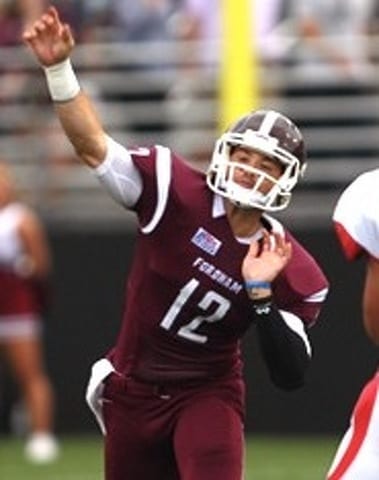
First, at Lake Braddock Secondary School in Virginia. Then at Fordham under Moorhead as his head coach.
Then you need to listen what Nebrich has to say about Moorhead’s offense.
Because Michael Nebrich knows Joe Moorhead’s passing offense better than anyone – other than Moorhead himself.
You can see a lot of McSorley in Nebrich.
Both are intelligent, football savvy, articulate communications majors. Neither is overwhelmingly big — Nebrich was 6-foot-1 and weighed 205 pounds at Fordham; McSorley is listed as 6-foot and 199 pounds on Penn State’s current roster. But both were hugely successful Northern Virginia high school dual-threat quarterbacks. Nebrich threw to Matt Zanellato as a senior in high school, McSorley spent two seasons throwing to him in Penn State’s practices.
Nebrich and McSorley have never met, but they know all about each other.
“Joe told me a lot about McSorley,” Nebrich said a few weeks ago.
“Oh, I know who Nebrich is. He was a couple of years ahead of me in high school,” McSorley said. “It was amazing what he did.”
McSorley was also amazing. Maybe even moreso.
RECORD HIGH SCHOOL STATS
A lot of numbers follow, but to understand where Nebrich was and what he did, and what McSorley could possibly do, it’s important to read, compare and digest these statistics. Slowly.
In high school, Nebrich threw for 7,963 career yards and ran for 2,752 more, for 10,715 total yards and 113 touchdowns – 64 passing and 49 rushing. As a senior in 2010, Nebrich set state-record for total yards (4,967) and completions (262).
As a high school quarterback for Briar Woods in Northern Virginia, McSorley started as a freshman and took his team to four state championship games, winning three. He threw for 9,981 career yards and ran for 2,072 more, for 12,053 total yards – second all-time in Virginia. His 693 career completions are a Virginia record and his 149 total touchdowns (111 passing, 38 running) rank No. 3 all-time.
Nebrich was recruited by Moorhead to UConn in 2011. The next season, Moorhead went to Fordham and Nebrich eventually followed. Nebrich missed most of 2012 with an injury, then went wild in 2013-14 directing Moorhead’s offense.
Nebrich was a devastating dual-threat running quarterback for Fordham in 2013, running for 513 yards on 154 carries, while completing an astounding 73.5% of his passes. In leading Fordham to a 12-2 record, he was 353 of 480 for 4,380 yards passing, with 35 TD passes and just seven interceptions.
He tore his ACL just five months before the 2014 season opener and played most of the year with limited mobility, staying more in the pocket as Moorhead modified his offense. But only to a degree. Nebrich completed 270 of 423 passes for 3,599 yards, with 30 TD passes and nine picks, while losing 96 yards on the ground.
In 2013, Nebrich threw 20 straight completions to open Fordham’s game against Georgetown. Against Lehigh that season he scored five TDs and had 451 total yards. Against Penn in 2014, Nebrich had 566 yards of total offense and six TDs. His career numbers: 642 for 940 (68.35) for 8,153 yards, for an average attempt of 8.7 yards, with 66 TD passes and only 17 interceptions. In his two seasons as a starter, Fordham was 23-5.
So, when it comes to McSorley, Moorhead has seen it before in Nebrich: a quarterback from Northern Virginia who perfected the spread as a record-setting dual threat in high school, who has the tools to make it work again in college.
Nebrich did it at Fordham. Can McSorley do it at Penn State? Moorhead and his offense are the common threads.
To better understand the task ahead for McSorley and fellow Penn State quarterbacks Tommy Stevens and Jake Zembiec, as well as learn the intricacies of a Moorhead offense, we recently talked with Nebrich, who works in Chicago these days for Vivid Seats. Nebrich clearly earned his masters in the advanced-level Moorhead Spread Offense course while at Fordham, as evidenced by the following comments, edited for length and clarity:
WHAT MADE FORDHAM’S OFFENSE SO GOOD:
“Coach Moorhead is absolutely brilliant. The system is his. It came out of his mind and he is absolutely brilliant with knowing what plays to attack each defense with on each play. His big thing is he wants to use the run game to set up the explosive pass game. He really uses a ground-and-pound run style that opens up the pass game, especially for a mobile quarterback like I was my junior year. That threat of the run from the quarterback is so hard to defend on the defense because it just inevitably leaves people open downfield.
“That’s one of the reasons why I was so successful in that system, plus I also came from a similar style in high school. I gelled in the system really quickly and the guys I had around me were tremendous. Anything I did at Fordham couldn’t have been done without them or Coach Moorhead.”
LEARNING MOORHEAD’S OFFENSE:
“It will take some time, for sure. It will be a little more difficult because the [Penn State] coaches don’t know it inside-and-out like they need to or like they’re going to. When I got to Fordham, it really took me a couple of months to have the offense down and even then, there were always little nuances that you don’t realize until you’re actually playing the game or in practice. I think the players are at Penn State for a reason, because they’re all smart guys. Coach Moorhead is an incredible teacher with that system so he’s going to have them ready to go by the start of the season.”
TRUSTING THE QUARTERBACK:
“Coach Moorhead puts a lot of pressure and responsibility on the quarterback. He had extreme trust in me to make suggestions on plays and making sure the offense was in the right place every time. You know the system like the back of your hand. He trusts you to go out and execute no matter what. He’s so great at figuring out how to get into different plays and what plays to call with different defenses. He does it at the drop of a hat when a defense lines up and they don’t know what to do. He’s an incredible offensive mind and it was a pleasure to play in his system.”
CALLING PLAYS:
“He has three live guys that are on the sideline with him. I don’t know what he’s going to decide to do in terms of being in the booth or on the field at Penn State. He has three live guys that call in the tempo of the offense — there’s three different tempos. They call in the formation, the actual play and he’ll also have a handful of dummy signals.
“The offensive line will get to the ball as fast as they can and look over at the sideline. The quarterback tells them what the play is and what the tempo is. Basically, the wide receivers, running backs and tight ends are on their own to figure things out. They have to know the plays just as well as the quarterback because the quarterback isn’t going to be out there yelling the play out, which will help get the pace moving in some Big Ten stadiums when it gets really loud. You really don’t need any verbal communication because it’s all done by hand signals. “
THE QUARTERBACK’S STRENGTHS:
“If he has a quarterback that is mobile and can sit in the pocket when need be, that’s when his offense is at his best. He likes to set up the pass game with the run game, and he uses the quarterback and the running back very equally.
“Making quick decisions is a big part of his offenses. He wants guys who are able to make quick decisions in the pass game. It’s not always about taking shots down the field. It’s also about taking your five-yard hitch, your five-yard slant and letting your wide receivers do their thing. I had trust in my wide outs. It’s about taking the small things. He really doesn’t want to force the ball. If the quarterback doesn’t force the ball, then they are going to be real successful.”
THE WIDE RECEIVERS:
“Coach put a lot of responsibilities on receivers knowing what coverages were on their side of the field. He obviously doesn’t expect the wide outs to go out there and look at the safety shell or the cornerback tilt. But there’s a lot of things in the offense that if the receiver sees one thing he has to do this and if he sees another thing, then he has to do something different.
“There are some option routes that you really have to be out there to understand what they’re dealing with. That takes time because of the chemistry that needs to build between the receivers and the quarterback to be on the same page. Coach Moorhead doesn’t expect them to know too much, but they should also be good to go.”
THE OFFENSIVE LINE:
“The big thing is their mobility. They have to be quick off the line of scrimmage. I remember watching a couple Penn State games last year because I had a buddy, Matt Zanellato, play for the team. It was very easy to see they lacked in size and speed going against the big defensive linemen who are in that conference. I think there is actually a good offensive line in place in regards to speed and quickness. It’s a lot of zone-blocking schemes and they have to get up to different guys at different levels. It’s not all about the brute power and force like most Big Ten offenses. I think he’s got what he needs there and he’s going to get them ready to go come the first game.”
RUNNING BACKS:
“You look at the stats see all these big offenses and passing yards, but the key behind all the passing yards is running the football. He loves running the ball with play-action passing. That’s where the big plays come from. If he’s got a good running back, that’s really going to help out with what he wants to do on offense.”
DISTRIBUTING THE FOOTBALL:
“I was blessed to have the wide receivers and running backs I had at Fordham. They were so explosive and so smart with the offense that it made the offense extremely easy on me. The best part of the offense is that it’s designed to not fit one key guy. It’s not designed to where your slot receiver is going to get 75% of the targets and the rest of the guys aren’t going to get their mix in. It’s designed to where each receiver on every given play has the potential to get the ball. It just depends on what the defense does. When the quarterback is in his pre-snap cadence he needs to figure out the three or four receivers who have potential to get the ball. I think that’s why we had such an even distribution.”
HOW A DEFENSE STOPS THIS OFFENSE:
“You really don’t. If you have a quarterback, running backs and receivers that know what they’re doing and are really explosive players, the only people that stopped us were ourselves. There wasn’t a defense we went up against and said we couldn’t do anything or they’re going to shut us down the whole game long. We lost the playoff games we lost because we came in at halftime and said, ‘Guys, we’re beating ourselves.’ If the offense executes, then there’s no stopping it.”
WHY MORE TEAMS DON’T RUN THIS OFFENSE:
“I don’t know. It’s a complicated offense to run and it takes a smart coordinator to run it. A lot of coordinators nowadays are running power-back, two-back offenses that are very simple. Coming from an offense like the one I ran in college, I hate it because it limits you in every single thing you do. It limits your offensive potential. It’s so hard to stop scheme-wise, but on offense it’s so easy to learn and there’s so many ways to attack a defensive system on top of game-planning for it all in one week.”
A HIGH SCHOOL BACKGROUND IN THE SPREAD OFFENSE:
“Without that background it will be difficult for a quarterback because you’re not familiar with the general philosophies of a spread offense. It’s different coming from a more traditional offense into a spread. That’s like a spread quarterback going into a traditional-style offense the NFL and struggling. It’s difficult, but it’s not impossible. Coach Moorhead is a great educator with that system and he’s going to get you up to speed with it. The question with a lot of guys is, Do they have the athleticism to run that kind of offense? If they have the athleticism, then the knowledge will come. If you’re a traditional pocket guy, then it’s going to be a struggle for sure.”
ADVICE FOR PENN STATE’S QUARTERBACKS:
“The first thing I’d tell them is to take it slow. There’s a lot of time between now and the first game to figure the system out. There’s no need to rush things. Make sure you sit down with Coach Moorhead and the quarterback coach to get all the little nuances down.
“Once you get that down, then the second thing is to start to take what the defense gives you. This offense is designed to throw the ball downfield, but obviously that’s not going to work every play. As a quarterback, you’re going to want to throw the ball downfield every time a big pass play is called. We were so successful because if those big plays aren’t there, you need to get your five to 10 yards. Then you come back three or four plays later and that’s when you get the big play. That’s when it’s open.
“The third thing it obviously to trust Coach Moorhead. Trust what he’s telling you because it’s his baby. He knows what he’s doing. He’s an extremely smart man on the offensive side of the football. He’s going to get you in the best play, so trust his method and you’re going to be successful.”
THE PERSONAL SIDE OF MOORHEAD:
“He’s so good at what he does and is so good with his offense. But the media doesn’t understand how great he is with his players. He’s an unbelievable players’ coach because he has the truest aspects of a family dynamic. That’s what he preaches with his guys and that’s how it was when I was with him. That’s why I’m so close with him to this day. He knows how to get the best out of each guy — by getting in their faces and yelling at them or bringing them into his office sitting down with them. He’s an incredible motivator and just an unbelievable guy.
“Every single guy that played under him wanted to play for him. He really showed how much he cared for each guy. We are extremely close. When I played, I started calling him by his first name. The first time I did that around the team, the other guys looked at me with this strange face like they couldn’t believe I just did that. It’s a relationship I’ll always hold onto. We’ll always be friends.”