
The fourth quarter in 2017 has been a bit of a conundrum for James Franklin and Penn State.
In both victory and defeat, 11 games in.
As such, two questions represent the heads-you-win, tails-you-lose sides of Penn State’s fourth-quarter coin:
1.) How to hold a lead heading into the fourth quarter?
2.) What to do when the game is already over and there are still 15 minutes to play?
The two questions are “different conversations,’ Franklin said after practice on Wednesday. “But there’s no doubt it’s a philosophical deal in how you are going to approach it.
“I think every coach in the country has read the coaching book of what you do in a four-minute offense,’ he continued. ‘You’ve been taught since high school as a player what you should do.
‘But the game has changed and to try to become something that you’re not, at the end of the game, in either situation — whether it is four-minute or you’re up by a bunch of points — you really can’t recreate yourself for certain situations. You have to stay true to who you are and be aggressive and play.”
The fourth quarter is final in many ways. It can define, shape and even expose a head football coach and his core philosophy, identity and, ultimately, his legacy.
Over the past four games, as Franklin has faced both questions, Penn State has been outscored in the fourth quarter, 45 to 24.
The Nittany Lions have led at the end of the third quarter of all 11 games in 2017. At Penn State overall, Franklin is 29-5 when his team is leading after three quarters. At Vanderbilt, his teams were 20-6 when they led after three quarters. (Making Franklin 49-11 as a head coach when his teams are ahead entering the fourth quarter, an .816 winning percentage.)
In its 11 games in 2017, Penn State has outscored its opponents 84-72 in the fourth quarter. Throw in the Rose Bowl vs USC, and PSU has trailed, 89-84, over its last dozen fourth quarters. That’s 180 minutes of football.
Compare that to the 13-game run-up to the Rose Bowl, when the Nittany Lions held a 172 to 55 scoring advantage in the fourth quarter, fueled by a comeback mentality that was required to overcome a halftime deficit in six separate games.
IN TIGHT GAMES…
Let’s put the last four games — when Penn State has only scored three TDs and made a 24-yard field goal in four fourth quarters — into perspective. The losses to Ohio State and Michigan State were against ranked foes in very challenging situations, were by just one and then three points, and in both cases the final crushing blow coming in the games’ final seconds.
The other two games were blow-outs, with Penn State holding a combined 70-30 lead after three quarters over Rutgers and Nebraska.
But, despite a 9-2 record and a Top 10 ranking, the fourth quarter has resulted in some hand-wringing by Franklin.
That’s why on Wednesday, Penn State’s head coach said this about the fourth quarter: “The reality is, we have to play better.”
This is nothing new. After the Nittany Lions were outscored 19-3 in the fourth quarter to lose 39-38 at The Horseshoe, Franklin said: “The biggest issue? It was that the momentum was getting to the point where we had a hard time slowing them down.”
After the Michigan State game, Saquon Barkley chimed in: “The biggest thing is that we didn’t finish,” he said, when I asked him to compare Penn State’s two losses. “These last two weeks we lost by a combined four points. We didn’t finish. We need to find a way to make plays, starting with me.”
…AND NOT
On Saturday, after Penn State led Nebraska by a whopping 42-10 at halftime, but was outscored 32-14 in the second half, Franklin looked at the other end of the spectrum. Again.
What should he do in a blowout?
It’s a question that was raised about the end of the Georgia State game, in what Franklin later termed “Field Goal Gate” and “Time Out Gate”:
On Saturday after beating Nebraska, Franklin offered, unprompted:
“…in the second half, obviously it just kind of leaves a bad taste in your mouth on offense and defense. I didn’t think we played up to our standards there at the end. The fine line is, you second guess yourself all the time, when do you put the 2’s in the game? You leave the 1’s in and people say you’re running up the score. You put the 2’s in and you give up 21 points late, or whatever it was. So, I’m still not completely sure when the right time is to make those changes.”
On Tuesday, he continued his inner dialogue, offering again without prompting:
“I still kind of struggle with what that answer is. You leave your 1’s in, yore jeopardizing injuries, people say you’re running up the score. You put your 2’s in, people score a lot of points. You get angry text messages from people who have been drinking and the spread got messed up probably for them. A lot of things go into it…I know the most important thing for us is the guys that go on the field, whoever they are, they have to play up to our standards.”
And on Wednesday, when I asked him again, he put a ring on it:
“I get emails and direct messages and stuff from people who say, ‘You shouldn’t be throwing the ball. You should run the ball at the end of the game.’ We don’t do that in our offense. I don’t believe we have a run play that we just call and if they are overloaded in the box that we run it in there.’
There you have it: Not. In. The. Playbook.
NIT PICKING
The 2017 squad is more dominant than the Nittany Lions of 2016.
In all of its 11 games this season, Penn State has started the final quarter with a lead. Penn State trailed at the half six times in 2016, and four games after the third quarter.
But in their last 21 games since the Michigan blowout in 2016, only twice have the Nittany Lions trailed heading into the fourth quarter — both last year: 24-21 vs. Indiana, 31-28 vs. Wisconsin in the Big Ten title game. And they won both of those games. That includes the Rose Bowl, when Penn State (in)famously led USC 49-35 heading into the final 15 minutes, before losing 52-49.
In 2017, there have been plenty of games when Penn State was leading by a wide margin after three quarters: ahead by 45 vs. Akron, 49 vs. Georgia State, 24 vs. Indiana, 24 at Northwestern and 18 last week against Nebraska (after a 32-point halftime lead).
Damned if you try to run. (And can’t, in losses against the Buckeyes and Sparty.)
And damned if you don’t. (Ahead in a big way in those aforementioned blowouts.)
Although it may not have looked that way, Franklin and offensive coordinator Joe Moorhead learned their lesson from Penn State’s fourth-quarter collapse vs. USC.
They stayed true to form in the fourth quarters against Ohio State and Michigan State this season, right down to throwing the ball on Penn State’s biggest offensive play against Sparty, a fourth-and-3 from the MSU 31. With 4 minutes to play and the score tied 24-24, the Lions passed. Trace McSorley’s throw to DeAndre Thompkins was a bit high, but catchable. It fell incomplete, Michigan State took over and marched downfield for the winning field goal.
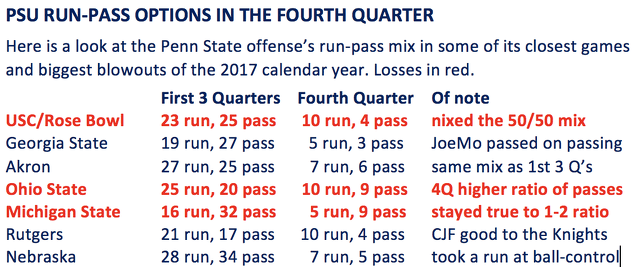
In the fourth quarter in 2017, in blowouts big and late-game margins small, the Nittany Lions have stayed fairly true to RPO, spread-it-out form of their first three quarters, as the chart below indicates:
JOEMO AND THE RPO
Franklin is not the RPO guy. Moorhead is. Although Franklin has worked with West Coast and spread-type offenses in the pros (at Green Bay) and in college, as an offensive coordinator, he’s never been all-in like he has the past two years.
And he still has questions, and — admittedly — not all the answers.
‘It’s kind of just an interesting balance of, ‘How do you do it? In this style of offense?’ ‘ Franklin admitted.
‘I think if you’re at Stanford or you’re Michigan State or Michigan, it’s a different deal,’ he said. ‘That’s your mentality, that’s your philosophy. You’re going to line up in sets, with 2-1 personnel (2 running backs, 1 tight end), 12 personnel (1 RB, 2 TE’s), 22 personnel (2 RB’s, 2 TE’s) and run the ball down people’s throats. But when you’re running these spread-style offenses, it’s not like that.
‘I think myself and my staff and the fans just kind of need to understand, we’re going to be throwing the ball in the fourth quarter with the second group in there. The reality is, we have to play better. We have to play better.
‘I think part of it is me getting comfortable with it,’ Franklin added, holding his left hand to his heart. ‘It’s different than how I’ve done it in my career. I’ve even had the same issue in the past, running the pro-style offense, the West Coast offense. You’re sitting there trying to run the ball at the end of the game and they have 12 guys in the box or they’re blitzing like crazy at the end of the game, and you could make the same argument: If you don’t want us throwing the ball, stop blitzing.
‘That’s the challenge.’
THE BOTTOM LINE
Like adversity, the fourth quarter of a football doesn’t just build character. It can reveal it.
To get a better handle on how to handle the final 15 minutes of a game, Franklin said this week that he’ll spend the offseason doing some benchmarking and making some calls.
CJF has his own POV. And for as much he is sensitive what the media reports and what folks DM and text him, Franklin tries not to be a snowflake.
‘There are some coaches that don’t care’ about easing off with a big lead in the last quarter. ‘They’re going to try to score 85 points in a game,’ Franklin said with a shrug of his shoulder, emulating such coaches. ‘I haven’t really gotten to that point yet.
‘I care what people think. I try to balance what’s doing right for our football team ‘ — Franklin hopped to his left — ‘and also what’s right for sportsmanship’ — Franklin bopped his head to the right. It’s a balance that keeps Franklin on his feet.
‘I don’t really know,” he offered, “what the answer is in an RPO offense.’
More Columns
View all Columns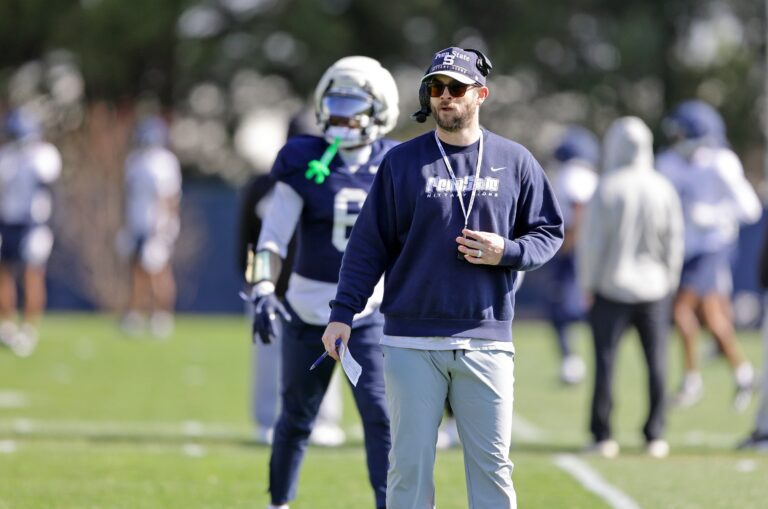
Penn State Game-Planning and Play-Calling: What Campbell, Mouser and Becht Have to Say
Over the course of his 2024 and ’25 seasons at Iowa State, offensive coordinator Taylor Mouser called 1,813 plays. Give or take. The Cyclones’ offense ran that many. But head […]
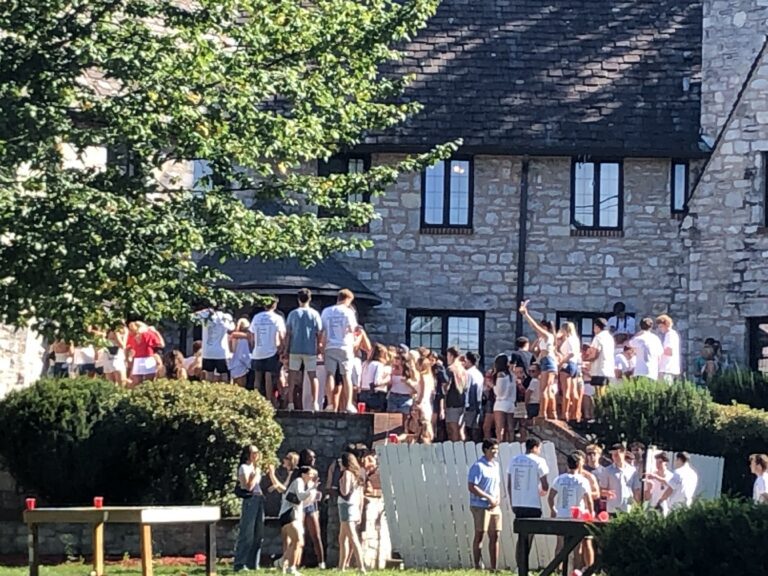
Greek Life at Penn State: Plus Ça Change
It was back to business as usual among the Woo people last weekend, which meant very loud outdoor parties, very many shirtless young males and very many young females wearing […]
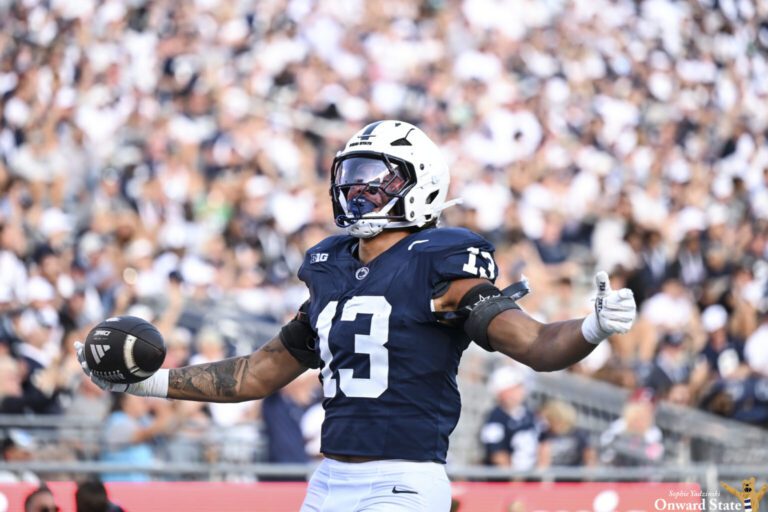
It’s Time to Watch Penn State Linebacker Tony Rojas… Again
Watch Tony Rojas. He’ll be back at linebacker for Penn State on Saturday against Marshall, the culmination of a journey that seemingly took him everywhere, but ultimately brought him back […]


