I like to go downtown early in the semester to write. It’s nice to be among more people after spending the summer in an emptier version of State College. It’s fun to watch new students walk wide-eyed through the throng of people just trying to find their place in the world.
Usually this time of year is bustling with activity and excitement. And this week, the last without football, always exudes the optimism that comes with being part of something bigger than yourself. No matter if you’re a fan or not, a media member or not, college football ramping up is almost as thrilling as the games themselves. Something is happening.
How times have changed.
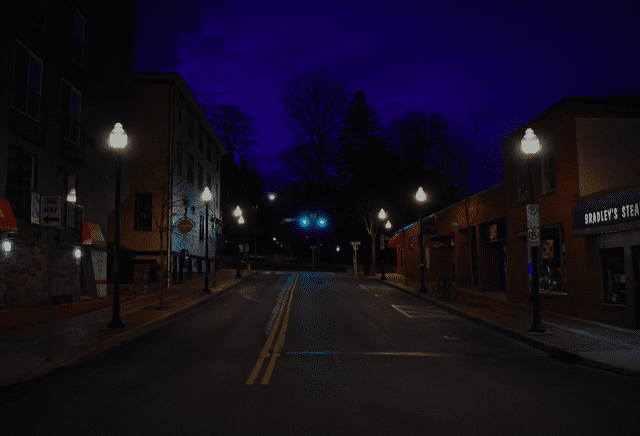
It is nearly impossible to drive through State College these days and avoid the relative silence, harder still to miss the fact it looks nothing like a town that — in any other year — would be gearing up for a game this weekend. This was supposed to be a game week, now it’s just another week.
Students are wearing masks and lines to bars are shortened by design. There is a renewed energy that comes with the start of every semester, but this one is dampened by an understanding that nothing is the same. I’m writing from home, avoiding the uncertainty of a pandemic.
Across campus Beaver Stadium is no more prepared for a season than it was a month ago. The caravan of marketing trucks and stages are nowhere to be seen. There has been no obligatory picture by the ground’s crew of a field cut to perfection. The Blue Band is practicing, but there is no telling when a snare drum will begin to tap, signaling the start of pregame, or any indication fans would be there to see it when it does.
The absence of noise, the absence of purpose, has made the silence all the louder.
State College has always been a bubble. It is surrounded by a different kind of America and is impacted by different kinds of factors. The town is largely run on the back of two very simple things: sports and a college.
But what happens if that goes away?
As you continue to drive through town you would have a difficult time missing out on another sight; the shops that have closed.
It’s the pizza places that have boarded up their windows, the diners being sold to someone else, the slow decay of downtown State College’s unique personality through a one-two punch of high-rises and a pandemic. What was once thriving is now on the ropes, what was once full of character and local flare is slowly morphing into something far less memorable.
One would hope those new copy-paste structures fill out their commercial retail spaces sooner rather than later, although as regional and national corporations continue to call State College home, one imagines that the little guy could get pushed out in the process.
For a lot of people across the country, the absence of college football is a disappointment but something that holds no particular sway in their life. For a town like State College, the absence of football is like a slowly dying root connected to hundreds and thousands of people who find themselves facing an uncertain future.
“I carry a weight with me,” Penn State coach James Franklin said earlier this month. “Not just for my players, and our coaches on our staff. I also carry the weight of the athletic department. I know that the success of Penn State football impacts more than just Penn State football, that’s 31 sports. I also know the impact it has on the community. I feel ingrained in this community, I go on my little walks through town and, you know, up Beaver and down College or vice versa and I feel the weight of that, that I know that Penn State football has a significant impact on the community, on the people in our community [and] on the businesses in the community.”
It will be a test of Penn State’s own creativity too, not of survival but of partnership with State College in ways that go beyond corporate sponsors and feel-good videos. The success of State College as a community is in both the university’s and athletic department’s own best-interest and the looming obstacles for both should lead the powers that be to forgo traditional business models for the sake of mutual survival.
In turn, it would be unfortunate if Penn State’s first significant act of support in the coming weeks and months was simply returning to play rather than finding ways to participate in ongoing economic recovery efforts. The athletic department has long touted the support fans and locals have given the university. If there was ever a time to repay the favor in some form, this would be that moment.
Summer is great for hope in college football because in the summer everyone is undefeated. There is optimism to be found, but eventually the trees change and the rubber meets the road.
And for State College there was optimism football would return, and for all of the hits college towns would take amid a pandemic, that football would certainly be back to help with the recovery. The assumption was always the same: it would all work out in the end.
But football isn’t back, not yet, and even if it returns a month or two from now, it will be too late for many. Penn State Athletics will be fine — maybe it won’t be able to build all of its fancy buildings on time — but it will survive.
There is far less certainty for those just down the hill and those who live in the neighborhoods beyond. Time is money, and the clock has been ticking for a long while now.
It is perhaps hyperbolic to compare a struggling local economy to a natural disaster, slightly over dramatic to call failing businesses something more than the byproduct of a horrible year in all ways that horrible can be measured.
But the absence of football is something that will kill everything slowly and take longer to rebuild. Nothing will feel different until it is. Nothing will seem difficult until you realize what has happened. It will be a slow and painful period that will transcend anything quite like what this town has seen before. Sure, the scandal was bad, but it was largely Penn State’s problem to handle. The circumstances now are everyone’s to survive.
So on a Monday that once upon a time marked the first game week of Penn State’s season, it’s easy to think about football. It’s easy to think about all the little things that come with football and the warm feelings of tailgates and fireworks and community. It’s easy to think about Sean Clifford and Ohio State down the road, easy to think that everything will be fine.
In truth, things won’t all work out in the end. Football will be back, but not everyone will be back with it. For all the sad feelings that come from the lack of sports, there is a very real threat for what that will mean and continues to mean for a town dependent on what a football flying through the air means to so many people in so many ways. The damage will continue to be prolonged, and State College will continue to change because of it. The analogies and hyperbole are easy writing, but illustrate a point: these months could very well define much about State College for years to come.
So yes, it feels peaceful and quiet. Maybe the pandemic feels boring and old, the thought of football in 2020 still bouncing around the rumor mill handing out some small amount of hope, but there is an undeniable truth that the winds will pick up again after a moment of feeling like maybe everything was OK, and it’s too late for football to stop them from coming.