
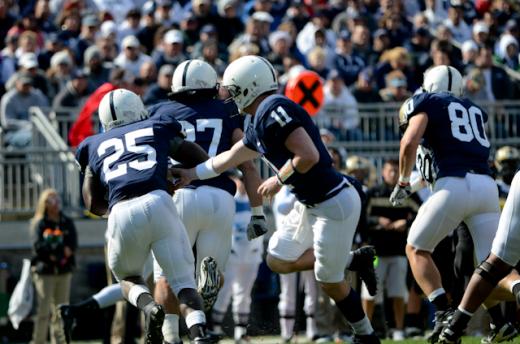
To win on Saturday night, Penn State will need to keep Northwestern quarterback Dan Persa off the field.
The Nittany Lions’ defense is up to the task.
And, more importantly, so is their offense.
The Penn State offense’s ability to sustain drives is the hidden strength of a much-maligned unit that has averaged just 21.7 points per game in 2011.
The key for the PSU “O” is time on the field, even more than running off a lot of plays. Or maybe even running up the score.
And over the past three games – against Indiana, Iowa and Purdue – the Nittany Lions have done an extraordinary job of playing ball-control football. They may not score a ton of points (59 over the past three games), or score red zone touchdowns with stunning regularity (just 13 in 28 trips).
But the Lions’ offense does hold onto the ball — it has turned the ball over just twice over the past 164 plays.
And when Penn State (6-1) has the ball, the opposition doesn’t.
That will be particularly effective against Northwestern (2-4) and Persa. The Pennsylvania native has amassed 4,173 yards of offense and 22 passing TDs over the course of 13 starts and a few mop-ups in his career, punctuated by an all-time Big Ten single-season completion percentage of 73.5 last season.
THE OFFENSE’S HIDDEN ABILITY
Penn State’s offense has found its ball-control religion fairly recently:
- In the first four games of the 2011 season, the PSU offense held the ball for 27 minutes and 30.5 seconds per game. And it had just three drives that lasted more than 5 minutes.
- Over the past three games, the PSU offense has had an average possession time of 35:44. That’s eight more minutes per game, compared to the first four. (Biggest reasons: Silas Redd, with three consecutive 100-yard games, Curtis Dukes’ punishing contributions and the O-line.)
- It has had nine drives of more than 5 minutes against Indiana (3), Iowa (4) and Purdue (2). Not so coincidentally, quarterback Matt McGloin’s playing time has escalated to go along with his Lions’ share of those long drives – 6, compared to 3 for Rob Bolden.
Here’s an amazing thing about those drives. OK, not all that amazing, if you’ve been paying attention.
Of the 12 drives over 5 minutes that McGloin (7) and Bolden (5) have engineered in 2011, Penn State has scored six points on just three of them. Three!
The breakdown – a double entendre of the worst kind:
Three went for the aforementioned TDs (McG 2, RBold 1), five went for field goals (McG 3, RBold 2), one ended in a fumble (Bolden), one was stopped by a pick (McGloin) and two ended in punts (1-1).
(Boy, if Galen and Jay find a way to punctuate some more of those drives with more TDs, there may be something to those 1985 comparisons.)
The points count, but to a certain degree they don’t matter. Keeping the ball is almost as important as scoring – which may be especially true against the Wildcats.
Penn State does not want to get into a quick-possession, pinball-like, shoot-out against the Wildcats. The Lions can’t replicate their five-straight TD performance from the 2010 400 Bowl. Persa, the Lake Michigan wind, the loss of Derek Moye and the herky-jerky QB rotation won’t allow for that.
GIVE IT A REST
Doesn’t matter. Penn State is not going to score the 30 points Northwestern routinely gives up per game. So give it a rest.
More important is that when the Penn State offense holds onto the ball, it gives the Penn State defense a rest. And against Northwestern, it also gives Persa and the Wildcats an unwanted rest, too.
The Nittany Lion defense does well with the extra time. It has:
- Created eight turnovers over the past three games – and six of those have come in the second half, when the Penn State defenders have still had fresh legs. (They had zero takeaways against ‘Bama, when they were on the field for 57 percent of the game.)
- Stopped opposing offenses with alarming alacrity over the past three games. Only two times over the past three games has an opposing offense been on the field for more than 5 minutes against the Lions’ defense – and it was Iowa both times.
Certainly, Indiana, Iowa and Purdue were not stunning offensive juggernauts. And two of them tried to play a fast-paced game, which lessened the time they were on the field.
Nevertheless, for three-quarters of the drives (28 of 37) the Nittany Lions have defended against Big Ten foes this year, the opposing offense has been ushered off the field in 150 seconds – or less.
You have to figure that Persa and Northwestern will stay on the field much longer than that against Penn State. You’d think that, wouldn’t you?
Well, they haven’t so far. Northwestern has had 26 scoring drives in 2011, and they averaged 3:03 per drive. The Wildcats move fast, strike often and get the ball downfield.
PACE AND PATIENCE
All that means it’s OK if the Penn State defense stays on the field a little longer than usual. And that should be the case, too – Tom Bradley will eschew the blitzes of Iowa and will lay his secondary and ‘backers back. They’ll purse their lips and wait out Persa.
As a result, patience will be Penn State’s virtue if it is to beat Northwestern.
And that’s patience on both offense and defense.
Not a bad lesson to learn from your legendary head coach — especially when he’s 84 going on 408.
Related content
More Columns
View all Columns
Penn State Game-Planning and Play-Calling: What Campbell, Mouser and Becht Have to Say
Over the course of his 2024 and ’25 seasons at Iowa State, offensive coordinator Taylor Mouser called 1,813 plays. Give or take. The Cyclones’ offense ran that many. But head […]
Greek Life at Penn State: Plus Ça Change
It was back to business as usual among the Woo people last weekend, which meant very loud outdoor parties, very many shirtless young males and very many young females wearing […]
It’s Time to Watch Penn State Linebacker Tony Rojas… Again
Watch Tony Rojas. He’ll be back at linebacker for Penn State on Saturday against Marshall, the culmination of a journey that seemingly took him everywhere, but ultimately brought him back […]


