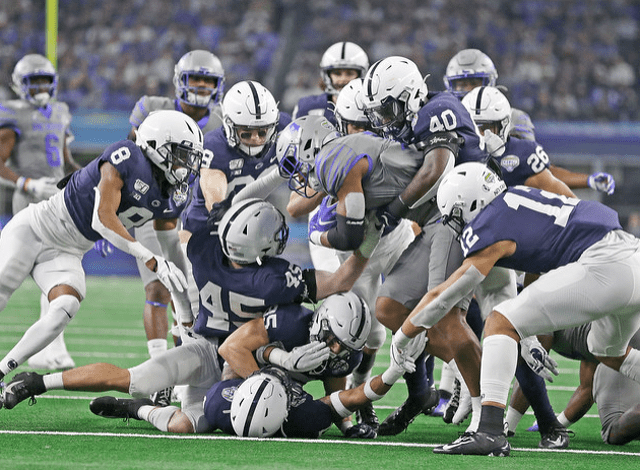
The season is long, the games are unique, and the storylines are ever-changing. With Penn State’s 2019 season in the books, here are a few lingering thoughts just days after the Nittany Lions’ Cotton Bowl victory.
Overall:
New quarterback, new players on both sides of the ball, 11 wins. It’s hard to really find major issue with how Penn State’s season unfolded. The loss to Minnesota wasn’t a poorly played game or an emotionless venue, and Ohio State was just better. I think unless Penn State is in a position like it was in 2017 to make a serious run at things, you take your wins and enjoy them. Penn State wasn’t supposed to be this good and it was anyway. End of the day, don’t turn down 11-2.
It Won’t Happen Overnight:
If there is any major theme to take from Penn State’s place in the football world it’s that making the next step won’t happen in a week. It might mean going 10-3 or 11-2 and having to live with that as a step in the process. Penn State is trying to chase down Ohio State, one of the most successful and dominant programs in the history of the sport with the distinct pleasure of having to go head-to-head with the Buckeyes every single season. Nothing about that is easy, and nothing about that changes simply because someone wants it to.
Take, for example, the teams’ respective depth charts. There might not be a single player aside from Micah Parsons that you would rather have than Ohio State’s version. That’s not to say Penn State’s players are bad, or even far off of Ohio State’s, but the Buckeyes are a better team top to bottom on both sides of the ball and on the sideline.
That kind of thing doesn’t just change or flop by sheer force of will. It takes time on the recruiting trail, luck on the field and development off of it. Point being, it might not be hard to get to 11-2 more often than not, but that doesn’t mean getting to 12-1 or 13-0 is as simple as a few play calls here or there. Penn State was yards from beating Minnesota, and that win wouldn’t have changed the outcome of the Ohio State game. It may have sent the Nittany Lions to the playoffs, but is losing to LSU better than winning in the Cotton Bowl?
Clifford Steps:
It is difficult to find real issue with a quarterback who has won 10 games (Levis gets credit for his own) and proved to be plenty capable of leading the Nittany Lions on the road. All the same it’s not unfair to say he will have to improve if Penn State wants to take the next step.
Sean Clifford has not turned the ball over often, but more than a few of his missteps have been avoidable decisions. Clifford has also been extremely up and down with his deep ball accuracy along the way, which can hurt you in games where those moments may be few and far between. None of this is to say Clifford can’t continue to lead Penn State to 10 or 11 wins, but if we’re talking about getting over that last hump, he will have to get better.
It’s fair to give him some slack considering this was his first year as a starter, but teams go as their quarterbacks go, so the pressure is on for improvement. In the broader spectrum Penn State has locked down commitments from high-profile quarterbacks (hello Justin Fields) but hasn’t hung on to them. In a different world Clifford wasn’t the guy, and failing to land ‘the guy’ is as big of an obstacle as anything. Clifford has to get better, but James Franklin has to land that elusive quarterback big fish.
Real Issue Or Just A Bump?:
Brent Pry’s defense had been, for 90% of the James Franklin era, the unit Penn State could lean on. We can talk all day about Penn State’s late losses and fourth quarter issues, but at least in my eyes that had as much to do with the offense not staying on the field as it did Penn State’s defense not getting off of it. That being said, there is clearly something going on that Penn State’s opponents have been able to exploit.
The answer here might be a lot of things. The Nittany Lions are fairly young, at least in some coverage areas, and will need time to grow up. A blown coverage is not a scheme issue as much as it is a development one. People make mistakes. It’s a matter of mitigating the frequency. So in that light I would hesitate to say Pry has lost his touch or that something about how Penn State is approaching defense is wrong. The Nittany Lions have proven proof of concept in the past under Pry, so the issue appears to be more a matter of comfort than any broader issue.
Nevertheless, Penn State’s defense will have to improve in coverage, the ability to consistently get to the quarterback and its Achilles heel: the screen pass. But what defense in America doesn’t have its weak spots?
Back Attack:
There was a time not long ago that Penn State’s running back rotation felt somewhat like James Franklin treading water to keep everyone happy rather than making tough choices. While Memphis’ issues stopping the run are simply one example over the course of a larger set of data points, it’s fair to say the multiple back unit has worked far more than it hasn’t.
Looking ahead to 2020 it’s not hard to imagine Journey Brown or Noah Cain getting the fair share of carries together, but with an eye on Devyn Ford and Ricky Slade being a part of the equation. It would be interesting in a sans-KJ Hamler world (if that happens in 2020) if Slade makes a position change to something of a running back/slot player role. The only change here: work these backs into more situational roles. Ford is better than Slade at short yardage, Brown is probably the best every-down back and Cain is maybe the most efficient at getting the extra yard. Penn State generally sticks to a back for an entire drive, and that’s fine, but don’t be afraid to find the right guy for the job when the situation isn’t so routine.
Development:
Maybe it’s a misread of the situation, but from the outside Penn State’s receivers don’t appear to have gotten markedly better between the start and the end of the year. That could even be said of Hamler, who is elite with the ball but kind of above average when it comes to actually catching it. Justin Shorter was better than he gets credit for, and much like Jahan Dotson, probably didn’t get targeted as much as he could have been. Some of this may have been Clifford, some of it may have been coaching, some of it may have been Shorter. The overarching point here is that Penn State has to find ways to solve its issues over the span of the year. Nobody is suggesting the Nittany Lions have to be perfect from Day 1, but in a broad sense, Penn State wasn’t much better at its weaknesses Day 1 than it was Game 13. That’s not to say there wasn’t actual improvement, but the ability to turn up-and-down players into consistent ones is key to any elite season.
Tough Starts:
Penn State does not have an easy road ahead when it comes to opening the season, and finding a way to be ready for those moments will be crucial. Road games at Virginia Tech, West Virginia and Auburn, not mention a rare Big Ten season opener at Wisconsin all sit in Penn State’s path in the coming years. Road games are tough no matter when they come, but losing early is never great for overall momentum. The good news is that, generally, an early-season loss is better than a late one. The only issue comes with the likes of Oregon and other fringe playoff teams: Is it better to play good competition early to help your resume, or does playing good teams open you up to losing before conference play ever begins. All of a sudden you are a two-loss team trying to make a four-team playoff. Who knows what life will be like down the road, but nothing on the road is going to be easy the next few seasons, and those moments will happen right off the bat.
Notable early-season games: (Several incomplete schedules could bump some of the post-2021 games around a bit)
2020 – at Virginia Tech (Week 2)
2021- at Wisconsin (Week 1), vs. Auburn (Week 3)
2022- at Purdue (Week 1), at Auburn (Week 3)
2023- vs. WVU (Week 1)
2024- at WVU (Week 1)
2025- vs. Virginia Tech (Week 1)
Make It Count:
To James Franklin’s credit, Penn State’s losses have not been to random teams. There has not been a season derailed by a wildly inferior opponent or a team outside the conference that catches Penn State napping. Equally true, Penn State’s biggest losses under Franklin have been in his biggest moments. And in both 2017 and 2018, Penn State had an argument to make that they should have beat Ohio State both times. The point here is this: Penn State is not in a position to be better than Ohio State every year; it is rarely in better position every five years. This means that when Franklin has a very good team and very good chance to beat Ohio State, he has to make that happen. Lots of game-specific variables play into how you lose, but all things being equal the next step for Franklin is finding a way to beat Ohio State when the game is the most even it can get. The Nittany Lions will probably never be a favorite by any wide margin, but the openings will come, and he’ll have to make that count.
Little Things:
I tend to think Franklin gets a bit worse rap in game management areas than he deserves. I think there are moments where you might not agree, but decisions like going for two against Minnesota instead of kicking an extra point count against him after the fact, even if there is fair argument to be made as it happens.
But you also could argue his timeout usage in the Cotton Bowl’s final minute of the first half opened the door for a Memphis field goal. And in a way it did, but Penn State also could have played better defense on that ensuing drive. All things being equal I don’t think Franklin has made a choice in a loss that has had a major or significant hand in Penn State’s ultimate demise. All that being said, the perception is there, and Franklin would be well served to be in a constant state of self-evaluation, if he isn’t already.