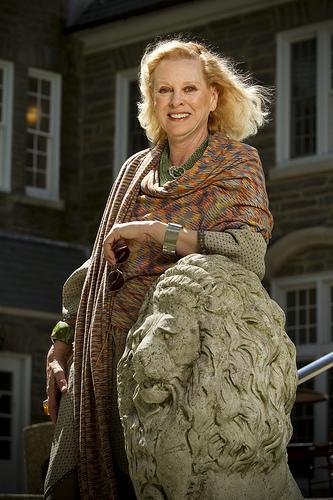
In traveling to nearly every Commonwealth campus, Penn State laureate Linda Miller said she hasn’t had to dig very deep to find a connection to the humanities.
Instead, she has discovered that most campuses are bursting with a respect for the arts and are rich in culture.
Miller will celebrate the laureate program, as well as welcome next year’s featured artist, with the first-ever jubilee gala on Tuesday afternoon.
Free and open to the public, the gala runs from 3-5 p.m. in the Pasquerilla Spiritual Center on-campus, featuring light refreshments, and a performance program in Worship Hall.
The afternoon will culminate in the announcement of the 2012-13 Penn State laureate. Miller said she dreamed up the gala as a means to not only bring her trip full circle but also allow the Penn State community at large to digest and embrace a new culture.
Miller, faculty at Penn State Abington, does not want the poet laureate position to be limited to the perception that it is just someone who writes only poems.
Rather, and like other laureates who have represented the arts in different areas of study, Miller is a general humanities scholar.
Her concentration lies in the 1920s and ‘the lost generation’ of artists, who include Ernest Hemmingway and F. Scott Fitzgeralad, individuals who fled to Paris, disillusioned by a post-WWI United States and seeking inspiration through the art colony they formed on the river.
‘They’re mythologized today, they’re larger than life,’ Miller said. ‘They went to find America, overseas, in their hearts and through their experiences.’
Specifically, she focuses on the long-lost correspondence of these artists. Now, what started as a happenstance finding of a few letters turned into the largest effort to date to chronicle and publish any and all of Ernest Hemmingway’s correspondence.
‘I was hooked, that whole era, his art, is extra-powerful,’ Miller said.
Miller is working on the project with Hemmingway scholar Sandy Spanier, wife of the former Penn State president, Graham Spanier. Traditionally, women did not admit to reading Hemmingway early on, so this project also represents the great strides women have taken in the arts, Miller said.
The letters total more than 6,000, and Miller said the project is so important because it puts on display the talent of a historical figure, but also immortalizes a lost art.
‘Getting the inside story sheds light and life on the art, itself. It really reveals yet another layer of culture,’ Miller said.