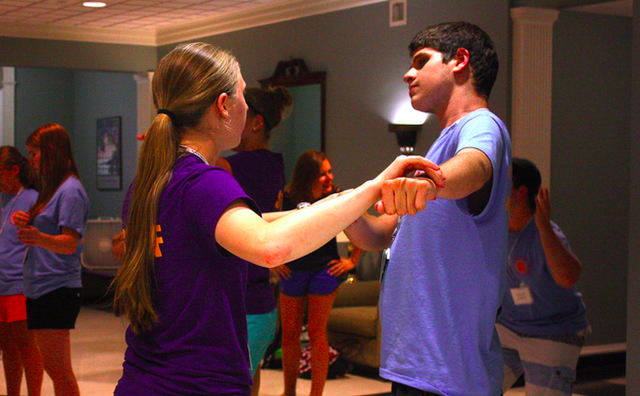
Elizabeth McKay was born legally blind, but her visual impairment isn’t stopping her from attending college in the fall.
McKay, along with 23 other high school students who are blind or visually impaired, spent three weeks at Penn State as part of the Summer Academy program.
The program, which began on July 13 and ran to the end of the month, is an intensive program designed to help blind and visually impaired high school students who are interested in attending college or a technical or trade school improve their independence and self-advocacy skills.
“When they go to college, all the responsibility goes to them. They have to identify that they have a disability and talk with their teachers,” said Stan Swaintek, the director of field operations at the Pennsylvania Office of Vocational Rehabilitation.
McKay, who graduated high school this year, is among the older students in the program and is enrolled in Duquesne University for the fall. But, most of the program’s students are still high school students.
It’s the first time many of them have had to do their own laundry, clean their own rooms and live independently.
“For some of them, it’s the first time they’ve been away from home,” Swaintek said.
Students in the program live in Atherton Hall, eat their meals in the campus dining commons, and audit select Penn State classes.
In many ways, the program mimics college life and, Swaintek said, the students go home knowing what they have to work on before graduating high school and going to college.
McKay already had many of the necessary skills to succeed at college under her belt after she began attending a public school in 11th grade. But, she said she benefited from the vision rehabilitation therapy work at the Summer Academy, which helps student enhance independent daily living skills such as shopping, food preparation, labeling, cleaning, laundry and self-care.
“This sounds kind of lame, but if you are blind and trying to clean a mirror, you can’t see what you are doing, but they taught us different techniques to deal with that,” McKay said.
The program also offers orientation and mobility instruction where students learn to travel on and off campus using canes, to use adaptive mobility equipment, to ride the buses and to travel using GPS devices.
A variety of other workshops and activities also help students develop social and networking skills, improve their confidence, learn how to complete college level work and use assistive technology in college classes.
Still, the course is challenging and puts students in an unfamiliar setting.
“A lot of them come in and they are angry about being here and they want to go home, but in the end they realize how much it impacted their lives and changes them for the better,” said Allison Epting, the resident director who has worked with the program for three years.
This year’s assistant resident director, Tarik William, is a testament to that statement. He first came to the program in 2011 as a student after becoming visually impaired when he was 16. He then went on receive an English degree from West Chester University and plans on pursuing a master’s degree in rehabilitation counseling.
“I don’t think I could have done it without the Summer Academy,” Williams said. “And, I am really happy about being able to relate to the other students here and help them realize you can be successful. It might be hard, it might be tough, you might be doing things differently, but that’s okay.”
There are a total of five RAs who are graduates of the program, Swaintek said. Students spend much of their day with all 22 RAs, many who are Penn State students.
The Summer Academy is hosted through a variety of partnerships, but Penn State’s College of Education and College of Health and Development, in conjunction with Penn State Conferences and Institutes, have brought the program to Penn State.
After five years at the Hiram G. Andrews Center in Johnstown, the Summer Academy moved to Penn State’s University Park campus last summer.
Williams said, “At the end of the day, we want a student to be successful in whatever job they go do, whatever school they go to and be independent and live on their own.”