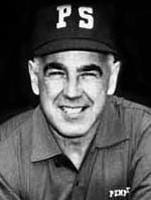
Editor’s Note: This is the 13th of a 19-part daily series that seeks to answer the questions surrounding the 2010 Penn State football team. Check back every weekday until the Blue-White Game to see the question of the day. Thursday, we asked: ‘What Was PSU’s Best Quarterback Battle Ever?‘ Today, we ask: ‘Who were Jim O’Hora and Red Worrell?‘
——————————
Penn State’s annual spring football awards, to be announced during next Saturday’s Blue-White Game, have names; here are their stories:
This is how Joe Paterno’s life at Penn State was molded, by a man and a family that helped a brash young Brown grad grow into a man who became college football’s greatest coach.
‘From 1951 to 1961,’ wrote the late Jim O’Hora in 2001, ‘Joe Paterno was the man who came to dinner and never left.’
This story begins in 1952. O’Hora, a veteran on the Penn State football staff, spied Paterno, a young assistant just two years into the job. Paterno was looking a bit down in the mouth.
‘Joe, what are your plans for housing next year?’ asked O’Hora, an assistant football coach at Penn State from 1946-1976 after playing center for the Nittany Lions from 1933-35.
‘I don’t know,’ replied Paterno, who lived with the Suhey family his first year in State College (1950), then spent a year in McKee Hall. The only single coach at the time, Paterno had the job of baby-sitting the players in the Penn State dorm.
The O’Hora family had just moved into a new home with extra space. There was an additional room and bathroom upstairs.
‘It was Joe’s for the taking, for $40 a month,’ O’Hora wrote in the ‘324’ commemorative magazine I edited in 2001 after Paterno set the all-time record for wins by a major college football coach.
‘Joe moved in and stayed with us the next decade, even when we built a new house three blocks away after our fourth child was born.’
Housemates for a decade, Paterno and O’Hora were Penn State assistants under head coach Rip Engle for 16 years. They were together on the Penn State staff for 27 years. Along the way, O’Hora served as interior line coach, defensive coordinator and Paterno’s assistant head coach.
O’Hora and Paterno often talked and argued football into the night, as the more mature and calmer O’Hora modulated the cocky and bright, young Paterno.
O’Hora’s best call came after a decade of being Paterno’s landlord, Dutch uncle and best friend. Here’s how Paterno describes it in his book, ‘By The Book,’ with co-author Bernard Asbell:
‘During one year of my comfortable arrangement with the O’Horas, when I was 34, Jim one day opened an evening’s conversation a little differently than he had ever done before,’ Paterno wrote.
‘He cleared his throat a few times and worked his fingers and asked me if I wouldn’t like to sit down. I was sure he was going to tell me the facts of life. Which, in a sense, he did.
‘ ‘You know, Joe,’ he began, looking out the window, ‘my father and my mother came to this country from Ireland. Later, one after another, my cousins came and lived in my parents’ home. My parents always said it was wonderful having them. But then, after each of those relatives found their place in the way of life of this country and they were financially able to take care of themselves, my father would sit down and say, ‘Patrick,’ or ‘Terence,’ or whoever it was, ‘now it’s time for you to go out in the world on your own and set a proper home.’ ‘
Paterno got the message.
‘I don’t remember what he said or I said next,’ Paterno continued. ‘I just remember that I got the hint and quickly found a little apartment. In June 1961, after nine years of living with the O’Horas, I set up own housekeeping.’
• • • • •
Jim O’Hora’s 31 years on the Penn State staff and three years as a varsity letter-winner, are remembered through the Jim O’Hora Award. It is given every spring to a Nittany Lion defensive player for ‘exemplary conduct, loyalty, interest, attitude and improvement during spring practice.’
On offense, the Red Worrell Award is given to a player for ‘exemplary conduct, loyalty, interest, attitude and improvement during spring practice.’
• • • • •
Thirty-nine miles south of Pittsburgh, along the Monongahela River, lies the tiny town of Denbo, downstream from Brownsville.
In the late 1950s, everyone in the Monongahela Valley knew a young man named Robert Worrell. A great all-around athlete, he was called Red.
According to the Brownsville Telegraph, as later reported in the Brownsville Times Capsule, ‘during his senior year at Centerville High School, Worrell received the highest award in the nation when he was named to the All-American schoolboy team.
‘He was the only gridder in history to win consecutive awards as the outstanding back in the WPIAL. He received over 75 college offers, and after initially selecting North Carolina, he changed his mind and enrolled at Penn State, where he starred…on the freshman team.’
While at home for the holidays on a December afternoon in 1957, the 19-year-old ‘Worrell was helping his father erect a television antenna…Red was standing on the ground, holding a metal pipe attached to the antenna when it came in contact with a high tension wire.’
Worrell collapsed to the ground, and despite the efforts of the Brownsville fire department, he died, leaving behind a wife, Carol, and their eight-month-old daughter, Kim Jeannette.
Fifty-three years later, Worrell’s time at Penn State will be remembered once again next week. As it is every year, his name will be associated a Nittany Lion football player’s good deeds.