
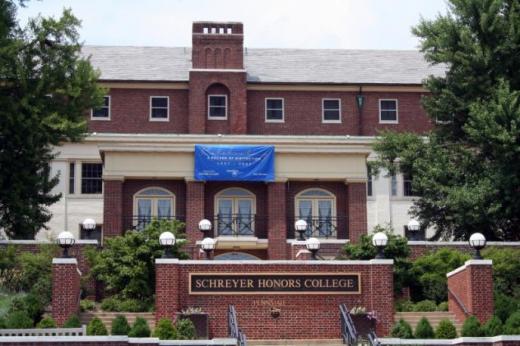
Penn State is set to launch today the public phase of a multi-million-dollar fundraising campaign, dubbed ‘For the Future: The Campaign for Penn State Students.’
The campaign opened its quiet phase more than two years ago, when university leaders began gauging high-level donors’ interest, priorities and ability to give. Starting today, the effort will focus more on encouraging donations from the general public.
An announcement of the overall, multi-year fundraising target also is scheduled for today. The university is expected to report that it has already raised $1 billion in the quiet phase, and to set a total goal of $2 billion, according to sources close to the campaign.
Penn State’s last capital campaign, known as ‘Grand Destiny,’ raised $1.37 billion in seven years. It ended in 2003.
‘Philanthropy has become essential to Penn State’s fulfillment of its mission to educate and serve in an increasingly competitive academic marketplace,’ reads a university case statement about the new campaign. ‘As the cost of preparing students for a rapidly changing, technology-driven global economy rises, and state support for higher education declines, tuition has increased at schools across the country, including Penn State.
‘Families are evaluating institutions on the economic value of their degrees as well as educational excellence,’ the statement continues. ‘ … Universities and colleges are competing to provide not just the best classroom education, but also the most stimulating and supportive environment for students.’
Penn State has outlined several primary priorities in the ‘For the Future’ campaign, according to the case statement. They include scholarships, honors education, faculty strength and research capacity, and the overall student experience.
Philanthropy ‘adds to the margin of excellence’ at the university, Penn State President Graham Spanier has said. The university is expecting to see a fundraising total of about $200 million for this year, with $300 million more anticipated in new pledges, he said. Pledges can be paid off over several years.
Private contributions to Penn State have reached new highs while state appropriations, as a portion of the overall university budget, have stagnated. State support now accounts for about eight percent of the $3.7 billion annual budget at Penn State — down from about 37 percent in 1970.
To help the university make up the difference, tuition rates have increased substantially. In-state, full-time undergraduates now pay more than $13,000 in annual tuition, one of the highest prices among public universities in the U.S.
If Penn State is to uphold its mission of educating students of all backgrounds, Spanier has said, it will need continued help from alumni and friends.
The new campaign ‘will ensure that our students can learn from top scholars and scientists, explore their own potential for leadership and service, and make a difference in their communities and the larger world,’ Spanier has written in a letter to prospective donors.
‘I hope you will join us in this historic effort to become the nation’s most comprehensive, student-centered research university,’ he writes.
Watch StateCollege.com for ongoing coverage of ‘For the Future.’
Earlier: Spanier: Penn State ‘very determined’ to provide pay raises
More Local News
View all Local News
‘Music in the Gardens’ Brings Free Outdoor Concert to Arboretum at Penn State
The Arboretum at Penn State will turn into an outdoor concert venue Thursday evening as the Penn State Symphonic Wind Ensemble performs a free show surrounded by the scenery of […]
16 Downtown State College Businesses Receive Facade Improvement Grants
More than a dozen downtown State College businesses and properties will receive funding for new signs, awnings, lighting, painting and other exterior improvements through a state-backed facade grant program. The […]
FCC Approves Transfer of WPSU to WHYY
The Federal Communications Commission on Wednesday approved the transfer of WPSU TV and radio to WHYY, a pivotal step in the transaction that will keep public broadcasting alive in Central […]


