There are plenty of iconic landmarks on Penn State’s campus.
The stoic Old Main, with its bell tower that can be heard for miles, is in the mix.
The obelisk is another, standing tall as an ode to geology and an urban legend all at once.
But there’s one natural landmark that can be found scattered around campus, though it’s becoming more and more rare these days. And that’s the Penn State elm trees, which are being depleted by the lethal dutch elm disease.
It wasn’t long ago that the view of Old Main was perfectly balanced, with two large elm trees planted on the lawn, perfectly framing the bell tower. And now, just one remains.
The elm trees are living on even in death, in part thanks to the Elms Collection, which turns the departed trees into everything from benches to tables to picture frames to clocks for sale.
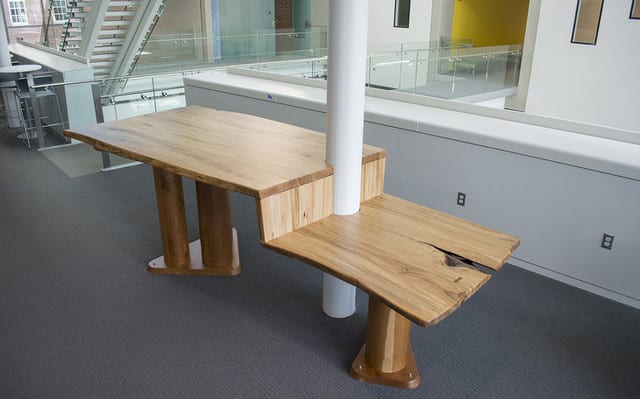
But that’s not all. The university is also finding a way for the elm trees find new life on campus, just a short walk away from where they once stood tall. One example is a beautifully handcrafted table in the atrium of the newly constructed Health and Human Development Building.
A local furniture maker, Tom Svec of Lock Haven, put months of his time into creating the table, which is wrapped around a pillar in the building’s atrium. He spoke with Penn State News about his work on the project, which placed the table within 100 yards of where the tree it came from was first planted.
“I think it is going to be a place that is going to be very productive intellectually and socially. I was given a real marquis space to place this table,” Svec said.
According to the Penn State News article, there are “remnants of chainsaw bypass cuts made by a Penn State arborist” on both ends of the table.
“These were left in evidence to remind people that generations of these staffers have worked for years to preserve the canopy that defines the central campus,” Svec said.
The local furniture maker said that the would like to see a similar resting place for other heritage trees that succumb to disease and have to be cut down.
“My personal wish is to see to it that as many heritage trees as possible find their way indoors when their outdoor life is over,” Svec said. “It may come to pass that huge trees of the sort that are abundant on the Penn State campus are a thing of memory.”
The elm lumber is finding similar homes in new buildings on campus. The Biobehavioral Health Building has elm paneling in its entrance area and conference room, as well as elm benches. The Burrowes Building, which is currently under construction, will house an elm conference table and elm wall panels.
“We are honored to have been able to incorporate wood from the Penn State elms into the design of our two new buildings,” College of Health and Human Development dean Ann C. Crouter said. “In each case, elm wood is featured in the entry ways to the buildings — a fitting way to honor the neighboring trees that have graced our part of campus for so long.”