
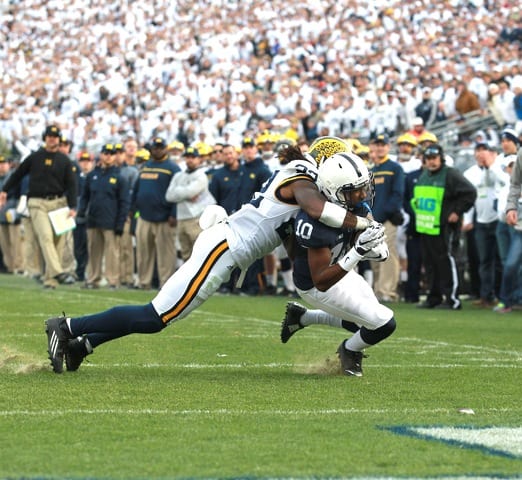
Penn State’s offense sees red when it gets inside the red zone.
Red, as in stop.
Against Michigan on Saturday, the Nittany Lions made three trips inside the Wolverines’ 20-yard line. And came away with just three field goals.
Penn State’s offense couldn’t score a touchdown when it needed it most – and was at its closest. They got to the 9-yard line in the first quarter. And in the fourth quarter they got to 6-yard on one drive and the 1 on another.
Each time, they were stopped.
And all three times, they settled for a field goal by Tyler Davis, from 23 yards, then 24, then 18 yards. Penn State’s inability to get six points, while settling for three, was a big difference in its 28-16 loss before 107,418 fans on hand for a Beaver Stadium Whiteout. Counting extra points, that was the entire winning margin – 12 points.
“We have to score touchdowns in the red zone,” said Penn State coach James Franklin. “We were not able to run the ball consistently today, whether it was traditional runs or Wildcat – we were getting knocked back into the backfield. By the time the ball-carrier got the ball he had someone in his face.”
10 PLAYS, 19 YARDS
Penn State had 10 plays from the 20-yard line and in – nine of them from 9 yards or less. It was an equal opportunity ineffective offense.
Saquon Barkley carried four times in the red zone and gained zero yards – on carries of minus 3, minus 1, plus one and plus three yards.
Wide receiver Brandon Polk ran once — after lining up in the backfield and taking a hand-off on a jet sweep from Barkley, playing the Wildcat quarterback — for five yards.
“We tried to do some different things – the jet sweep of the Wildcat on the edge,” Franklin said. “Their guy had enough speed to keep it to a minimal gain. We weren’t able to be consistent enough in the running game, which showed up in the red zone. Too many field goals.”
Quarterback Christian Hackenberg threw five passes in the red zone, completing one for 14 yards to Barkley, and missing on tosses to Polk, tight end Kyle Carter and wide receivers DaeSean Hamilton and Chris Godwin.
The red zone recap: Ten plays, 19 yards – with only four of the plays gaining positive yardage.
“It definitely puts us at a disadvantage with our offense,” said Godwin. “We can’t have that many plays inside the 10 and not punch it in. It’s definitely something we have to figure out.”
2015: 21 OF 39
Scoring touchdowns once it arrived in the red zone has been a problem for Penn State (now 7-4) all season. On 39 trips inside the 20-yard line in 11 games, Penn State has scored a TD only 21 times after going 0-for-3 on Saturday. On the other 18 times in the red zone in 2015, Penn State has made 15 field goals and come away with zero points three other times.
On Saturday, Penn State’s third and final trip to the red zone came midway through the fourth quarter and ended after Hackenberg’s incomplete pass to Hamilton on the Michigan 1-yard line. Penn State trailed 21-13 and instead of opting for a run or pass from scrimmage on a fourth-down play, Franklin called for Davis to kick the 18-yarder. The field goal pulled the Nittany Lions within 21-16 with 7:53 to play. That incompletion was followed by Hackenberg limping off the field, which may or may not have had anything with Franklin’s call.
“In that situation we were going to have to score a touchdown and then go for two (points),” Franklin said. “It was either that or kick the field goal and then score later in the game. That was the discussion on the headset with all the coaches. Take the points now or go for the touchdown and have to go for two. At that point, we had a bunch of big plays that got us to the low red zone and then we had a hard time punching it in.”
At that point, Franklin gave props to Michigan’s defense for its red zone prowess against the Nittany Lions.
“We have to give those guys credit,” Franklin said. “That’s one of the best defenses in the country. They’ve been No. 1, No. 3, No. 3 in almost every defensive category n our conference as well as the country. The last couple of weeks they’ve had some people do some things. You look at the type of defensive team they’ve had all year, they’ve had a good team. That’s a good veteran team. That’s a big aggressive group.”
With Polk on the jet sweep and Barkley at Wildcat, Penn State tried to mix things up inside the red zone. Earlier in the season, that was the case with Hackenberg as well. He has accounted for two of Penn State’s red zone touchdowns via the ground, when he ran for scores from 1 and 5 yards out against Indiana. And he also caught a 14-yard TD pass from Nick Scott against Illinois.
Hackenberg contributed with his feet in the fourth quarter against Michigan. But not in the red zone. On the drive that led to Penn State’s third field goal, Hackenberg dashed off runs of six and 17 yards – both resulted in first downs.
But when Penn State got close to the goal line, Hackenberg was limited to passing the ball. Not that he can’t run or roll out. He had four short TD runs as a freshman in 2013, including a 1-yard sneak against Michigan that sent that game into the first of four overtimes, as Penn State won, 43-40. Last season, however, he ran the ball just twice among Penn State’s 120 red zone plays.
And he ran zero times in the red zone against Michigan on Saturday.
“We just weren’t able to get it done, for whatever reason” inside the red zone, Hackenberg said after the game. “At the end of the day, we’ll go back and look at the film and just see what we need to do to get better.”
PAYDIRT
Tight end Brent Wilkerson, who caught a career-high three passes for 16 yards, pointed to his team’s ineffectiveness inside the 10 as its biggest failing on Saturday.
“That was our biggest mistake – not capitalizing in the red zone,” said Wilkerson. “We took field goals, not touchdowns down there. .. It’s communications problems. Just us straining that one extra second or getting off the blocks, stuff like that. It’s on the players. The players have to step up and make those plays. Nothing changes down there. We know we have to be physical. We know they’re going to stuff the box. On the outside we have to get off the press and make the plays.”
As a player, Wilkerson was asked, would he rather go for a touchdown than a field goal on fourth downs in the red zone?
“Honestly, that’s not in my pay grade,” he said with a little smile. “That’s something for the coaches. I just play. That’s definitely their decision. I leave that to Coach Franklin.”
More Latest Penn State News
View all Latest Penn State News
Greek Life at Penn State: Plus Ça Change
It was back to business as usual among the Woo people last weekend, which meant very loud outdoor parties, very many shirtless young males and very many young females wearing […]

New Judge to Oversee Penn State Fraternity Cocaine Ring Case
A new judge has take over the case against the men accused of operating a cocaine trafficking ring out of two off-campus Penn State fraternity houses, a day before the […]

‘Night at the Museums’ to Showcase Penn State Exhibits and Archives
By Chris Kick, Penn State Ag Sciences News The second week of Penn State’s fall semester offers a chance to visit university museums during the “Night at the Museums,” planned […]


