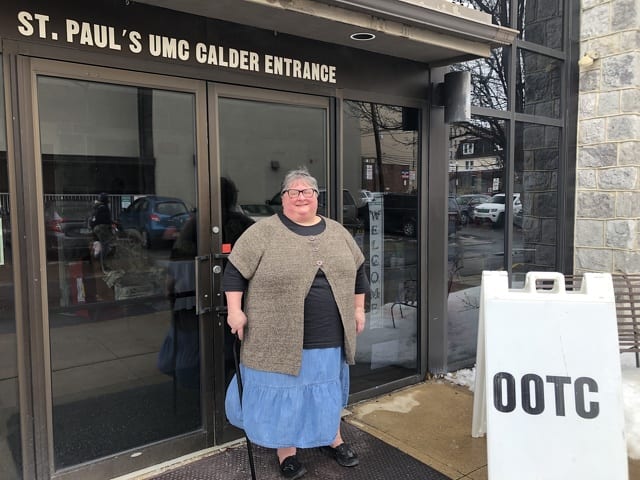
During the coldest times of the year, program manager Beckie Romig worries about the homeless people who seek relief at the of Out of the Cold: Centre County emergency shelter.
She worries about them all through the year. She knows living homeless can be dangerous and difficult no matter the weather, but during the cold months, the elements can kill an unsheltered person quickly.
During the recent cold spell, when the polar vortex came down and the temperature dipped well below zero, Romig really worried.
“It doesn’t take long, in those conditions for people to get seriously hurt. Frostbite is huge concern,” said Romig. “We have some really vulnerable folks and there is just danger from a lot of different places.”
It’s on these cold nights that participating churches in State College open their doors to the homeless, providing them with shelter and sustenance.
This past year, Romig said the program has seen more people at its emergency overnight shelter than previous years — up to 26 people on some nights. She said about half of the people who use the shelter have jobs, but they haven’t been able to find a place to call home. Romig said that mental health or addiction issues often play a part in the homeless population at the shelter.
The program goal is to provide a safe, warm place for any adult who needs it — a cot and two warm meals all through the winter months.
CENSUS OF THE HOMELESS
A recent Point-in-Time count conducted by the Centre County Office of Adult Services showed a total of 129 homeless people in Centre County on Jan. 24.
“One way to put it is that it is kind of like conducting a census of the homeless,” said Director of Adult Services Faith Ryan. “It is a federal initiative that is a snapshot of what homelessness looks like in your community at that point in time.”
To conduct the count, teams of county workers and community groups go out into the community looking for homeless at various locations. Breaking up into teams that hit different regions of the county, the group goes to gas stations, coffee shops, libraries and many other places with resources, looking for leads on people who may be living homeless. The teams visited more than 150 locations on Jan. 24.
Through those contacts, the teams found 26 leads for unsheltered homeless people and leads for 12 individuals or families with housing instability. That number is similar to other recent years.
Through those leads, four people were found to have spent the night of Jan. 23 somewhere not meant for human habitation. Such locations include vehicles, streets, parks, sidewalks, bus stops or bus stations, abandoned buildings, tents and campgrounds. AccuWeather reported a low temperature of 24 degrees that night. The four unsheltered homeless people found in the count is similar to previous years’ numbers, said Ryan.
The other 125 homeless people found in the count were reported from emergency and transitional shelters or in programs that look to help with long-term housing for people in housing need. This number is about double prior years, due to new federally funded programs that provide service.
Thirty-one people were found to have been residing at emergency shelters like Out of the Cold: Centre County, which had 17 individuals that night. CentreSafe (formerly the Woman’s Resource Center) served six people and Housing Transitions had eight.
Transitional programs are for people who have experienced homelessness and are in a bridge-type program as they look for more permanent housing. Case management is provided to help people find stable long-term housing. On the night of Jan. 24, CentreSafe served 29 individuals, while the Youth Service Bureau had four and Housing Transitions had two.
Another homeless designation counts those in housing-first programs where the survey counted 44 individuals at Rapid Re-Housing and 15 at Permanent Supportive Housing.
Rapid Re-Housing is a relatively new program that provides a housing subsidy for people who meet the qualifications of unsheltered homeless to pay for rent. They have to be able to get their own lease and the subsidy is based on their current situation and will change as they get back on their feet and their situation changes. The program comes with extensive case management.
“It is a housing-first model. It is meant to say that even if you don’t have a job, maybe you are struggling with substance abuse. Maybe all these things are happening and if you a have a house first or somewhere stable to live, you will be able to deal with your issues,” said Ryan.
The program has a waitlist, and Ryan said the case management needs of the individuals in the program are extensive. As the county continues with the program, Ryan said more emphasis will be put on case management to help people as they transition back to stability.
Ryan said the number of homeless is probably higher than the count indicates, because there are many different definitions of homelessness and the count only accounts for a couple of them. But while the number is high, Ryan said it is good to see so many of the people in need getting some kind of help.
“Although we probably didn’t find all the unsheltered people out there, we still only found four and we have 125 people in services. That is really outstanding. A lot of communities don’t have that, so we can be proud of that,” said Ryan.
The county uses to the Point-In-Time count as an opportunity to share information about all the resources in the county and find people who may need help, said Ryan.
A MISSING PIECE
According to Romig, other homeless shelters do a great job, but have a limited amount of space, so Out of the Cold provides an additional resource for the homeless during the harshest time of the year.
Out of the Cold is just that — a shelter to keep homeless people out the cold during the months from Oct. 22 to May 5, from 9 p.m. to 7 a.m. The program started in 2011 when a Bellefonte man died while sleeping in a tent during the winter, so the faith community got together to help. The hundreds of volunteers provide two warm meals and a safe place to stay for homeless adults.
But what are the homeless to do with the rest of the day, when it is too cold to be outside?
Hearts for Homeless operated a day shelter below Dunkin’ Donuts at College Avenue and Fraser Street and provided a safe, warm place while the overnight shelters were closed. But it is in the process of dissolving and has not been available this winter, said Romig. This left a need unfilled.
“When we found out Hearts was dissolving, we went into a sort of panic mode, because what will our folks do during the day?” said Romig. “Because there really aren’t a lot of options for them during the day.”
Realizing the issue, Out of the Cold rushed to find a solution and inquired about what would be needed to take over the Hearts for Homeless location, but code changes put an end to that pursuit. Luckily, two neighboring churches, Saint Paul’s United Methodist and Faith United Church, both on College Avenue, were able to find the space to provide a day program Monday to Friday throughout the winter months. But this doesn’t cover the whole day, as the day program is open only from 9:30 a.m. to 1:30 p.m. Lunch is provided each day from local businesses and warm showers are available at one of the locations. The space is also able to provide mail service.
This still leaves part of the day and weekends where homeless must find a place to stay warm or be left out in the cold until the overnight shelter opens again at 9 p.m.
The day shelters do provide some relief, though. Romig said the program has been successful, and she is unsure what the group of 16 participating congregations and seven partner agencies will do with the program in the future. One thing that Romig said she knows is that case management is a big need to help people find their way off the streets. This is not something the program can provide.
She hopes that the program can extend the day service hours next winter to more fully bridge the daytime hours, but there are many things that would need to be figured out to make that work. While the group has strong support, the day shelter and overnight shelter eat up a lot of resources.
DISPELLING RUMORS
Romig laughs at the idea that her program brings people from outside areas in to reap the benefits of the shelter. She said that while other communities might lack homeless resources, she does not think that anyone would be drawn into staying at the shelter.
“We’ve heard a lot of accusations of people saying we are drawing people from all over the state to come here,” she said. “You are welcome to go take a peek at the room. When you look at the room with all of these cots lined up side-by-side-by-side, and they can’t come in till 9 o’clock and they have to leave by 7, people aren’t coming from all over to take advantage of this amazing shelter that we have, it is just not that. I just have to laugh when I hear that and think you haven’t seen our shelter because if you did, you would realize that this is not a draw.”
She said that most of the people who use the shelter are from Centre County and say that they could no longer afford the rent or they may have lost their job and gotten behind and are left homeless.
Along with the day program, Hearts for Homeless also offered a shelter home in Bellefonte. The closing of that shelter may have added to the Out of the Cold numbers this year, said Romig.
ON THE FRONT LINE
While Romig talked about her program, a young man slept peacefully in a chair nearby, warm and safe on a cold day. An older man said he was going to take a nap before he headed to work later that night. He was worried about another man from the shelter who had a medical emergency recently and had to go to the hospital. Romig assured him that the other man was going to be OK.
Romig cried as she talked about the situation. She helps because “everybody needs an advocate,” and she is grateful to be part of a community that has supports for homeless. She understands that some of the people in the shelter will probably never be able to support themselves, but she has seen the success of a young couple at the shelter who made it to one of the housing-first programs with Housing Transitions, and now is doing well.
“The couple was in our program two or three years, chronically homeless. They had some mental health challenges and (were) kind of resistant to help … but they qualified for this program and they put them in an apartment and it has been amazing,” Romig said. “She is working and has mental health support. A case manager checks on them every week. This is the gold standard of what success looks like, because when you do it right people can succeed.”
Romig said these programs at least provide an opportunity for people to be off the street, and save the community money without extra trips to the ER or time-consuming interactions with the police.
A man who recently volunteered at the shelter had stayed there years ago and told Romig that when you are on the street, all you are doing is focusing on the next moment.
“The toll that it takes with your mind constantly consumed with, ‘What am I going to eat next, where can I go to get warm, how can I get out of the public eye?’ As soon as you are homeless, that consumes your every moment,” said Romig. “There is no future. There is only the present moment and what the next moment will bring.”
Centre County government and the many programs like Out of the Cold are working to help people on the street have a future.
“We try to say, ‘With just a little bit of help, you can make this,’” she said.