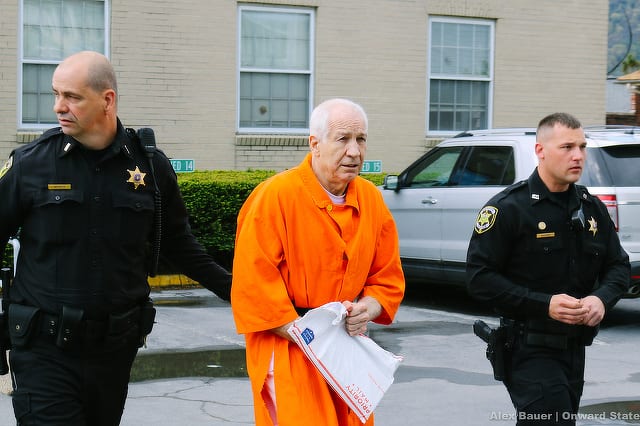
Jerry Sandusky is scheduled to appear in Centre County court next month for resentencing on his 2012 child sexual abuse convictions.
An order filed Wednesday by specially presiding Judge John Foradora, who has been overseeing trial court level appeals in the case since 2017, scheduled the resentencing for Sept. 23, about seven months after Pennsylvania Superior Court ruled mandatory minimums were improperly applied when Sandusky was sentenced to 30 to 60 years in state prison following his conviction on 45 counts related to child sexual abuse.
Foradora, a Jefferson County judge, also signed an order for Sandusky to be transported from State Correctional Institute-Laurel Highlands in Somerset County to Bellefonte for the resentencing.
Sandusky, the former Penn State football assistant coach and founder of the Second Mile charity for at-risk youth, had sought a new trial under the Post-Conviction Relief Act. While Superior Court denied his request for a new trial, it did concur with one of his arguments — that the trial court’s use of mandatory minimum sentences to structure the aggregate sentence was unconstitutional.
Trial Judge John Cleland previously wrote that it was done as a way ‘to simplify an otherwise complex sentencing structure into a more easily understood format.’
Since Sandusky’s conviction, Supreme Court decisions changed the legal requirements for mandatory minimum sentences
Prosecutors conceded mandatory minimums were used but asked Superior Court to “’effectuate the intent of the trial court by preserving the overall sentencing structure but removing the mandatory designations currently affixed to the counts’ where the mandatory sentences were imposed.’
Superior Court, however, ruled it did not have the authority to simply strip the mandatory minimum designations and maintain the sentencing structure. The panel agreed with Sandusky attorney Al Lindsay’s claim that the use mandatory minimums in the aggregate sentence was unconstitutional citing Supreme Court cases that held ‘any fact that increases the sentence for a given crime must be submitted to the jury and found beyond a reasonable doubt.’ Previously in Pennsylvania, the sentencing judge would determine if mandatory minimums would apply, sometimes based on his own finding of fact — a process that was mostly made illegal following the Supreme Court decisions.
Last month, Pennsylvania Supreme Court declined to hear Sandusky’s arguments for a new trial, exhausting his appeals in Pennsylvania. Lindsay has said he will attempt pursue relief at the federal court level.