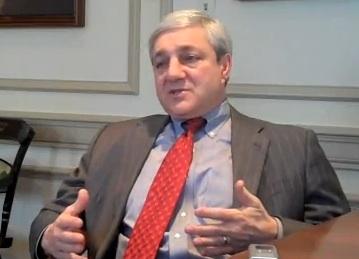
Editor’s Note: This is the first report in a two-part series following an exclusive interview with Penn State President Graham Spanier. Click here for part two.
—————————
Penn State employees could begin to see pay raises again in the 2010-2011 academic year.
In an interview this week with StateCollege.com, university President Graham Spanier said Penn State is ‘very determined to give some level of pay increase this year,’ even as it faces other fiscal challenges. The university froze salaries for the 2009-2010 academic year, one of multiple cost-cutting measures.
‘I don’t think (the likely pay raises) will be as generous as people would like or deserve, but we don’t think it’s right to go two years in a row without a pay increase,’ Spanier said. ‘We have to find a way to help people keep up with their cost-of-living needs.’
Severe stresses on the university budget and the persistent danger of students’ alcohol abuse are among the top concerns facing Old Main this spring, Spanier said. A separate article, to appear Friday on StateCollege.com, will focus on his thoughts about the alcohol issue.
On the financial front, Spanier said, the university is feeling immediate pressure from several sources. Its appropriations from the state government have seen a new, permanent cut of six percent, and the temporary federal stimulus funds now filling that gap will be depleted by the end of next year. Meanwhile, the State Employees’ Retirement System, utility bills and health-care expenses are taking heavier tolls on the budget, Spanier said.
Millions of dollars in reported budget cuts last year — including the salary freeze — helped Penn State hold tuition increases to the 4.5-percent range for 2009-2010. The increase was among the smallest seen in recent years at the university, where overall tuition rates have more than doubled in the past decade. In-state, full-time undergraduates at University Park now pay more than $13,000 in annual tuition.
University trustees have approved the higher tuition rates as another primary revenue source, state appropriations, has failed to keep pace with inflation and other cost increases on campus. State funds, just more than $300 million for the 2009-2010 academic year, now account for about eight percent of the Penn State budget, down from nearly 37 percent in 1970.
Spanier said state appropriations for the university are likely to stagnate or decline further, in part because the funding is designated only as discretionary spending in the Legislature. No federal or state mandate requires a minimum funding level for Penn State.
‘We could continue to suffer relative to other state priorities,’ Spanier said. He said tuition increases will probably continue to outpace the inflation rate, if only by a slim margin, ‘because the state is not keeping up with their part of it. But I don’t think we’re going to get into double-digit tuition increases.’
Even as state support wanes, Penn State is striking new highs in private fundraising. The university is projecting a fundraising total of about $200 million for this year, with about $300 million more anticipated in the form of philanthropic pledges, Spanier said. Pledges may be paid off over several years.
Much of that money will be counted as part of an upcoming fundraising campaign, ‘For the Future: The Campaign for Penn State Students,’ scheduled to launch in late April. A central priority in the multi-year effort will be increased scholarship support, intended to help students pay the rising tuition bills.
Such philanthropy ‘adds to the margin of excellence at the university,’ Spanier said. About 1,000 people are expected to attend campaign kick-off events on the weekend of April 23.