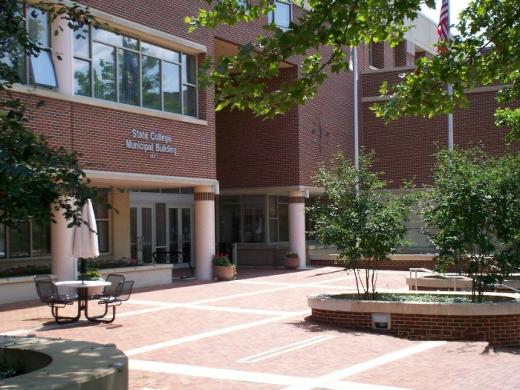
State College Borough Council appears committed to building an affordable-housing mandate into the town zoning ordinance — despite a Planning Commission recommendation to the contrary.
The zoning concept would require new six-unit and larger residential developments to include a minimum amount of ‘inclusionary housing’ — dwellings priced within reach of middle-class, working-class families. In lieu of incorporating those inclusionary units, developers could pay a borough-calculated fee or devote separate property to affordable housing.
Borough planning commissioners last month panned the idea in a 4-1 vote. Among their biggest concerns, they worried that the requirements would impede overall redevelopment in the borough and send more development into the surrounding townships. They recommended that the borough work with the Centre Region Council of Governments or the Centre County to strike a more regional approach — not a borough-centric approach — in cultivating affordable housing.
But several Borough Council members, presented with that recommendation Monday, seemed disappointed.
‘I think it’s something that is badly needed. It’s badly needed by the borough,’ council member Peter Morris said of an affordable-housing mandate. ‘The (surrounding) townships have an infinite amount of space to build in, so I don’t know that it’s so necessary for them.’
Some surrounding townships offer incentives for the development of affordable housing, but they don’t require it.
Borough Council member Don Hahn said it’s unlikely that the borough is ‘going to be having a commonality of interests with the county and the COG’ in handling the matter. He also questioned developers’ earlier statements that an inclusionary housing requirement would impede construction in the borough.
‘I think they’re very intelligent,’ Hahn said of local developers. ‘They know what they’re doing. But they also don’t necessarily tell us … something that’s contrary to their interests.’
And while he respects the Planning Commission’s stance on the housing issue, Hahn said, ‘that doesn’t mean that I’m going to be following the Planning Commission’s opinion.’ (The commission is an advisory body that serves at the pleasure of the council.)
The inclusionary housing proposal, promoted for months by the Borough Council, is rooted in the idea that the borough needs and should accommodate a diverse base of permanent residents across income brackets. Council member Theresa Lafer said Monday that the region suffers from ‘a division of types of housing’ that can ‘divide us into a series of ghettos,’ each oriented toward a separate demographic.
Most of the new construction in the area is ‘very much higher-end,’ and the community somehow should ensure that middle-income people aren’t pressured out of the local housing market, Lafer said.
‘It is a necessity that we keep bringing in families who can afford to live here and (that) we don’t simply price them out,’ Lafer said.
Council members are expected to address the matter in more detail at their Oct. 11 meeting. In other news Monday:
- The council heard from Elody Gyekis and Natalia Pilato, of the Community Arts Collective. The community group, with help from more than 500 local volunteers, has developed the ‘Dreams Take Flight’ mural. It will be assembled on wall space on the south side of West Calder Way between South Allen and South Fraser streets, probably within the next few weeks. The 170-foot mural carries several local themes, including migration, education, the arts, youth and nature. A community unveiling ceremony is scheduled for Nov. 13.
- Penn State student Lienard Chang outlined his efforts to bring a bike-share program to Penn State University Park. A ‘low-tech’ bike-sharing program will begin on campus within the next week or so, but Chang hopes to help bring a larger company here in the longer term, he said. The initiative would be similar in concept to car-share offerings in metropolitan areas, where motorists can pick up and drop off rented transportation at numerous locations.
- The council heard an update on the Centre Region’s emergency-preparedness efforts. Locals can now receive emergency alerts via Facebook and Twitter, said emergency-management coordinator Shawn Kauffman.
Earlier coverage