

State College Borough Council on Monday discussed several potential changes addressing parking violations, a continuing pilot program for meter downtown parking and a new pilot for special event rate parking in neighborhoods.
The measures are expected to be up for a vote at council’s June 15 meeting. Council also continued its review of a pilot to covert four downtown street segments to one-way, though members indicated they would not be prepared to vote on that until July.
Special Event Parking in Neighborhods
The borough Parking Department has proposed a pilot program from August through December that would require payment for street parking in the College Heights, Highlands and Holmes-Foster neighborhoods at times when special event rates are in effect at borough garages and meters, such as Penn State football home weekends.
State College has traditionally lifted overnight parking restrictions in neighborhoods during those special event periods, essentially creating all-day free street parking. But under the pilot, visitors without a residential parking permit would be required to pay $25 for a 24-hour session or $50 for a 48-hour pass through the borough’s digital parking platform.
“This was initially researched and devised as a measure to help ease the financial burden on neighborhoods and generate general fund revenue during periods where historically parking was free without any time restriction,” Parking Director Tom Brown said. “An attempt at a previous permission program had faults, however, technology has greatly improved. over the last decade to where enforcement and payment would be much simpler.”
While education and implementation would limit revenue during the pilot period, Brown said that if it continues it could potentially generate up to $350,000 per year, assuming 100% compliance.
“This is basically the equivalent of adding three to four football games per year that would be the additional revenue,” Brown said.
Council member Susan Venegoni noted that residents who get $10 annual ‘R’ permits can park on the street in any designated ‘R’ zone and allow their guests to park in their driveways.
2-Hour Meter Parking
A pilot program enacted in 2025 that extended 90-minute maximum street spaces to two hours but prohibits “meter feeding” would continue with some minor changes, if approved.
The two-hour limit would be in effect from 10 a.m. to 6 p.m., instead of the current 5 p.m. The maximum after 6 p.m. would then be four hours, until 10 p.m. when meter enforcement ends. The maximum on Saturdays would be five hours.
Brown said the change to 6 p.m. is because it is “just a natural kind of break in the day as people are leaving their offices and places of work downtown and then going to more of a nightlife type evening vibe.”
The borough enacted the pilot program in 2025 to encourage regular turnover of street parking and use of garages. While street meter maximums were extended, parkers are unable to add time, or “meter feed,” through the ParkMobile app.
Ordinance Updates
• A construction permit requirement would be added for parking construction vehicles in R, R-1 or commercial zones for work lasting seven days or longer.
“If you have a contractor that’s going to be there for a couple of days, that’s not what we’re talking about,” Brown said. “This is for long-term projects, construction projects where there’s going to be a slew of contractors parked on the street for weeks on end.
• Parking along the south side of East Calder Way west of McAllister Street and West Calder Way west of Miller Alley would be permitted for five minutes only for loading and unloading purposes unless an exception is approved by the Parking Department or an occupancy permit is obtained.
• Passenger vehicle operators who incur more than five loading zone violations would receive a scofflaw penalty that raises fines to $75 for every occurrence thereafter.
• Unpaid parking violations in excess of $200 would be added to the policy for booting vehicles parked in any public space, along with the existing criteria that include five or more unsettled parking violations and one or more arrest warrants as a result of parking violations.
Additionally, release of the vehicle would require payment of all unsettle parking violations, along with the existing condition requiring collateral be deposited for the owner’s appearance before a district magistrate to answer for each unsettled citation. If the vehicle is towed, both conditions also must be met before it will be released.
• Parking in commuter and R zones without a permit is limited to two hours, and the policy would be updated to clarify that the maximum applies to the entire block Monday through Saturday. So effectively the driver cannot simply move their vehicle to a different space in the same zone after two hours.
• Twenty-minute tour bus loading and unloading zones would be added on Beaver Avenue near South Fraser, South Burrowes and South Pugh streets, joining established drop-off and pick-up zones on Calder Way near South Atherton Street and on the 100 block of South Fraser Street.
“The ability to maneuver large busses on 100 S Fraser and Calder near Atherton has been successful in keeping the streets safer and the right of way less impacted, but the demand is exceeding the supply at other high traffic locations where buses frequent for passenger coordination and short dwell,” Brown wrote in a policy briefing summary.
• Digital payment only zones on the 300 block of South Allen Street, 100 block of West Foster Avenue, 200 block of South Burrowes Street and and 400 block of West Beaver Avenue have been in effect under a pilot program since 2025. They would be permanently codified under borough ordinance, if approved by council.
“Last year, we tried out these digital payment zones. It’s been wildly successful, with a large increase in paid sessions,” Brown said. “The major goal has been achieved with people purchasing parking and parking legally. We will not have to replace expensive multi-space meters that are in these locations that are now basically non-functioning. If we codify the digital payment zones, we can remove that equipment and clean up the curb line and make it a little bit easier for everyone.”
ONE-WAY PAIRS
Council also continued the discussion of a proposed pilot to convert segments of four downtown streets —the 100 blocks of Locust Lane, Hiester Street, Sowers Street and Hetzel Street — to one-way pairs.
As previously reported by StateCollege.com, Locust Lane would be one-way southbound (toward East Beaver Avenue) and nearby Hiester Street one-way northbound (toward East College Avenue). For the other couplet, Sowers Street would be one-way southbound and Hetzel Street one-way northbound.
If approved the pilot would be in effect for a year beginning in August before student move-in, except on Hetzel Street which would begin after move-in.
Eliminating one travel lane on each of the four street segments would allow for the addition of 32 metered parking spaces and five loading zones, borough transportation engineer Ron Seybert said.
“It is a relatively low cost implementation that has the potential to improve pedestrian safety, assist with the move-in for students in the fall, have the potential for future sidewalks to be widened when reconstruction projects are completed, and the potential to create ped nodes at the intersections of College and Beaver Avenue at the end of these additional parking bays for amenities,” Seybert said.
The drawbacks, he said are the potential for inconveniencing drivers who would need to travel another block and possible confusion, particularly in the early going.
“The potential for traffic delays is something that needs to be evaluated, and we propose to do that as part of the trial for this project as opposed to trying to forecast those types of changes,” Seybert said. “There is the potential for wrong-way bike movements on the one-way streets, as well as additional delay for emergency response. Although minor, there would also be some additional signs and markings that would need to be maintained as well.”
Borough staff have consulted on the plan with the Downtown State College Improvement District and the Retail Advisory Committee, but not with individual businesses.
Council President Evan Myers said the one-way southbound on Sowers Street could create issues for businesses in the Centre Court plaza, as customers who typically turn from Beaver onto Sowers to access the parking lot there could no longer do so and would have to loop around to East College Avenue.
“People would have to go around the block, creating more traffic or just bypass it altogether,” Myers said. “I’m concerned that the businesses in this area have not been consulted, other than just in a large sense. And I understand that may be difficult to do that, but I wonder how it might affect them.”
Council member Matt Herndon said he generally supported the concept, except that it “effectively bars bikes from Locust between College and Beaver.” Locust Lane on the south side of Beaver is one-way northbound, so the two segments are in opposing directions and the change would cut off all through-travel.
“The only legal way to ride a bike on that stretch is really to come from College, which is probably one of our most dangerous roads to bike on,” he said.
Herndon suggested leaving Locust out of the pilot.
“It’s going to need some more work in my opinion because I just don’t think we could ban cyclists from that road and walk away and feel good about ourselves,” he said.
Council members agreed the one-way pairs pilot would not be ready for a vote on June 15 and expect to take it up on July 6.
More Local News
View all Local News
Harlem Globetrotters Bringing New Rivalry Tour, Free Pregame Party to Bryce Jordan Center
The Harlem Globetrotters are bringing a new lineup of rivals and interactive basketball challenges to Penn State in March as part of the team’s 2027 world tour. The exhibition basketball […]

State High Band Celebrates 100th Anniversary
More than 230 State College Area High School marching band alumni returned to the field on Friday night to join 240 current band members for a celebration 100 years in […]
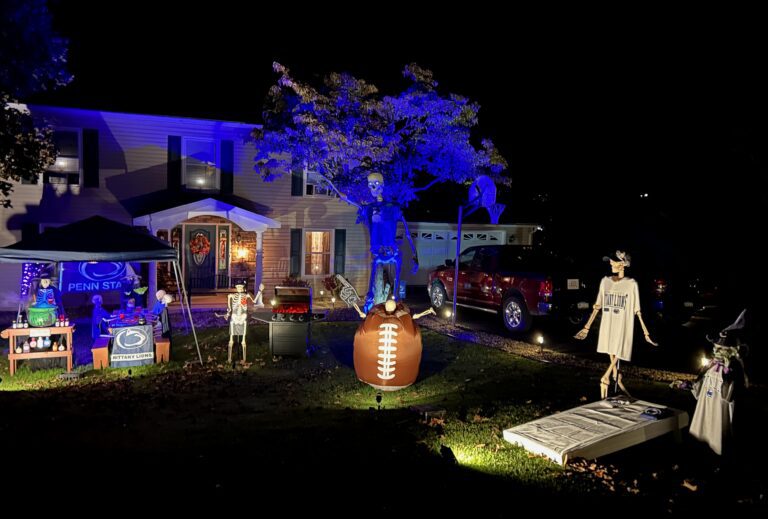
‘Big Leboneski’ and Friends Are Back in Bellefonte With Tailgate-Themed Display to Raise Money for St. Jude Children’s Hospital
A 12-foot-tall skeleton named Big Leboneski and his friends are back for another year on a Centre County family’s lawn to raise money for St. Jude Children’s Research Hospital. Now […]


