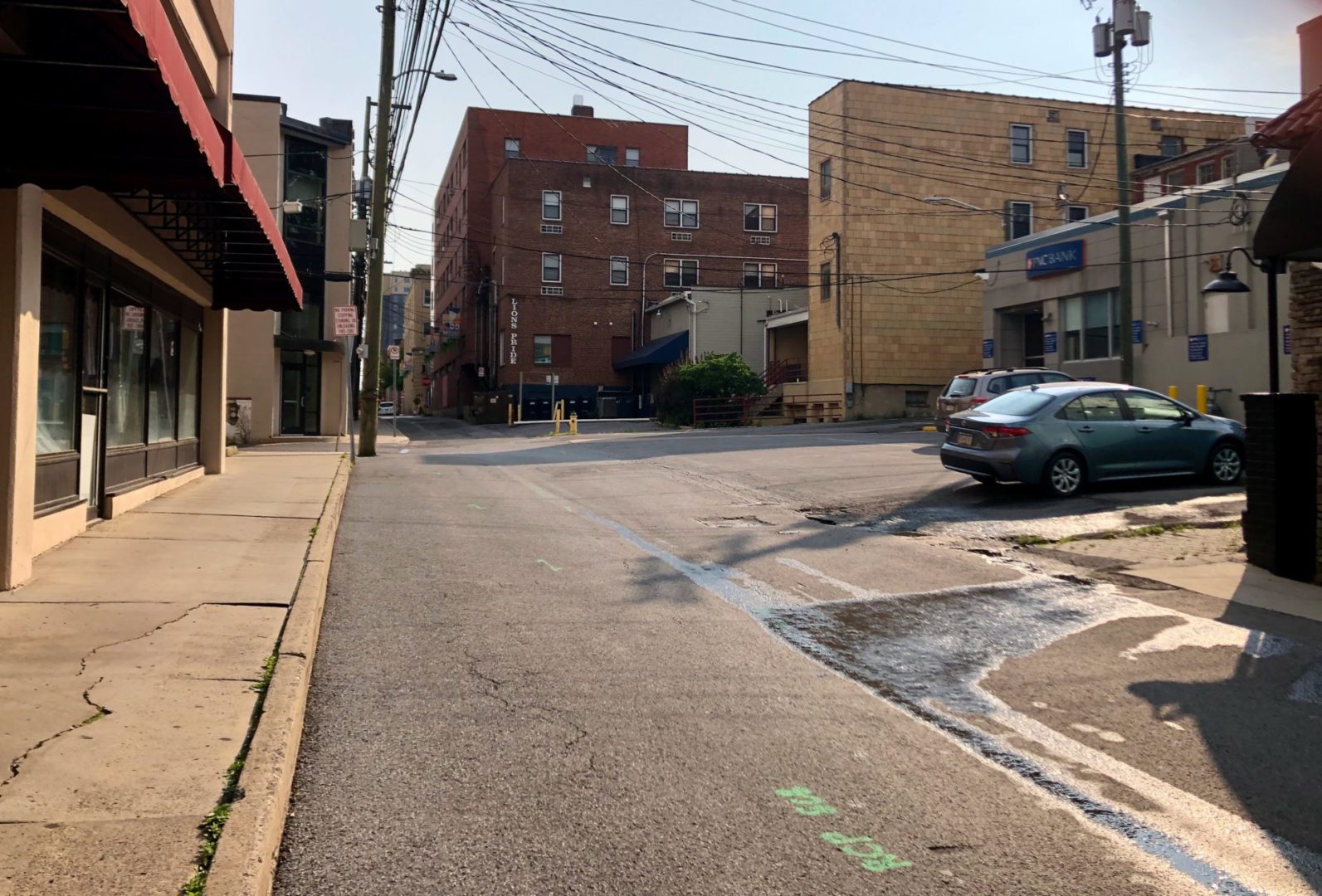
A long-planned project to replace aging utility infrastructure and create a more pedestrian- and bicycle-friendly space on Calder Way in downtown State College is expected to get underway this summer.
Andy Arnold, of engineering firm Gwin, Dobson & Foreman, said at a borough council work session on Monday that work on phase one of the multi-year project is anticipated to begin after the conclusion of the Central Pennsylvania Festival of the Arts, which ends on July 16, and continue until mid-November.
The project stems from the 2013 Downtown Master Plan, which envisions Calder Way as “a shared use space which is more friendly for pedestrians and bicyclists while maintaining vehicle access for emergency and essential services, deliveries, refuse and parking access.”
Phase one, which encompasses Calder Way between South Fraser and McAllister streets, is part of an overall project to transform Calder Way into a “pedestrian-preferred” corridor with limited vehicular traffic, “replacing curbed sidewalks with more artistic measures and the incorporation of other streetscape enhancements from Hiester to Burrowes,” according to the borough’s 2023-27 Capital Improvement Plan.
Streetscape and transportation work planned in the first phase is expected to include widened sidewalks to provide an at-grade pathway using stamped concrete, ADA upgrades at all intersections with detectable warning devices and installation of retractable bollards for traffic control. The project vision also calls for new lighting, greenery and public art.
At the same time, infrastructure needs to be replaced in what “has been a utility corridor for as long as State College has existed,” Arnold said. Over the past year engineers have completed the design for utility replacement and relocation the entire length of Calder Way from South Atherton Street — where there is a confluence of utilities supplying everything east in the downtown — to High Street.
Work in the first phase between South Fraser and McAllister will include replacement of sanitary sewer, stormwater, water main and gas main lines and providing provisions for electric and telecommunications lines to be moved underground. Future phases will involve similar work on the rest of the street.
Water main replacement is a State College Borough Water Authority project.
“This project schedule has been driven largely by the water authority,” Arnold said. “They had a planned project to replace the waterline. There have been several breaks over the past few years, two in the past year, and it is at the end of its useful life. In conjunction with that, the remainder of the utilities are scheduled to be replaced.”
The borough has $6 million, supported by American Rescue Plan Act funds, budgeted for 2023 for sanitary sewer system upgrades and received a $2.44 million low-interest loan from the Pennsylvania Infrastructure Investment Authority for stormwater management infrastructure replacement.
“At the end of the day what we hope to provide is uniformity throughout Calder [from Atherton to High],” Arnold said. “Not just the above-grade concerns, but also with the utilities.”
The required Act 537 Sewage Facilities Plan Update for the sewer system upgrades is in the process of approval and the work “sets us up to provide sewer capacity for the next 50 years of potential buildout in State College.”
Logistics will be a challenge, Arnold said, with work to replace deeply buried utility lines taking place in a narrow corridor in close proximity to “some very old buildings,” all while trying to maintain access to more than 30 properties and nearly 100 businesses.
The borough is coordinating with the Downtown State College Improvement District in preparation for the work.
“There’s no false pretense here of the inconvenience these folks are going to be put through for this summer and fall,” Arnold said. “We will continue to coordinate that with them and throughout construction likely on a daily basis.”
Sequential project phasing will help limit downtime for utilities, Arnold said. The sewer will be temporarily pumped and the water line will experience “a few hours of downtime rather than weeks.”
Traffic detours will be necessary, though plans will aim to keep the main thoroughfare intersections at Fraser, Allen and Pugh streets open for the majority of the project. They will see some closures, but those are expected to take place in the summer when there is less traffic.
The project will be put out to bid in April, and a stipulation of the contract will be to have roads open during large event weekends, particularly home Penn State football weekends in the fall, Arnold said. Fridays of football or holiday weekends would be no-work days, and on Thursdays the work area will be back filled to open access.
“This is why what amounts to a 1,500-foot utility replacement is going to take four months,” Arnold said. “It’s a very restricted area and working in there is fairly difficult.”
With the Calder Way project, part of the borough’s Pedestrian Safety and Universal Accessibility Initiative, expected to take multiple years and with external funding still being sought for future work estimated at a cost of approximately $32 million, first-phase work in 2023 will be a “barometer” for what can be completed in a construction season.
“It will dictate where we go moving forward,” Arnold said. “We anticipate about two or three blocks a year for the next three to four years, possibly five, depending on funding opportunities and grants and that sort of thing.”
Two other accessibility and safety projects, both of which are funded by the Pennsylvania Department of Transportation, are expected to take place next year and will be coordinated with the Calder Way project.
Work at the College Avenue and Allen Street intersection will include ADA ramps, ramps for bicycle connection, a bike lane as part of the crosswalk, sidewalk expansion and expanded bulb-outs, or curb extensions, at the intersection. A project on Beaver Avenue will reduce travel lanes and expand the sidewalks 3 feet, add brick banding on sidewalks with large brick fields at intersections, implement sharrows for shared bike lanes and expand bulb-outs at intersections.
Both projects are in the final design phase.