Don’t have a garbage disposal?
Many residents don’t blink an eye or think about what happens to the food scraps they toss into their trash cans, nor do many realize that these items are compostable.
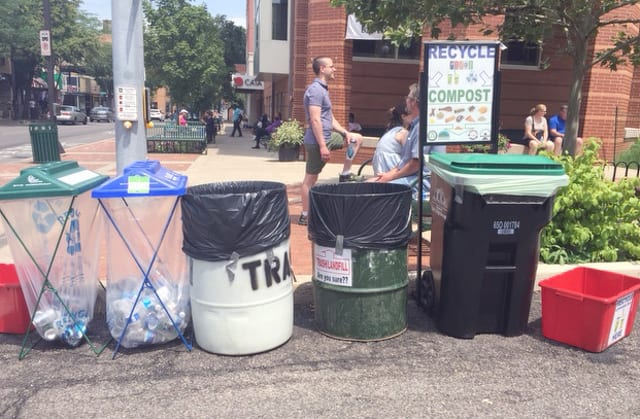
In recent years, though, State College has positioned itself at the forefront of a zero-waste movement making recycling of organic matter more accessible and feasible to its residents. Now, the rest of the Centre Region is considering stepping on board.
State College is the only borough in Pennsylvania that recycles food waste and is also the only borough with a fully implemented residential organic waste curbside collection program.
“We want to be on a leading edge of this,” said Ed Holmes, State College’s public services manager.
When organic waste — including food scraps, napkins and tissues, newspapers, garden waste, grass clippings, and brush and leaves — is sent to landfills, it decomposes quickly, releasing methane into the atmosphere. Methane is a greenhouse gas 23 times more efficient at trapping heat than carbon dioxide, according to the U.S. Environmental Protection Agency.
About 32 percent of what is thrown out in the trash is actually recyclable organic material, with the average single-family household throwing away about 45 pounds of food scraps and food-soiled paper every month, said Joanne Shafer, deputy director and recycling coordinator at the Centre County Recycling and Refuse Authority.
Centre County disposes of about 93,000 tons of trash each year, Shafer said. So, that would mean residents may actually be able to divert 28,000 tons of that material by composting it.
Shafer said after developing a residential and commercial curbside organic recycling program — where trucks pick up organic material from the curb each week and bring it to the recycling center in Patton Township — State College now diverts about 5,000 tons of this type of waste away from landfills each year.
“Adding the addition of food waste has been a relatively new phenomenon,” Shafer said.
Curbside composting gains momentum in State College
A new wave of organic materials recycling is growing in State College, and it’s more commercial friendly than ever.
State College extended a curbside food waste and organics recycling program to all residents in the borough in April 2013. The following April, the borough began to think commercially and extended the program to businesses.
State College is now looking to add more commercial organic waste locations, said Mimi Cooper, of the Centre County Refuse and Recycling Authority.
“Commercial pickup is very limited, but it continues to grow,” added Ed Hicks, the borough’s public works foreman.
After piloting 10 locations through the commercial program, State College now picks up organic waste recycling from 18 locations, including several downtown restaurants, area supermarkets and elementary schools.
The amount of material collected has substantially increased since two Weis Markets, which are actually located outside the borough, joined the program about six months ago, Hicks said.
In 2014, about 13 percent of organic material that State College collected through the program was from commercial locations, but in 2015 that percentage rose to about 25 percent.
The borough is also purchasing two front-load organic waste recycling dumpsters to replace the 65-gallon carts at larger commercial locations such as Weis. Hicks said this would free up some of the carts that other interested business could use.
Centre Region gauges regional organics recycling interest
As curbside composting is gaining momentum in State College, the Centre Region Council of Governments is talking about catching up.
“State College is so forward-thinking with organics recycling and I think COG wants to get on board with that and move forward,” said Laura Gebhart, who was one of the four Penn State students who partnered with COG to create a survey to gauge the region’s interest in a curbside composting program.
The survey, which was available online April through the end of May, was intended for households in Benner, College, Ferguson, Harris and Patton townships, as all are on COG’s refuse contract, Holmes said.
The four students are just now releasing the results, which reveal that many residents are interested in a curbside program that would mimic State College’s.
“The program was so positively adopted by borough residents, so we were anticipating a similar interest,” Gebhart said.
More than 80 percent of the 733 survey respondents said they would be somewhat or very likely to participate a curbside organic waste recycling program. And, a similar percentage of participants said it was of moderate to extreme importance that the county implement such a program. However, some participants did express concerns about cleaning the storage containers, the odors from the waste, health issues and attracting household pests.
The survey’s response rate was just more than 3 percent of the 22,409 residents living in the five townships and the results may be skewed, with those interested in composting more likely to have taken the survey than others, according to the report.
However, Gebhart and others said this does not diminish the value of the results.
“The survey is not accurate for being representative, but it’s valuable because there were 733 households who took the time to take it,” said Tim Kelsey, the professor who oversaw the four students who helped create the survey and report. “There is at least a critical enough mass of residents who want this done.”
The next step is presenting the report during the General Forum meeting in August or September and introducing the information to the public.
If participating municipalities agree that there is interest in developing a program, COG would have to determine the compost facility, said Pamela Adams, the regional refuse and recycling administrator at COG.
Any changes wouldn’t likely occur until the next contract round that begins in about four years, Shafer said. Until then, COG has details to discuss.
“We would have to figure out where this organic material would go, the scope of services, method for collection and frequency,” Adams said.
The facility that State College uses for its curbside composting program has 72 acres of space and actively uses four of those acres for composting, Holmes said.
There is plenty of space to expand the facility if needed, according to Holmes, but there is a lot that would go into the expansion. For example, the facility would have to pave more areas, because food scraps must be composted on a hard surface.
Based on the report, about 24 percent said they would not be willing to pay a nominal fee.
Adams said, “There has to be a balance between how much people want it and the cost.”
Borough says composting saves money
It’s become popular belief that recycling and composting procedures are more expensive than tossing organics in the trash.
But, Holmes said it is actually less expensive for the borough to compost organics than to send them to the landfill.
The tipping fee at the landfill is about $68 per ton, he said, while the processing fee at the compost facility varies around $40 to $50 per ton.
State College also sells the finished compost at $15 per cubic yard or $4 for a 2-cubic-foot bag, which helps fund the curbside and composting operation.
Within the borough, there is no additional charge for the curbside organic waste recycling pickup. It is also not financed through taxes, Shafer said.
“I end up with one truck collecting organics and another landfill, instead of two going to the landfill,” Holmes said. “It really ends up balancing itself out.”