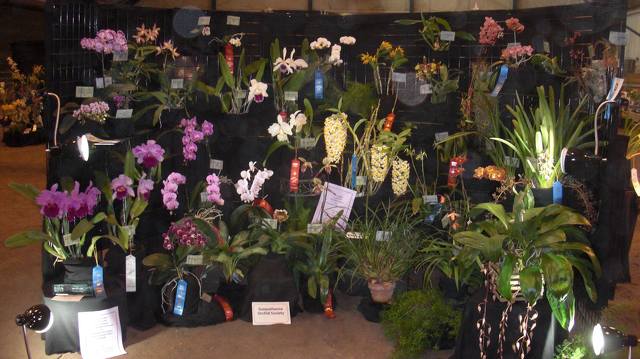
The Central Pennsylvania Orchid Society will hold its 53rd annual Orchid Show from 1 to 6 p.m. Saturday and 10 a.m. to 5 p.m. Sunday at Penn State’s Snider Ag Arena. This promises to be the premier event for local orchid growers of all experience levels, and it will be a draw for collectors from nearby states and beyond.
Some of the highlights of the show include:
■ Tours by knowledgeable orchid growers at 1 and 4 p.m. Saturday and noon and 3 p.m. Sunday.
■ Orchid potting demonstrations at 3 p.m. Saturday and 2 p.m. Sunday. Visitors may have one orchid plant repotted for free and up to two more repotted for only the cost of supplies. Orchid plants and potting supplies will be available from onsite vendors.
■ A special photographers’ hour from 9 to 10 a.m. Sunday. This time has been allotted to allow for photographers only.
■ Vendors of orchid plants and supplies from Pennsylvania and several surrounding states who can answer questions and give advice about home care of the plants. The vendors say that being at this show provides them with the opportunity to acquire new plants from Central Pennsylvania Orchid Society members, some of whom are not only collectors, but breeders developing new crosses available from no other source.
Judging for the show is done by highly qualified American Orchid Society judges, who travel around the U.S., and sometimes internationally, judging and attending shows of all sizes. Rumor has it that they look forward to this show because of the high quality of the plants being exhibited, as well as for sale. I am told that many judges actually purchase plants from the show to add to their own collections.
“In the first place, you will see some fantastic orchids,” long-time AOS member Kit Hume said about the show. “We have vendors and showers who come in from other societies and a certain number of orchids will get national awards. That’s what the judges are for. They come in from outside so no one local has a connection there. So, they are judging things by standards set up by the national orchid society, and there will certainly be at least a half-dozen plants that get awards of that sort.”
While orchid plants were once seen as expensive and exotic, they now have come more into the mainstream.
“Orchids are found in every continent except Antarctica,” Hume said. “The native ones in Pennsylvania that most people would know are the pink lady slippers (Cypripedium). Those are orchids, but you should warn people not to dig one up and try to grow it in a pot. They need the fungi and so forth that are in the ground and they would die if you dug them up.”
There are a few common varieties of orchids that are now available at various State College locations such as garden shops, supermarkets and building supply stores.
For those, like myself, who do not have a long history of orchid growing, the American Orchid Society offers some tips in a video, “Orchid Care for Beginners,” on its website, www.aos.org. Here are some of the group’s recommendations:
■ Place the orchid close to an east, west or lightly shaded south window. Without enough light, orchids may produce lush-looking growth but no flowers; if the light is sufficient, the foliage will be somewhat green-yellow with upright growth.
■ Orchids are comfortable with typical home temperatures of between 55 and 60 degrees at night and 75 degrees during the day. The plant should not touch the window.
■ Orchids need good drainage and should be watered copiously just before they dry out. Water should be applied until it runs freely from the drainage hole at the bottom of the pot. It is better not to use the ice cube method of watering because it can harm the roots.
■ Good airflow needs to be provided to the roots, so it is advisable to use soil intended for orchids.
■ Growers suggest using a “balanced” fertilizer such as 20-20-20, applying a diluted (quarter-strength) fertilizer after watering. Orchids do better with too little fertilizer rather than too much.
“The easiest orchid I think to grow in a house is the Phalaenopsis, or the so-called moth orchid,” Hume said. “You also see those in great abundance at Trader Joe’s, or Wegmans, or Lowes. They are generally known to be easy for beginners. They like household temperatures. They don’t want to get too cold or too hot, and they don’t need a great deal of light. You can do perfectly well with windowsill growing, and they stay in bloom for a long time. So you get a lot of payback from a Phalaenopsis.”
As far as attending the show itself, Hume said the first thing to do is to take in all the wonderful orchids. But, she also advised not to skip the vendors.
“I would go to the vendors and see what orchids I would want to try to buy. Sometimes you would see something out in the arena that is rather splendid, and if you go out and ask, a vendor might say, ‘Well, ours is not that far along, but you can buy one here for $15 and in a couple of years, it might look like that.’
“The vendors are extremely knowledgeable — they are all professional growers — and they are very helpful to people who ask how to grow an orchid,” said Hume.
If someone would like to learn about orchids and their care, or is in the market to buy orchids, or would just like to enjoy their color and beauty, the AOS show is the place to go.
Admission and parking are free.