
The Cuban cigar is not the most coveted cigar simply because it is from Cuba. It is the soil from which the tobacco leaves grow in the valleys of Cuba that make the true essence of the cigar.
Like the French or the Italians think of wine and the special characteristics that each wine has that come directly from the soil it is grown in, a concept known as terroir, the Cubans think of cigars. This is especially the case for Ernesto Casillas, a Cuban immigrant and owner of Casillas Cigars in Miami, Fla.
But Casillas didn’t always live in Miami. Or own his own business. Or be abe to roll a cigar in two minutes flat. He started working in the fields of his grandfather’s tobacco plantation near Camaguey, Cuba when he was a little boy.
“I started rolling when I was 11,” Casillas says through his translator Tony, as Casillas does not speak much English. “My grandfather built the plantation.”
Casillas, who got into cigar rolling simply because it was the natural progression from working in the fields, moved to the United States in 1992 when he was 28 on a visa his father bought him. His father currently owns another company also called Casillas Cigars in Sacramento, Calif.
Even though he still has family in Cuba and is still able to visit as he is not an American citizen, he decided to move to the United States because “it is indisputably the best country in the world.” Casillas stays in Miami most of the time because the atmosphere is so close to home.
He is currently in State College for a series of cigar making demonstrations at Your Cigar Den located on Calder Way between South Fraser Street and South Allen Street. He was brought to State College by owners Russ and Patty Keller.
Even though Miami is his new home, Cuba is still the start of his cigar making process, since that’s where the seeds for the tobacco plants come from. For years the best cigars were produced in Cuba, but this is no longer the case.
It all goes back to the politics of the region that cannot, for better or for worse, be separated from the Cuban consciousness.
Before Fidel Castro took over the Cuban government, all the land intended for growing Caribbean tobacco leaves was owned by the farmers who grew the tobacco. In “post-embargo” Cuba, the government took over the land.
Not long after Castro took over, Cuba had a shortage of fertilizer and the crops began to die. To remedy this, the Cuban government began using minced up fish from whatever was left over from the catch of the day to fertilize the crops. This obviously led to a downturn in the product quality in the cigars. They began to taste like cod-liver oil.
After this, Cuban cigar rollers began moving to other countries in the Caribbean with similar soils, such as the Dominican Republic, Nicaragua and Honduras. The tobacco Casillas uses in his cigars may have Cuban seeds, but the tobacco itself is grown in the Dominican Republic and is shipped to the United States.
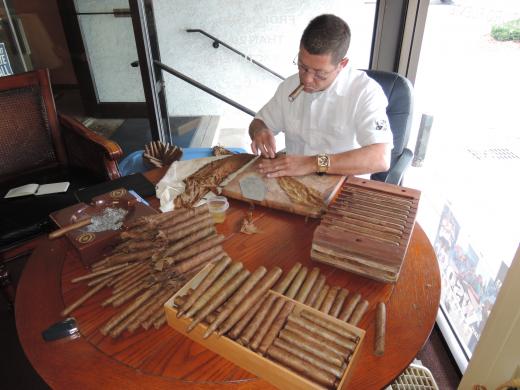
The process Casillas uses is much like many other cigar rollers, who are forced to take their craft very seriously. If you make a cigar wrong more than five times, you are no longer allowed to roll.
First, Casillas uses filtered tobacco that he folds perfectly straight. Next, he uses a different leaf that binds all of the loose tobacco together in a rough shape, which he then puts into a special press for 30 minutes, flips 90 degrees, and presses for another 30 minutes.
The final step is to put a wrapper over all of this, which is the outside layer, and put a cap on the end of the cigar. Casillas does this for up to 10 hours a day, seven days a week.
Even though the process was learned in Cuba, and most of the best cigar rollers are Cuban, this does not mean that cigars made in Cuba are the best. It isn’t that cigars currently made in Cuba aren’t still very high quality, but the very best cigars made in Cuba were made pre-embargo, and even though people talk about buying “pre-Castro Cubans,” the tobacco is too fragile to keep for very long.
“The cigars need to be maintained at a certain humidity at all times to still be good,” Russ Keller said. “Cuba is a third world country. What is the likelihood any would be still good?”
Also, a true Cuban cigar would be too rough for the American palate, as many Cubans start smoking cigars at age five.
If this does not show how engrained cigars are in the life of Cubans, not much else can.
But many things besides cigars do cross over into the America of many Cubans.
Casillas says the only thing that comes close in the cultural affection of Cubans is coffee. They love extremely small, extremely condensed, near rocket fuel quality espresso. Casillas said he drinks so many in a day he can’t even say how many cups he has.
But being a Cuban immigrant is more than just coffee, more than just cigars. It is the work ethic and the adherence to tradition that keeps their culture alive in their adoptive country.
Even though he does own the business, Casillas still works diligently every day. He primarily uses cash and, as many Cubans, keeps everything he owns in top shape, because you don’t know when you might get a new car or coffee maker.
But still, cigars are a large part of what being a Cuban means. Casillas said that the health risks often associated with smoking in the United States do not translate in Cuba.
“My grandfather smoked cigars until he was 91, when he died of a heart attack,” Casillas said. “We all have to die some day.”
When asked if the American perception of Cuba as an island paradise away from the rest of the world was different from the actual Cuba, Casillas didn’t have to think much about it.
“The problems have to do with the government,” Casillas says. “The perception is correct. … It is a jewel.”
More Community & Entertainment
View all Community & Entertainment
January Is a Call to Action to Respond to Stalking
This column by Centre Safe Executive Director Jennifer Pencek originally appeared in The Centre County Gazette. When we talk about acts of interpersonal violence, oftentimes people will focus on sexual […]

Busy Weekend of Fall Festivals and More on Tap Around Centre County
The weekend of Sept. 29-Oct. 1 is packed with activities around Centre County, including fall festivals, Oktoberfests, fairs, concerts and more. Check out some of the weekend highlights below. For […]
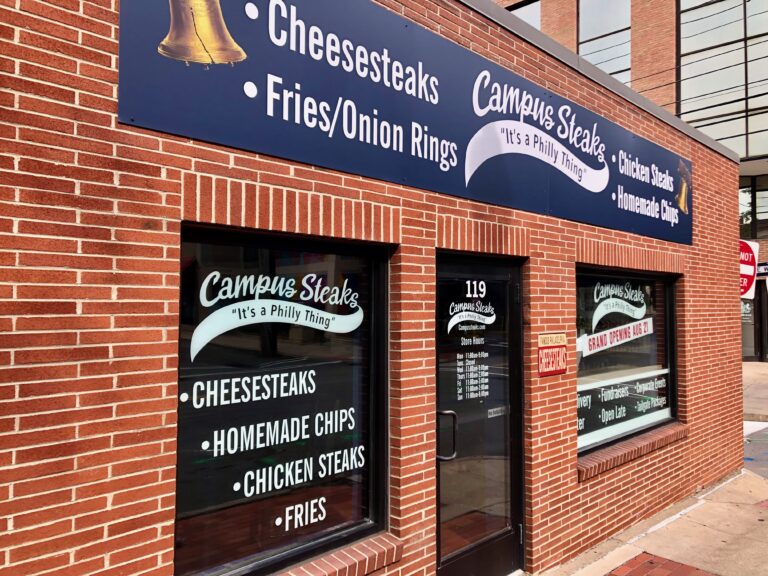
Downtown State College Cheesesteak Shop Sets Opening Date
A new cheesesteak shop that promises a taste of Philly in downtown State College has set an opening date. Campus Steaks plans to hold a grand opening on Aug. 28 […]


