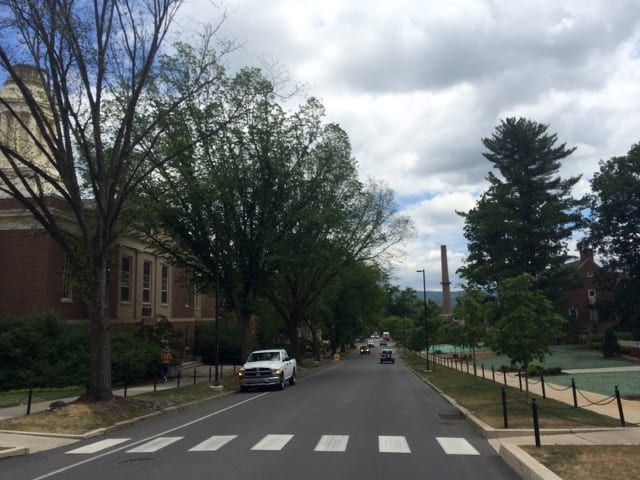
For more than a century, Penn State’s American elm stand was an iconic feature of the University Park campus’s physical plant. With the first elms planted in 1896, the number grew to about 300 by the turn of the 21st Century.
More than half of those elms have been lost to a combination of Dutch elm disease, which had been affecting the trees since 1950s, and the emergence of another disease around 2007, elm yellows. Penn State’s efforts have maintained the stand far longer than most in North America, but the diseases, which have no cure, continue to ravage the elm population.
On Thursday, two more will come down.
Burrowes Road between Pollock and Curtin Roads will be closed beginning at 6:30 a.m. for arborists to remove two elms believed to be suffering from elm yellows, according to the university.
No through traffic will be permitted during the removal, including CATA Bus and shuttle services. Access to Red H, Red D and Green C parking lots and loading areas will be maintained. The road is expected to re-open by mid-afternoon.
Elm yellows is a bacteria-like organism that is spread by the elm leafhopper and infects the root cells and inner bark of the tree, essentially depriving the tree of nutrients. Infected trees usually die in one to two years.
A Penn State Physical Plant spokesman explained to StateCollege.com in 2014 that the elms’ susceptibility to disease combined being planted in large numbers and close together led to the loss of so many trees. It took dedicated efforts of university arborists, plant science faculty and grounds crews to stave off the swift extinction of the elms on campus.
‘The reason we still have any elms at all is due to the work of Penn State scientists and the OPP tree crews that carefully shelter them and monitor the situation,’ he said.
Now, however, as the university plants new trees to replace the lost elms, it is carefully selecting a diversity of tree species to ensure a single disease won’t be able to wipe out a significant portion of campus trees in the future.