
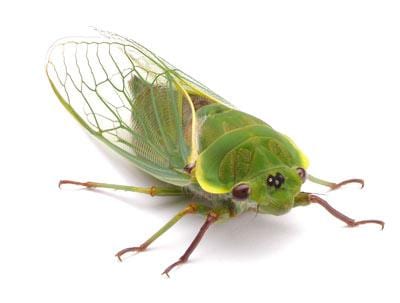
Only the males sing.
I refer, of course, to male cicadas.
Fitting that I heard a chorus of these tree-dwelling doo-woppers as I walked on Foster Avenue between Locust Lane and Fraternity Row, the masculine heart of our summer-somnolent town. I swear they were louder than the parties that will spill out into these same streets a month from now.
By the time I got home, the chirring in my ears had blocked out every other column idea, and I found myself looking up curious cicada facts. Such as:
- The cicadas serenading us currently are not the periodical cicadas that drop in every 17 years. (I believe their next visit is scheduled for 2021. Jamie Moyer will still be pitching; Joe Paterno will still be coaching.) This summer’s crooners are known, aptly, as dogday cicadas.
- Cicadas are big, as insects go, and some of them have wide-set red eyes, which might be a little off-putting, but they neither bite nor sting. “If a cicada lands on you,” one website notes, “it does so only because it finds you to be a convenient place to land.”
- Folks eat ‘em. They eat ‘em curried and quiched, in chocolate cake and cheese wantons and granola chews. (For recipes click here.) One popular way to serve them is as a pizza topping. What do they taste like? Like asparagus, supposedly, or “clam-flavored potato”(?). National Geographic’s website recommends grabbing them when they emerge from their burrows in the middle of the night and boiling them for a minute. (You should know, though, that the larger species of cicada are prone to shriek when disturbed. I’d say being picked up by human and tossed into boiling water qualifies as a disturbance.) If you’re really that hungry in the middle of the night, you might just run down to the nearest convenience store and snag a can of bean dip and a bag of Doritos.
- From another website I learned that the various kinds of cicadas are known by nicknames reminiscent of the noms de rue of my neighborhood pals in New York. Where my friends went by names like Pillpopper, Assman, Wags, Bookie, Nuts and Schwartzie, the cicadas go by such monikers as Black Prince, Green Grocer, Double Drummer, Redeye, Floury Baker and Cherrynose.
- In New Zealand, the Maori use the same word for both the cicada and the Englishman. Apparently, they heard a resemblance between the cicada’s song and the language of Shakespeare.
- Some people keep cicadas in cages because they like their song. You might as well keeping an electric hedge trimmer in a cage, as far as I’m concerned.
- Did you know that the cicada’s closest relative in the automotive kingdom is the 1949 Hudson? OK, I made that one up.
***
But enough about cicadas. Let’s talk about backyard birds. (I’m writing this on my back porch, so I have pretty good view of the backyard bird action.)
For years, whenever I saw a bird in the yard, it registered as a cardinal, a blue jay, a robin. Last month, though, when I had to spend a chunk of my California vacation standing around my sweetheart’s house and yard because sciatic nerve trouble wouldn’t let me do anything else, I noticed two red-and-brown birds flitting around the honeysuckle and the eaves.
I determined from a bird book that they were male and female house finches, and it quickly became obvious that they were a couple and that they had a nest. They were no longer just finches; they were the finches, even our finches.
When I returned home, it became just as obvious that I was seeing the cardinals, the blue jays, our robins, the same ones, every day. I didn’t need to see nests. I recognized them, the cardinals in particular. This is where they live.
The redbirds show up in the evening, right when I’ve installed myself on the porch after a day at the office. When my kids were littler there would have been too much ruckus. Now the cardinals — let’s call them Jose and Claudia after a Cuban ballplayer named Cardenal and the Italian actress Cardinale — have the run of the wiffleball field. They drop down from the trees and peck around in the grass, separately, but Jose can’t bear to leave his ladylove alone for too long.
He rushes over and sticks his big ol’ beak right in Claudia’s pretty little face as if to reassure her, I’m here for you, babe, or to reassure himself that she’s OK (there’s a gray cat they have to look out for). Then he hops away again. It’s very tender.
One often hears it said that State College is dead in the summer. But from where I sit I can see or hear cardinals, blue jays, robins, crows, rabbits, squirrels, cats, fireflies, crickets and cicadas. This place is not only alive. It’s teeming.
The real Jose Cardenal once famously told his manager he couldn’t play because loud crickets kept him up all night. Makes perfect sense to me.
More Columns
View all Columns
When Things Went South as Northwestern Beat Penn State, New PSU Coach Christian Smith Was on the Opposite Sideline
As Christian Smith sat in the Penn State football team meeting room in the Lasch Building, surrounded by a small handful of local media types on Tuesday — just 11 days […]

Nittany Lions’ Defensive Coordinator D’Anton Lynn ‘Embodies What Penn State Football Is Built On’
It was 15 seasons ago when D’Anton Lynn last stood on the Beaver Stadium turf for a fall football game as a Penn State cornerback. Lynn returns in 13 days […]

Column: Can Matt Campbell Follow Curt Cignetti’s Blueprint?
One of the major talking points of this offseason has been “who will be this year’s Indiana?” — as in, which team will seemingly come out of nowhere to compete […]


