

With continuing high numbers of COVID-19 inpatients, including a single-day high of 53 on Tuesday, Mount Nittany Medical Center is moving forward with additional surge-planning measures.
About half of elective surgeries that require overnight stays, as well as some other procedures, will be rescheduled through Jan. 11, Mount Nittany Health announced on Tuesday. Daily monitoring will continue, with possible further reductions made as needed.
Depending on future trends, other services may also be adjusted as the health system balances care for COVID hospitalized patients and those needing other care,’ according to a statement from the health system.
The medical center had been evaluating on a daily basis whether elective surgeries and non-essential procedures need to be rescheduled when COVID-19 hospitalizations were high.
“Health systems around the region and around the country are challenged by the increasing number of COVID-positive admissions,” Chief Medical Officer Dr. Nirmal Joshi said in a statement. “This surge is affecting everyone’s ability – including ours – to provide care to their communities. Until vaccines are widely available to the community, which will take some time, we urge the public to abide by advice they’ve been hearing about mitigation: wear masks, wash their hands, avoid gatherings, social distance and stay at home as much as possible.”
COVID-positive patients currently hospitalized at Mount Nittany range in age from 19 to 95.
Like the rest of Pennsylvania and much of the country, Centre County has seen a resurgence in COVID-19 cases over the past six weeks. New positives spiked from the beginning of September into early October, but began to drop until November. In October, the county reported 1,572 new cases. In November there were 2,126. Midway through December, the county has had 1,416 new cases.
‘Now that we’re in the post-Thanksgiving period we’re back up to numbers that we haven’t seen since early on in the fall,’ Tom Charles, Mount Nittany Health executive vice president for system development, said in an update to State College Borough Council on Monday night. ‘So obviously [it is] a significant concern in the way that this is continuing to work its way around the community and that’s really what’s driving the challenges.’
Despite the temporary decline in new cases, COVID-19 hospitalizations at Mount Nittany have steadily risen from 15 in September, to 58 in October, to 143 in November, and now 96 through the first half of December. The rise in hospitalizations mirrors what is happening throughout Pennsylvania, where there are 6,295 COVID-19 hospitalized, including 1,264 in ICU and 705 on ventilators, as of Tuesday morning.
‘The good news is that we have not seen our ICU bed capacity being maxed out nor have we seen undue strain on our ventilator capacity,’ Charles said. ‘A number of covid patients need to be housed in that environment; not all of them. We’ve been adding negative airflow beds as we’ve gone along to deal with this growth.’
The hospital also has had a decrease in the average length of stays for COVID patients, from a peak of 15 days in the spring to five days this month. Charles attributed that to changes in the way patients are treated and “some moderating in the overall severity of illness we’ve had.’
Of the approximately 370 COVID patients hospitalized at Mount Nittany since March, 86% have been over the age of 50 and 51% have been 70 or older. Average inpatient age for the past four months has been between 61 and 69 years old. But Charles stressed that while some have been from nursing homes, most have not.
‘It’s people from the community picking this up in community settings in a variety of different ways and ending up in the hospital,’ Charles said. ‘The message I want to get across is, this is not ‘over there.’ It’s not ‘out there.’ It’s among us. It’s present in the community.
‘It’s not the nursing homes that are driving these hospitalizations. It’s not the prisons. It’s the general community population that has been filling our beds.’
Deaths attributed to the virus among county residents have increased substantially in recent weeks. Of the county’s 110 COVID-19 deaths reported by the Pennsylvania Department of Health, 91 have been reported since the beginning of November.
Centre County’s positivity rate also has climbed. After dipping as low as 4.9% overall during the third week in October, it was at 12.9% last week, according to the health department’s early warning monitoring dashboard. Charles said positivity rates among Mount Nittany’s testing have been even higher after seeing a drop similar to the county average in October. From Nov. 16 through Dec. 7, the positivity rate among Mount Nittany tests has increased from 16% to 20%.
‘Again this is not unique to us. We’re seeing very high positivity rates with other health systems in our region and also with Department of Health testing as well,’ Charles said. ‘It’s reflective of a significant spread, prevalence of the virus in the community and that’s what’s really driving the challenges everybody is having.’
In response to a question from Borough Councilman Evan Myers, Charles said the challenges faced by Mount Nittany as it manages increased COVID-19 inpatients are similar to those faced by other health systems and not a result of nearly 300 management and staff layoffs that occurred earlier this year as Mount Nittany Health faced a $70 million revenue shortfall.
No nurses were laid off during that restructuring and the hospital continues to hire agency nurses, who are in high demand, he said.
‘Much of what we accomplished with that restructuring involved not filling open positions. We had a number of administrative positions that we adjusted,’ he said. ‘As I think everybody should understand, the pandemic has had an incredible impact on the health systems in terms of the disruption to services they provide and the impact on revenue they generate because of that. So we’ve adjusted in response to that to ensure we continue to be strong and operating well.
‘The staffing challenges we’re facing now are reflective of the general staffing challenges being faced by all health systems and they are not a consequence of what happened to us as a result of the restructuring.’
Both Joshi and Charles lauded the work of hospital and medical group staff.
‘They have been working under very challenging circumstances really going back to the beginning of March and we are now at a point in time where this is as challenging as it has ever been for us,’ Charles said. ‘Our team has been really remarkable.’
Added Joshi, ‘“We … want to recognize our outstanding staff that is showing tremendous commitment and flexibility under very challenging circumstances. We are doing everything possible to manage our operations in a way that serves the community and provides as much support as possible for our frontline workers.”
Those frontline health care workers will be the first in Centre County — as is the case elsewhere — to receive the COVID-19 vaccine.
Mount Nittany Medical Center is one of 87 in Pennsylvania slated to receive the state’s initial shipment of the Pfizer-BioNTech COVID-19 vaccine to be distributed to health care workers as outlined in the Department of Health’s interim vaccine distribution plan. Pennsylvania’s initial 97,500 doses will be delivered directly to the hospitals by Dec. 21, with more sites receiving it as additional allocations become available.
As of Tuesday afternoon, nine hospitals in the state had received shipments of the vaccine for health care workers, though Mount Nittany was not among them.
Charles cautioned, however, that not even all health care workers will be immediately vaccinated and the advent of the vaccine does not mean a switch will be flipped to return to normal. Preventive measures like mask-wearing, social distancing and frequent hand-washing will remain critical.
‘As promising as the vaccine is, and I think it is very promising, it is going to make it’s way into a community like ours over a period of time,’ Charles said. ‘The vaccine as we understand it doesn’t prevent the transmission from one person to another. It prevents you from becoming more sick if you should contract the virus. The need for people to practice these basic behaviors, even though you wish you could simply tell people this is going to stop in the month of January, that’s going to be with us for a period of time.
‘It’s important for people to understand that, to be very hopeful about where eventually the vaccine will get us, but to realize this is not going to simply evaporate on its own in a short period of time.’
Most important right now, he said, is a community effort to drive down case numbers.
‘The important thing is for us to get these case numbers down to a point where it’s not spreading so pervasively in the community,’ he said. ‘You have to be honest; it’s behavioral change that will get these numbers down and that is just the simple fact of the matter, even though we wish it wasn’t.’
More Health News
View all Health News
Health Insurance Rates Poised to Rise Again as Pa. Regulators Claim Limited Power to Control Increases
Nearly 202,000 people have canceled their plans through the state’s marketplace, Pennie, over the past nine months.

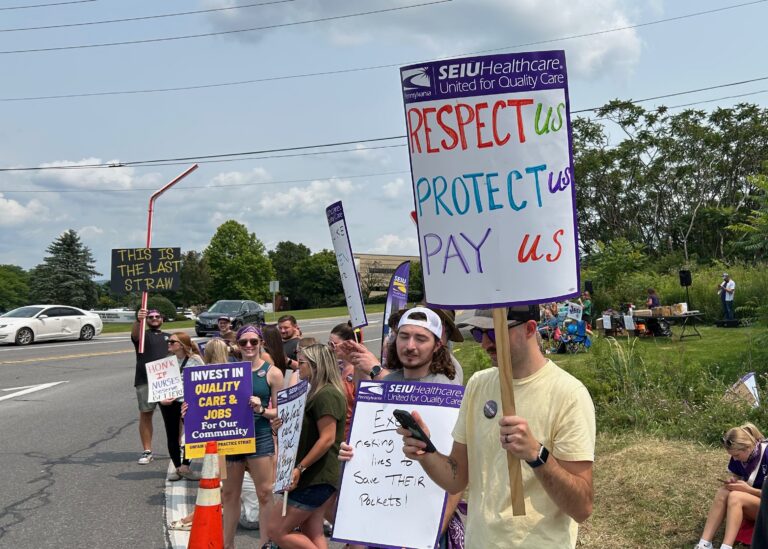
Mount Nittany Medical Center, Union Reach Tentative Agreement for New Contract
Mount Nittany Medical Center and the union representing about 950 of its workers tentatively agreed on terms of a new contract that would bring to an end more than four […]
Letters: Standing With Mount Nittany Workers This Labor Day; AI Needs a Constitution
I’m a proud union member who works just down the street from the Mount Nittany hospital workers still fighting for a fair contract. With Labor Day coming up, I wanted […]


